Finding the Right Powermatic Drill Press Mobile Base: Fit and Model Checks
A Powermatic drill press is a machine you buy once and keep, and the PM2800B in particular is a substantial floor-standing tool. That heft is exactly why owners want it on wheels, and exactly why the wrong base disappoints. A mobile base has to carry real weight and then lock the machine dead still, because a press that rocks on its wheels will never drill straight. Getting the fit right comes down to two model checks you can do before buying.
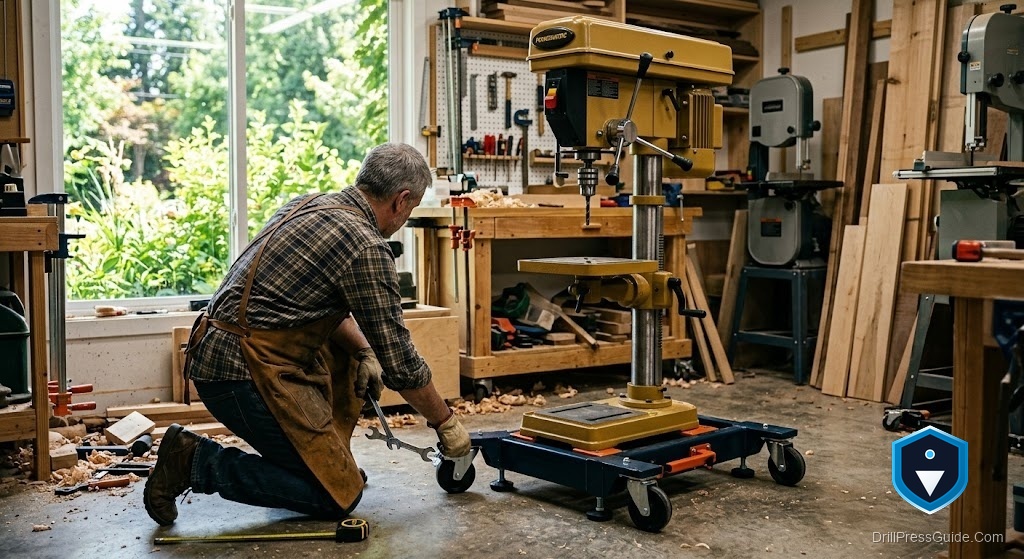
A Powermatic drill press mobile base is a wheeled frame the press bolts or clamps onto, with locking casters or drop-down feet that immobilize it for drilling. For a machine like the PM2800B, with its 18-inch swing, 1 HP motor, and cast-iron base, the mobile base must match the footprint of that cast-iron base and be rated for the machine’s weight. Those two checks decide the fit.
Short answer: the right base adjusts to your Powermatic’s cast-iron base footprint and is rated above its weight, and it locks the machine solid rather than leaving it on braked wheels. Confirm the footprint and weight from the PM2800B specifications, then match a base to both.
Check one: the footprint
The cast-iron base of the PM2800B is a specific rectangle, and the mobile base has to adjust to it so all the feet sit supported. Measure the length and width across the base feet and match a base whose frame expands to that size. A base too small leaves feet hanging; a base far too large wastes floor space and can leave the machine perched instead of seated.
The published specifications give you the base dimensions to work from, so you are matching numbers, not guessing.
Check two: the weight rating
The PM2800B is heavy, with its cast-iron base, cast-iron work table, and 1 HP motor all adding up. The mobile base has to be rated above that weight with margin, or it will sag, roll poorly, and strain its casters. Pull the machine weight from the specifications and choose a base rated comfortably higher.
The honest limitation: any mobile base raises the machine slightly and adds a little flex compared to bolting to the floor. For a drill press that matters less than for a saw, but you must lock the base fully before drilling. On the PM2800B, with its laser guide and digital readout inviting precise work, a base left on its wheels will undo that precision. Lock it solid.
Confirm before buying
- Footprint. Measure across the cast-iron base feet; the mobile base must adjust to that rectangle.
- Weight rating. Match a base rated above the PM2800B’s weight, with margin.
- Locking method. Prefer a base that lifts the wheels or drops feet so the machine rests solid.
- Floor and clearance. Confirm a smooth floor to roll on and that aisles clear the rolled height.
Universal base versus shop-built
Against a shop-built dolly, a universal adjustable mobile base wins on a secure lock-down and a proper load rating, while a homemade dolly is simpler but often lacks a firm lock, which matters most under a heavy Powermatic. For a machine of this weight, the secure lock is the deciding feature. You can compare a universal mobile base rated for heavy tools with heavy duty locking casters for a build.
Setting it up so it locks solid
- Confirm the base’s rating exceeds the PM2800B’s weight and adjust its frame to the cast-iron base footprint.
- Bolt or clamp the machine to the base per its instructions.
- Roll the press into place on a clear, smooth floor.
- Engage the lock, wheels up or feet down, so the base sits dead still and does not rock.
- Confirm the machine is level and the table still squares, then drill with work clamped and eyes protected, per OSHA and CCOHS.
Who should skip it
If your Powermatic lives in one fixed spot forever, a mobile base only adds a little height you do not need. If you reconfigure the shop, sweep often, or share space, a properly rated base earns its place the first time you roll the machine aside.
Bottom line
A Powermatic drill press mobile base is a two-number decision: match the cast-iron base footprint and beat the machine weight. Confirm both from the PM2800B specifications, choose a base that locks the wheels off the floor, and you get mobility without sacrificing the steadiness that a precise press like this deserves.
- Match the base to the cast-iron base footprint and the machine weight.
- Choose a base rated above the PM2800B’s weight with margin.
- Lock the base solid before drilling; never drill on braked wheels alone.
FAQ
How do I know a base fits my Powermatic drill press? Measure the cast-iron base footprint and match a base that adjusts to it, then confirm the base is rated above the machine’s weight from the PM2800B specs.
What load rating do I need? More than your Powermatic’s weight, with margin. An underrated base sags and rolls poorly under a heavy machine.
Will a mobile base hurt the laser and digital-readout accuracy? Only if you leave it on the wheels. Lock the base so the machine rests solid and the precise features stay accurate.
Braked casters or drop-down feet? Prefer a base that lifts the wheels or drops feet, so the heavy press rests solid rather than on casters that can still flex.
Can I build my own base for it? Yes, if it carries the weight and locks firmly. A dolly that only rolls is not steady enough under a machine this heavy.
Do I need a base if the press never moves? No. If it stays put, a base only adds height. The value appears the moment you need to roll it.
References
- Powermatic PM2800B Drill Press: https://www.powermatic.com/pm2800b-drill-press-1hp-1ph-115-230v
- WEN Drill Press FAQs: https://wenproducts.com/pages/drill-press-faqs
- OSHA Woodworking eTool, Drill Press: https://www.osha.gov/etools/woodworking/production/machines-tools/drill-press
- CCOHS, Metalworking Machines - Drill Presses: https://www.ccohs.ca/oshanswers/safety_haz/metalworking/drillpresses.html