
Buffalo Forge Company Drill Press: How the Range Breaks Down
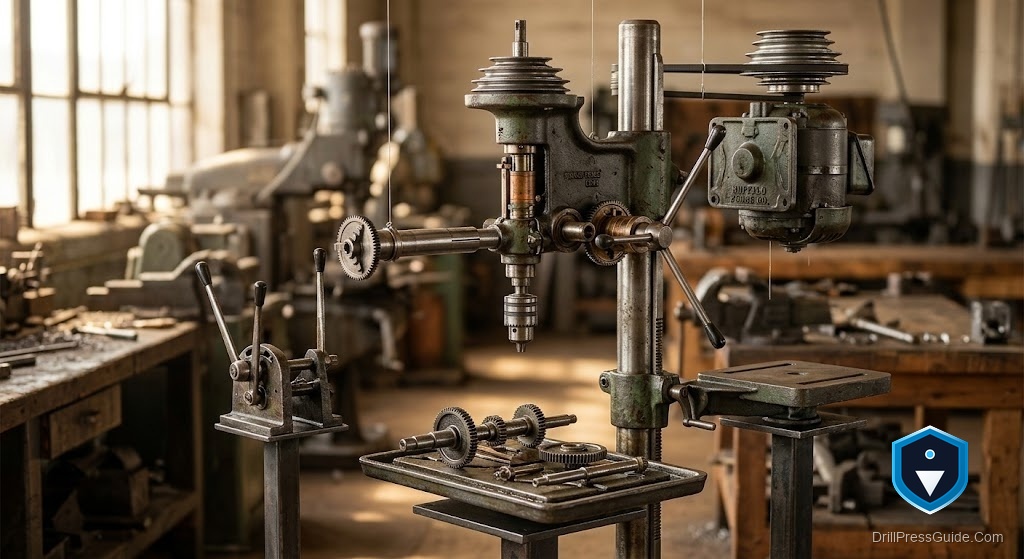
The Buffalo Forge Company drill press is one of the great American machine tool stories, and it ends the way a lot of great American machine tool stories end: the company stopped making drill presses, the machines are now vintage, and the people who own them take good care of them. Buffalo Forge started manufacturing drilling machines in 1883 in Buffalo, New York, and the drill presses they built through the mid-twentieth century are still in use in shops across the country. If you are trying to identify what you have, buy one intelligently, or figure out where parts come from, the range breaks down clearly by model number and size. Here is how.
The Buffalo Forge Company drill press is a floor or benchtop drilling machine manufactured by the Buffalo Forge Company of Buffalo, New York from 1883 through roughly the 1970s, best known for the No. 15 (15-inch swing) and No. 18 (18-inch swing) floor presses, both with stepped-pulley belt drives, MT2 spindles, cast-iron construction, and a reputation for heavy-duty long-life build quality, now found exclusively on the used market.
Short answer: the Buffalo Forge drill press range breaks down by model number, which equals the swing in inches. The No. 15 is a 15-inch floor press (1/3 HP, 5 speeds, MT2, 1/2-inch Jacobs chuck, 4-1/2-inch stroke, 13-by-14-inch table, about 190 pounds). The No. 18 is an 18-inch floor press (1 HP, 5 speeds, 14-by-14-inch table, 425 pounds). Both are vintage-only machines. Parts come through VintageMachinery.org documentation and generic substitutes. Here is the detail.
A brief history of Buffalo Forge
The Buffalo Forge Company began making blacksmith’s forges in 1878 in Buffalo, New York. They started manufacturing drilling machines in 1883 and built drill presses through most of the twentieth century, stopping production sometime around the 1970s. The machines they are best known for are the post drills (hand-powered), the camelback-style machines of the early twentieth century, and the modern-style floor presses (the No. 15 and No. 18) that dominated production from the 1940s through the end.
The company also made steam engines and industrial blowers. Their drill presses are unrelated to 1980s Taiwanese imports that used the Buffalo name; the original Buffalo Forge machines are American-built and are what collectors seek.
The range by model
No. 15 (15-inch swing floor press)
The most common Buffalo Forge press on the used market:
- 15-inch swing (7-1/2 inches bit-to-column).
- 1/3-HP motor at 115V or 230V, single-phase (some models also came in 3/4 HP).
- 5 speeds via step-pulley belt (speed range varies by motor configuration).
- MT2 spindle taper.
- 1/2-inch Jacobs chuck.
- 4-1/2-inch quill stroke.
- 13-by-14-inch cast-iron table.
- 2-3/4-inch column diameter.
- About 190 pounds, floor-standing at roughly 70 inches tall.
The No. 15 is the machine vintage-shop owners bring back to life. It has a foot pedal option (some models), is well-documented on VintageMachinery.org, and runs decades with basic maintenance.
No. 18 (18-inch swing floor press)
The bigger machine:
- 18-inch swing (9-inch throat).
- 1-HP motor (some versions 3/4 HP).
- 5 speeds: 305, 470, 735, 1,190, and 1,945 RPM.
- 14-by-14-inch working table.
- 5-inch quill stroke.
- 15/16-inch spindle diameter.
- 3.906-inch column diameter.
- About 425 pounds (some variants heavier).
The No. 18 is the industrial version, a machine that belonged in production shops and school machine rooms. It still does.
Post drills and camelback machines
Buffalo also made hand-powered post drills (for barns and pre-electric shops) and early twentieth century camelback drill presses (arc-shaped column style). These are collector machines; post drills ran from the 1880s through roughly World War II when rural electrification reduced demand.
What these presses can do
For woodworking and general metal drilling:
- The No. 15 handles general shop work: holes in wood, plastic, and metal within its 1/3-HP capacity.
- The No. 18 handles heavier work: larger bits, more continuous drilling, and steel within its 1-HP capacity.
- Both have the MT2 spindle for standard tooling and a Jacobs chuck for quick bit changes.
- Cast-iron mass reduces vibration and improves accuracy.
Parts and support
Buffalo Forge stopped making drill presses, so there is no manufacturer parts support. The path to parts:
- VintageMachinery.org: 199 publication reprints for Buffalo Forge, including catalogs, manuals, and parts lists. This is the primary documentation resource.
- Generic substitutes: Correctly sized V-belts, replacement Jacobs chucks, and matched MT2 tooling cover most needs.
- Machinist communities: Practical Machinist forums and similar communities regularly solve Buffalo Forge parts questions.
- Specialty dealers: Some vintage machine tool dealers stock or can source specific parts.
The honest flaws
No manufacturer support. Buffalo Forge is out of the drill press business; parts are vintage-only.
Heavy and awkward to move. A 425-pound No. 18 is a commitment.
Belt-change speeds. Five stepped speeds, no dial.
Used-market condition. No warranty; buy on condition and completeness.
Buying a Buffalo Forge
Inspect carefully:
- Spindle runout with a test bar.
- Quill travel through the full stroke.
- Motor condition and voltage requirements (115V, 230V, or 3-phase on some).
- Table condition and clamping.
- Completeness: Jacobs chuck, depth stop, and guards.
A clean, running No. 15 is a practical shop machine; a No. 18 is a heavy-duty floor press with decades left in it.
How it compares
Against a vintage Delta Milwaukee DP220 in similar age and condition, the Buffalo Forge No. 15 is a heavier-duty, more industrial floor press to the Delta’s lighter benchtop. Against a current RIKON 30-230, the Buffalo Forge has more mass and more character but no warranty and vintage-only parts. Against a variable-speed benchtop like the WEN 4212T, the Buffalo Forge is a floor machine in a completely different class. For a shop that wants American-made cast-iron floor press capability and is comfortable with vintage parts sourcing, a Buffalo Forge is an excellent buy.
The verdict
The Buffalo Forge Company drill press range breaks down by model number, which equals the swing: the No. 15 (15-inch, 1/3 HP, 190 lbs) and the No. 18 (18-inch, 1 HP, 425 lbs) are the main floor presses, along with post drills and camelback machines for collectors. Both are vintage-only machines; parts come through VintageMachinery.org documentation and generic substitutes. A clean, running Buffalo Forge press is a legitimate and capable shop machine built to last decades, but buying one requires vintage-market inspection skills and comfort with parts sourcing that runs through documentation and machinist communities rather than a dealer shelf.
Frequently asked questions
What are the specs of the Buffalo Forge No. 15 drill press? A 15-inch swing, a 1/3-HP motor, 5 belt-driven speeds, an MT2 spindle, a 1/2-inch Jacobs chuck, a 4-1/2-inch quill stroke, a 13-by-14-inch cast-iron table, a 2-3/4-inch column, and about 190 pounds, floor-standing at roughly 70 inches tall.
When did Buffalo Forge make drill presses? From 1883 through roughly the 1970s in Buffalo, New York. The camelback-style machines ran from around 1905 through the early 1940s; the modern-style No. 15 and No. 18 floor presses ran from the 1940s through the end of production.
Where do I get parts for a Buffalo Forge drill press? Through VintageMachinery.org publication reprints (199 for Buffalo Forge), machinist community forums like Practical Machinist, and generic substitutes: correctly sized V-belts, replacement Jacobs chucks, and MT2 tooling. There is no manufacturer parts support.
What is the difference between the Buffalo Forge No. 15 and No. 18? The No. 15 is a 15-inch swing floor press (1/3 HP, 190 lbs); the No. 18 is an 18-inch swing floor press (1 HP, 425 lbs). Both are 5-speed step-pulley machines with MT2 spindles. The No. 18 is the heavier-duty industrial machine.
Are Buffalo Forge drill presses good? Yes, for a vintage machine with proper inspection. They are American-made cast-iron floor presses with a reputation for heavy-duty longevity. The No. 15 is a solid shop machine; the No. 18 is a serious industrial press. The catch is vintage-only parts sourcing.
Is a Buffalo Forge drill press suitable for metal? The No. 15 handles general metal drilling at appropriate speeds within its 1/3-HP capacity. The No. 18, with a 1-HP motor and 5 speeds from 305 to 1,945 RPM, handles heavier metal work. Use slow speeds for larger bits and apply cutting fluid for steel.
What do the model numbers mean on Buffalo Forge drill presses? The model number indicates the swing in inches. A No. 15 is a 15-inch swing press; a No. 18 is an 18-inch swing press. The naming convention is straightforward.
References
- VintageMachinery.org, Buffalo Forge Company history, publications, and photo index: https://vintagemachinery.org
- Practical Machinist, Buffalo Forge drill press technical discussion: https://www.practicalmachinist.com
- Tencarva Machinery, Buffalo Forge Company history overview: https://tencarva.com/buffalo-forge-drill-press


