
JET Drill Press Mobile Base: Compatibility, Wear, and Replacement Options
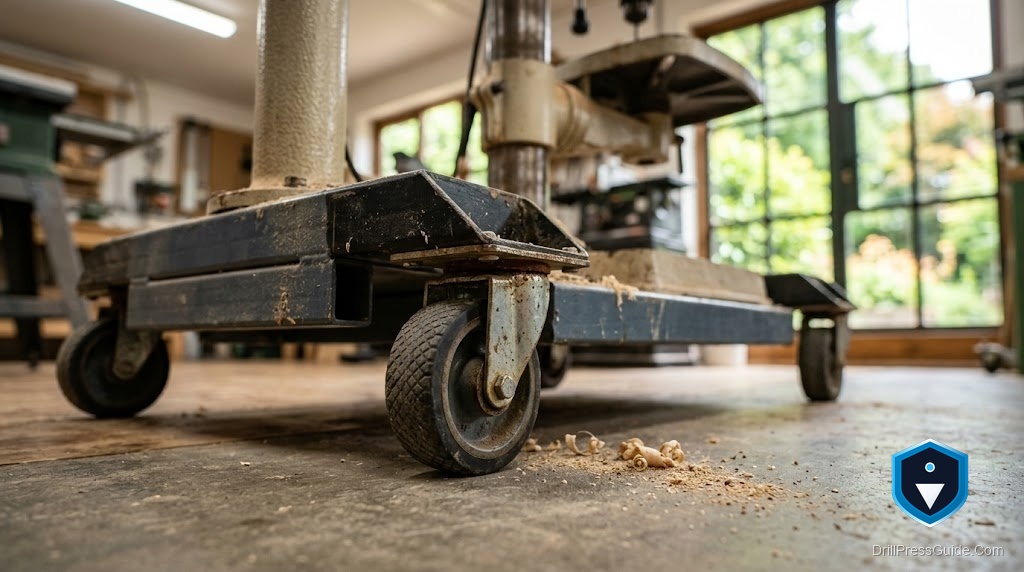
A JET drill press like the JDP-17 is a solid, heavy machine, and that heft is exactly why owners reach for a mobile base. Rolling a floor-standing press out to sweep or reclaim a corner beats dragging it. But a mobile base is a match-to-the-machine purchase, and over time the base itself wears, casters flatten, locks loosen, and needs attention. Understanding what fits your JET, how a base wears, and what to do about it keeps the machine mobile and, more important, dead still when you drill.
A JET drill press mobile base is a wheeled frame the press bolts or clamps onto, with locking casters or drop-down feet that immobilize it for use. For a JET, the base has to match the machine’s footprint and weight, both of which you can confirm from the JDP-17 product manual. Matching those figures is the core of compatibility.
Short answer: a mobile base fits your JET when it adjusts to the machine’s footprint and is rated above its weight, and when its lock holds the press dead still. Pull the footprint and weight from your JET’s manual, watch the base’s casters and locks for wear, and replace or upgrade the base, not the whole machine, when it stops holding.
Compatibility: footprint and weight
Two numbers decide fit. The footprint is the length and width across the press’s base feet, and the mobile base must adjust to that rectangle so the machine sits fully supported. The weight sets the load rating you need, since a floor-standing JET is heavy and an underrated base will sag or roll poorly.
The JDP-17 manual lists the machine’s specifications, including the base and weight details you need to confirm both. Read those before buying rather than eyeballing the footprint.
Wear: what goes first
Mobile bases wear in predictable places. Casters flatten or seize over time, especially under constant heavy load, so the base rolls hard or drags. Locks loosen, and a lock that no longer holds lets the press rock while you drill, which ruins accuracy and is unsafe. Frame joints can loosen on adjustable bases, letting the footprint shift.
Inspect these periodically. A base that has gone stiff or that rocks under the machine needs attention before it affects your drilling.
Replacement options
The honest good news: you rarely replace the whole base. Most wear is fixable at the part level, swap the casters, tighten or replace the lock mechanism, snug the frame joints. When the base is genuinely worn out or was underrated to begin with, replace it with a universal adjustable base rated above your JET’s weight, rather than buying a new machine.
Universal base versus shop-built versus repair
Against a shop-built dolly, a universal adjustable base wins on a secure lock-down and a proper load rating, while a homemade dolly is cheap but often lacks a firm lock, which matters most on a heavy JET. Against replacing the base entirely, a simple caster or lock repair is often all a worn base needs. Match the response to the wear: repair the part that failed, or upgrade to a rated base if the whole thing is undersized. You can compare a universal mobile base with replacement heavy duty locking casters for a repair.
Setting it up so it locks solid
- Confirm the base’s load rating exceeds your JET’s weight and adjust its frame to the machine footprint.
- Bolt or clamp the press feet to the base per its instructions.
- Roll the machine into place on a clear, smooth floor.
- Engage the lock, wheels up or feet down, so the base sits dead still and does not rock.
- Confirm the machine is level and the table still squares, then drill with work clamped and eyes protected, per OSHA and CCOHS.
Who should read this
If your JET stays in one spot forever, you may not need a base at all. If you move it, or if your current base rolls hard or rocks, this is a footprint, weight, and wear check, usually solved with the right rated base or a simple caster or lock repair.
Bottom line
A JET drill press mobile base is a footprint-and-weight match, confirmed from the JDP-17 manual, plus attention to wear. Most problems are a worn caster or a loose lock, fixable at the part level. When the base is undersized or worn out, upgrade to a rated universal base rather than replacing the machine, and always lock it solid before drilling.
- Match the base to your JET’s footprint and weight from the manual.
- Casters and locks wear first; inspect and repair them at the part level.
- Lock the base dead still before drilling; never drill on braked wheels alone.
FAQ
How do I know a mobile base fits my JET drill press? Measure the machine’s footprint and weight from the JDP-17 manual, then choose a base that adjusts to that footprint and is rated above the weight.
What load rating do I need? More than your JET’s weight, with margin. An underrated base sags, rolls poorly, and may not lock solidly.
My base rolls hard now. What is wrong? Usually flattened or seized casters. Swapping the casters often restores easy rolling without replacing the whole base.
The press rocks when I drill. How do I fix it? The lock has likely loosened or failed. Tighten or replace the lock mechanism so the base sits dead still before you drill.
Should I repair or replace the base? Repair the failed part, a caster or lock, if the base is otherwise sound and rated correctly. Replace it only if it is worn out or undersized.
Will a mobile base hurt drilling accuracy? Only if left on the wheels. Lock it so the machine rests solid before drilling and accuracy is fine.
References
- JET JDP-17 Drill Press Manual: https://www.manualshelf.com/manual/jet/716300/full-product-manual-english.html
- WEN Drill Press FAQs: https://wenproducts.com/pages/drill-press-faqs
- OSHA Woodworking eTool, Drill Press: https://www.osha.gov/etools/woodworking/production/machines-tools/drill-press
- CCOHS, Metalworking Machines - Drill Presses: https://www.ccohs.ca/oshanswers/safety_haz/metalworking/drillpresses.html


