Using a Drill Press as a Spindle Sander: What Works and What Does Not
It is a tempting shortcut. You have a drill press, you have a curved edge to smooth, and a sanding drum costs a few dollars and drops right into the chuck. So why buy a whole spindle sander? The honest answer is that a drill press will do light sanding, and it will do it with one real compromise that you should understand before you chuck up that drum. Knowing the compromise is the difference between a smooth edge and a burnt, banded one.
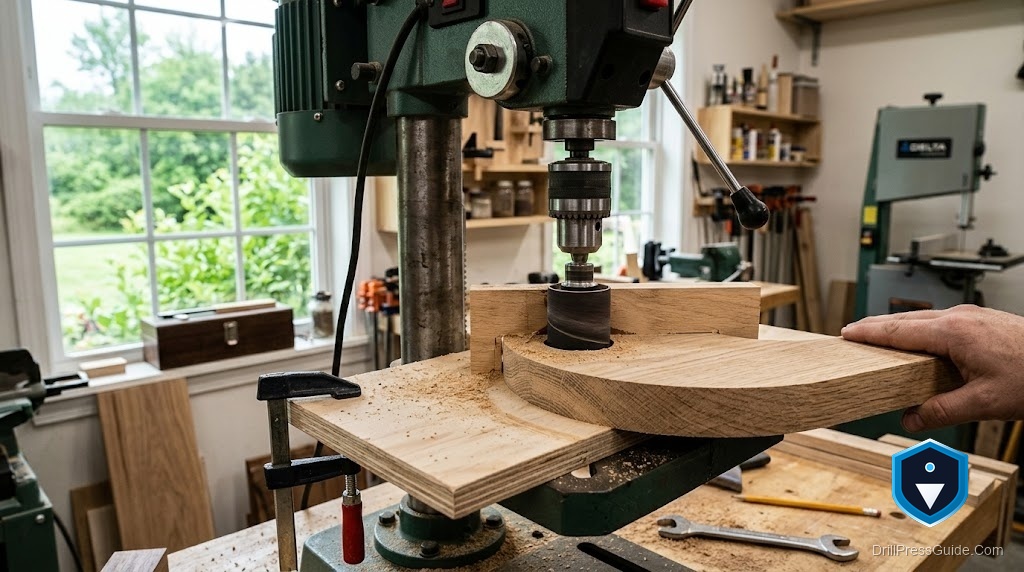
Using a drill press as a spindle sander means putting a sanding drum in the chuck and feeding a workpiece against it to smooth curved edges. The press already gives you a vertical spindle, a work table, and a motor, which is most of what a spindle sander is. What it is missing is the one feature in the name: oscillation.
Short answer: a drill press works as a stationary spindle sander for light edge sanding if you set a suitable speed, back the drum with a table opening, and feed the work steadily. The catch is that it does not oscillate, so the drum wears in one band and can burn, which you offset by moving the work up and down by hand.
What works
For smoothing the sawn edge of a curve, a drum in the drill press does a fine job. The vertical spindle keeps the drum square to the table, the motor has plenty of power for sanding, and you can set many presses to a reasonable speed. For occasional shaping of curved parts, it saves buying another machine.
It also uses gear you already own and stores in a drawer. For a shop that sands curves now and then, that is a sensible use of the drill press.
What does not work: oscillation
Here is the compromise. A dedicated oscillating spindle sander moves the drum up and down while it spins, which spreads wear across the whole abrasive and leaves a smoother, cooler cut. Most drill presses only spin. Without oscillation, the drum sands in a single band, so that band clogs and dulls fast, and the concentrated friction can scorch the wood.
The honest limitation, then: a drill press is a stationary spindle sander, not an oscillating one. You compensate by raising and lowering the workpiece by hand as you sand, which spreads the wear and reduces burning, but it never fully matches a true oscillating machine.
Set it up to sand cleanly
- Speed. Set a moderate speed suited to the drum; too fast burns the work and the abrasive.
- Table opening. Use a table with a clearance hole or an auxiliary top so the drum passes slightly below the work.
- Feed direction. Feed the work against the drum’s rotation for control.
- Hand oscillation. Move the work up and down as you sand to spread drum wear and limit burning.
Drill press drum versus a dedicated oscillating sander
Against a dedicated oscillating spindle sander, the drill press method wins on convenience and storage and loses on finish quality and abrasive life. The dedicated machine oscillates, has a table built with drum openings and inserts, and runs at the right speed out of the box. For frequent or fine sanding it is worth owning; for occasional curves, the drum in your press is enough. You can compare a drill press sanding drum kit against a standalone oscillating spindle sander.
Setting it up safely
- Seat the drum’s arbor in the chuck straight and tighten it fully.
- Set a moderate speed within the drum’s range.
- Use a table with a clearance hole so the drum passes below the work.
- Feed against rotation and move the work up and down to spread wear.
- Keep hands clear of the spinning drum and wear eye protection, per CCOHS and OSHA.
Who should skip it
If you sand curves often or need a fine finish, buy a dedicated oscillating spindle sander, since the drill press will burn and band on heavy use. If you smooth the occasional curve, a sanding drum in the press you own does the job with gear you already own.
Bottom line
Using a drill press as a spindle sander works for light, occasional edge sanding, with one honest caveat: it does not oscillate, so the drum wears in a band and can burn. Set a moderate speed, back the drum with a table opening, and move the work by hand to spread wear. Within those limits it is a smart use of a tool you already have.
- A drill press sands as a stationary spindle sander, not an oscillating one.
- Set a moderate speed and back the drum with a table clearance hole.
- Move the work up and down by hand to spread wear and limit burning.
FAQ
Can a drill press be used as a spindle sander? Yes, for light edge sanding. Put a sanding drum in the chuck and feed the work against it, but expect a stationary, non-oscillating action.
Why does my drum burn the wood? Without oscillation the drum sands one band, concentrating heat. Move the work up and down by hand and lower the speed to reduce burning.
What speed should I sand at? A moderate speed within the drum’s suggested range. Too fast scorches the work and clogs the abrasive.
Do I need a special table? You need a hole, insert, or auxiliary top so the drum can pass slightly below the work for full-edge sanding.
Is it as good as a real spindle sander? No. A dedicated oscillating sander spreads wear and cuts cooler. The drill press is fine for occasional use, not heavy sanding.
Which way do I feed the work? Against the drum’s rotation, which gives you more control over the workpiece.
References
- WEN Drill Press FAQs: https://wenproducts.com/pages/drill-press-faqs
- WEN 4214T 12-Inch Variable-Speed Drill Press: https://wenproducts.com/collections/power-tools/products/wen-4214t-12-in-variable-speed-drill-press
- OSHA Woodworking eTool, Drill Press: https://www.osha.gov/etools/woodworking/production/machines-tools/drill-press
- CCOHS, Metalworking Machines - Drill Presses: https://www.ccohs.ca/oshanswers/safety_haz/metalworking/drillpresses.html