
Delta Milwaukee Drill Press: Models, Capacity, and Parts Support Explained
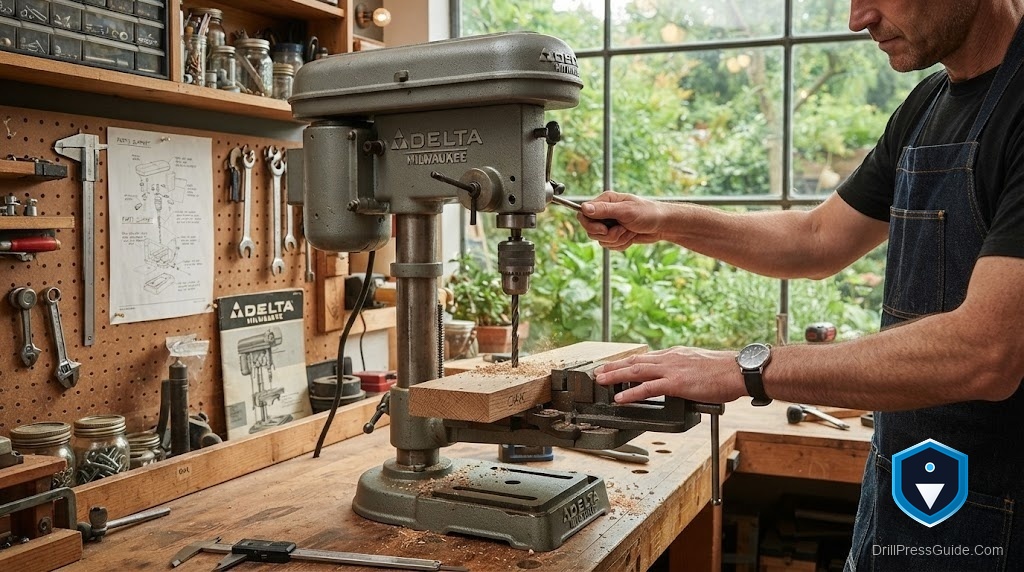
The term “Delta Milwaukee drill press” is what collectors and used-tool buyers reach for when they mean the early machines that Delta built before and after their merger with Rockwell, machines that carry the Milwaukee, Wisconsin address and the Delta name or the combined Delta/Rockwell badge. These are among the most respected vintage drill presses in American woodworking history, and if you are buying, owning, or restoring one, you need to understand what you have. Here is how the models break down, what they can actually do, and how parts and support work today.
The Delta Milwaukee drill press refers to floor and bench drilling machines made by the Delta Specialty Company (later Delta Manufacturing / Delta Rockwell) in Milwaukee, Wisconsin, spanning early models from the 1920s through the Rockwell-era presses of the 1960s and 1970s, including the iconic DP220 14-inch benchtop and DP290 17-inch floor presses, with cast-iron construction, belt-driven stepped-pulley speed selection, and induction motors.
Short answer: “Delta Milwaukee” covers a long line of vintage presses built by Delta in Milwaukee, Wisconsin. The most common are the DP220 (14-inch bench) and DP290/17-inch floor models, which run a 1/3-HP induction motor, 5 speeds from 620 to 3,100 RPM, and cast-iron tables. Parts come through Delta’s network and Sears PartsDirect by model and type number, supplemented by VintageMachinery.org documentation and specialty suppliers. Here is the detail.
A brief history of Delta Milwaukee
Delta was founded in 1919 in Milwaukee, Wisconsin by Herbert Tautz and William Peters. Early in the company’s history, machines carried the “Delta Milwaukee” mark identifying the city of manufacture. Through the 1930s Delta introduced what became some of the most iconic American benchtop tools, including the DP220 14-inch bench drill press.
In 1945 Delta merged with Rockwell Manufacturing, and machines from the late 1940s through the 1970s carried either the Delta/Rockwell or Rockwell-Delta brand. By the 1980s the company restructured and the Delta name stood alone again. The Milwaukee-era machines, roughly 1919 through the Rockwell transition, are the ones collectors specifically seek.
The key models
DP220 (14-inch benchtop, the most common vintage Delta)
- 14-inch swing (7 inches bit-to-column).
- 1/3-HP split-phase or induction motor at 115V.
- 5 speeds from 620 to 3,100 RPM via stepped-pulley belt drive.
- Cast-iron construction throughout: head, table, and base.
- 1/2-inch chuck on the spindle.
- Rack-and-pinion table adjustment.
- A machine that was in production in recognizable form from the 1930s through several decades.
Floor presses (DP290 and similar 17-inch models)
Delta Milwaukee also produced floor-standing presses:
- 17-inch swing (8-1/2 inches bit-to-column).
- Similar motor and speed configuration to the DP220 in earlier models.
- Cast-iron tilting table on a rack-and-pinion column.
- Designed for the professional and industrial shop.
Delta/Rockwell-era models
After the Rockwell merger, machines continued with the same basic cast-iron architecture but evolved in details, switches, and some configurations. These machines, sold through the 1960s and 1970s, are heavier users’ territory and are often found in industrial and school shops.
What these presses can do
A Delta Milwaukee DP220 or comparable machine is a light-to-general-purpose press:
- 5 speeds from 620 to 3,100 RPM cover most wood and light-metal drilling.
- 1/3 HP is plenty for a woodworking shop; it is not a metalworking machine.
- Cast-iron mass reduces vibration and improves accuracy compared to light stamped presses.
- Serviceable and repairable: simple construction, widely understood, documented in many VintageMachinery.org publications.
Parts and support today
Delta’s parts network (deltamachinery.com) and Sears PartsDirect (by model and type number) cover many replacement parts for the more recent Delta machines. For Milwaukee-era machines specifically:
- VintageMachinery.org is the primary documentation resource: manuals, parts lists, and owner discussions.
- Specialty suppliers like M&M Tool Parts and others stock some vintage Delta parts.
- Generic substitutes (V-belts, 1/2-inch chucks, torsion springs) cover most consumable needs.
- The type number on the ID plate matters: Delta changed components over production runs, and the type number tells you which parts apply.
Our Delta drill press replacement parts guide covers the ordering flow, and the Delta drill presses models, parts, and support guide covers the broader Delta range.
The honest flaws
Light-duty power. A 1/3-HP motor suits woodworking; heavy or continuous metal drilling is not its strength.
Vintage condition. No warranty; buy on condition, completeness, and spindle runout.
Parts availability varies. Generic wear items are easy; specific castings or switches for early machines can be scarce.
Belt-change speeds. Five stepped speeds, no dial.
Buying a vintage Delta Milwaukee
Buying a used Delta Milwaukee press requires the same inspection as any vintage machine:
- Spindle runout with a bit in the chuck.
- Quill travel through the full stroke.
- Motor sound: clean, no vibration or hum.
- Table condition: check for cracks and the tilt and clamp mechanism.
- Completeness: chuck, key, depth stop, and table.
A clean DP220 is one of the best benchtop drill press values on the used market, period.
How it compares
Against a current variable-speed benchtop like the WEN 4212T 10-inch, the vintage Delta Milwaukee trades a variable-speed dial, a digital readout, a work light, a laser, and a warranty for cast-iron mass, simple repairability, and used-market value. Against the Delta 11-990 12-inch benchtop, the DP220 is the smaller, older machine in the same family. For a woodworker who values cast-iron simplicity and repairability over modern convenience, a clean Delta Milwaukee press is the better tool.
The verdict
The Delta Milwaukee drill press is a family of vintage cast-iron machines built by Delta in Milwaukee, Wisconsin from 1919 through the Rockwell era. The DP220 14-inch bench press is the most iconic: a 1/3-HP induction motor, 5 speeds from 620 to 3,100 RPM, 1/2-inch chuck, and full cast-iron construction that survives decades of use. Models break down by era, size, and prefix on the ID plate. Parts come from Delta’s network, Sears PartsDirect, VintageMachinery.org documentation, and generic substitutes for consumable items. A clean Delta Milwaukee press is one of the most respected used-market drill presses available, and on the used market it is worth every bit of the careful inspection it demands.
Frequently asked questions
What is a Delta Milwaukee drill press? It refers to drill presses built by Delta (Delta Specialty Company, later Delta Manufacturing and Delta Rockwell) in Milwaukee, Wisconsin, from 1919 through the Rockwell era. The DP220 14-inch bench press is the most iconic model, known for cast-iron construction and simple repairability.
What are the specs of the Delta DP220 drill press? A 14-inch swing, a 1/3-HP induction motor at 115V, 5 speeds from 620 to 3,100 RPM via stepped-pulley belt drive, a 1/2-inch chuck, rack-and-pinion table adjustment, and full cast-iron construction throughout.
When were Delta Milwaukee drill presses made? Delta was founded in Milwaukee in 1919. They began producing drill presses in the late 1920s and the DP220 became iconic in the 1930s. Delta merged with Rockwell in 1945, and machines carried Delta/Rockwell branding through the 1970s. The Milwaukee-era machines are roughly 1919 through the mid-1940s.
Can you still get parts for a Delta Milwaukee drill press? Wear items like V-belts, chucks, and springs are available as generics. Delta’s parts network covers newer models; for older Milwaukee-era machines, VintageMachinery.org documentation and specialty suppliers supplement the standard parts sources. The model and type number from the ID plate is essential.
Is a Delta Milwaukee drill press good for metalworking? For light metalworking with small bits at a slow speed, yes. Their 1/3-HP motors are woodworking presses, not metalworking machines. For heavy metal drilling, a floor press with more power is the right tool.
What is the difference between a Delta Milwaukee and Delta Rockwell drill press? Delta Milwaukee refers to machines made before or shortly after the 1945 Rockwell merger. Delta Rockwell (or Rockwell-Delta) machines from the late 1940s through the 1970s continued the same basic cast-iron architecture with some evolution in components, switches, and configurations.
How do I identify my vintage Delta drill press? Check the ID plate for the model number (DP220, DP290, etc.) and type number. VintageMachinery.org has a photo index and publications database to help date and identify your machine. The serial number prefix can help narrow the production year.
References
- VintageMachinery.org, Delta / Rockwell drill press history, photos, and publications: https://vintagemachinery.org
- Delta Machinery, current parts and model support: https://www.deltamachinery.com
- Old Woodworking Machines, vintage Delta drill press history and collectibility: https://www.old-woodworking-machines.com


