
Getting Better Results from a Dremel Drill Press Attachment
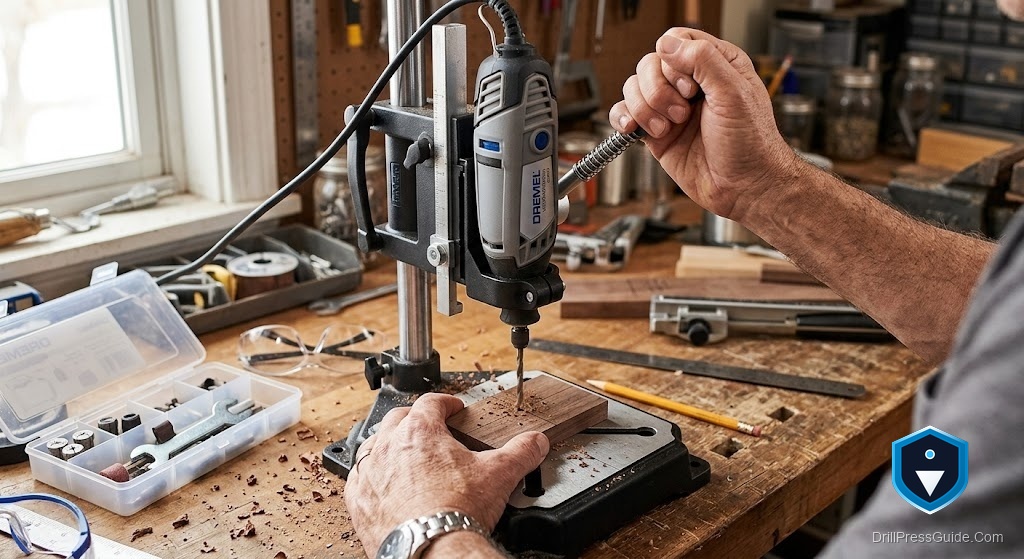
You picked up a Dremel rotary tool because you wanted precision. Now you want to drill perfectly perpendicular holes in PCB stock, jewelry findings, pen blanks, or miniature wood parts - and you are tired of holding the tool by hand and guessing at 90 degrees. A drill press attachment is the answer, but only if you understand exactly what it is and is not capable of doing.
This article is about the Dremel 220-01 Workstation - what it does well, what it does not, and how to get the most out of it.
What the Dremel 220-01 Workstation Actually Is
The 220-01 is not a drill press. It is a drill press stand - a rigid frame that holds your Dremel rotary tool and guides it vertically along a column, giving you controlled spindle travel for perpendicular drilling.
The distinction matters. A real drill press has:
- A built-in induction motor with variable speed and digital speed readout on higher-end models
- A quill with a proper MT2 spindle taper or keyed chuck rated for side loads
- A heavy cast iron work table
- Spindle travel measured in inches, often 2 to 3.5 inches
The 220-01 has:
- A spring-loaded arm that holds your Dremel tool
- A plastic column with a metal base
- A work table that measures roughly 6 by 6 inches
- About 2 inches of vertical travel
- No motor of its own - it is entirely dependent on the rotary tool you supply
That is not a flaw. It is just what it is. Once you understand the tool’s actual nature, you stop fighting it and start using it correctly.
What the Dremel 220-01 Does Well
PCB Drilling
PCB drilling requires small drill bits - typically 0.8mm to 1.5mm in carbide - at high spindle speeds (35,000 RPM range), with light downfeed pressure and perfect perpendicularity. The Dremel tool delivers all of that. The 220-01 Workstation ensures the bit enters the board at exactly 90 degrees, which matters when you are drilling through-holes for 0.1-inch pitch header pins.
Jewelry and Metal Findings
Drilling small metal pieces by hand risks bit wander, broken carbide bits, and injury. The Workstation holds the tool steady while you control the depth stop for consistent hole depth across multiple pieces.
Detail Woodwork and Pen Blanks
Pen turning requires centered holes through blanks before the blank goes on the lathe. The 220-01 handles this cleanly when combined with a self-centering vise or a V-block under the blank.
Model Making
Scale models in resin, balsa, and thin plastics benefit from the same qualities: small bits, light pressure, high speed, and perpendicular entry.
What the 220-01 Does Not Do
Full-scale woodworking. If you want to drill 3/4-inch holes through a furniture leg or drive a 1/2-inch Forstner bit through pine, stop reading about the 220-01 and buy a proper benchtop drill press. The Dremel’s chuck capacity tops out at about 1/8-inch shank accessories.
Heavy metal drilling. The rotary tool motor is not designed for the torque loads that come with drilling steel above 3mm. You will stall the tool, strip bits, and potentially damage the motor.
Long production runs. The Workstation is a hobby and detail tool. A small drill press with a proper keyed chuck handles production drilling better.
Setup: How to Get the Most Out of the 220-01
Depth Stop
The depth stop on the 220-01 is a collar on the column that limits downward travel. Set it before you drill your first hole. For PCB work, set it to just clear the back of the board. For pen blanks, set it slightly past center. Locking the depth stop eliminates the risk of plunging too deep.
How to set it: Lower the arm until the bit tip is at your desired max depth. Tighten the depth stop collar against the column stop. Test with a piece of scrap first.
Fence and Work Table Positioning
The 220-01’s work table has inch and metric markings. Use these to position your work relative to the spindle centerline before clamping. For repetitive holes in a line, mark your workpiece, align the first mark under the bit tip, then use the table markings to index subsequent positions without re-measuring.
The table has four clamping points for securing work or accessories. Use them.
Speed Selection
| Material | Recommended Speed Range |
|---|---|
| PCB / FR4 | 25,000 to 35,000 RPM |
| Soft wood, balsa | 20,000 to 30,000 RPM |
| Hardwood | 15,000 to 25,000 RPM |
| Soft metals (aluminum, brass) | 10,000 to 20,000 RPM |
| Acrylic / plastics | 15,000 to 25,000 RPM |
| Resin | 15,000 to 25,000 RPM |
Slower speeds for metals reduce heat buildup and extend bit life. Faster speeds for thin, soft materials give you cleaner entry holes with less tear-out.
Drilling Perpendicular Holes: Getting True 90 Degrees
- Make sure the column is vertical. Set a small machinist’s square against the column and the table.
- Verify the Dremel tool is seated fully in the arm clamp with no lateral wobble.
- Use a center punch or a marking awl to mark your drill point before drilling.
- Apply light, even downfeed pressure. Do not push. Let the bit do the work.
Drilling at Angles
One underused feature of the 220-01 is the ability to tilt the arm in 15-degree increments up to 90 degrees horizontal. This lets you drill angled holes for dowel joints, wedge-shaped assemblies, and angled hardware installations.
The Dremel 212: Older Model, Worth Finding Used?
The Dremel 212 is the predecessor to the 220-01. It is a simpler, older design with no Flex Shaft holder function and a smaller work table. You will find them on eBay and garage sales.
Honest answer: not unless the 220-01 is unavailable or the 212 is nearly free. The 220-01 is a meaningful upgrade - the 3-in-1 functionality (drill press, rotary tool holder, Flex Shaft stand), the larger work table, the integrated cord management, and the on-board accessory storage all make it more useful in a real workspace.
Exception: If you own an older Dremel model not on the 220-01 compatibility list, check the 212’s compatibility spec before buying.
The Right Product to Buy
Dremel 220-01 Drill Press Rotary Tool Workstation Stand
Dremel 220-01 Drill Press Rotary Tool Workstation Stand
The 220-01 transforms your Dremel into a functional drill press for detail work. The 3-in-1 design - drill press, rotary tool holder, Flex Shaft stand - makes it far more versatile than a dedicated single-function stand. Compatible with Dremel 4300, 4000, 3000, 8220, 8260, and other common models.
What it does well:
- Genuine perpendicular drilling for PCB, jewelry, pen blanks, and small metal work
- Depth stop for consistent hole depth across multiple pieces
- Work table with inch and metric markings
- Drill angles adjustable in 15-degree increments up to 90 degrees horizontal
- On-board accessory storage for bits and collets
What it does not do:
- Not a substitute for a real drill press on larger work
- Spindle travel is approximately 2 inches
- Work table is small
Verdict: The right tool for precision rotary work on small materials.
Pairing the 220-01 with a Vise
The 220-01’s work table has four clamping points, but for repetitive small-part drilling you want a vise.
- A Rockler self-centering drill vise is ideal for pen blanks and round stock - the jaws close simultaneously and keep the centerline under the bit.
- For small flat stock and hardware, a compact hold-down clamp through the table’s clamping points works cleanly.
- The standard 3-inch WEN vise (DPA423) is too large for the 220-01 table in most configurations.
FAQ
Q: Which Dremel models are compatible with the 220-01? The 220-01 works with Dremel 4300, 4000, 3000, 200, 100, 8220, 8260, 8250, 8240, 3100, and 8150. Check the compatibility chart on the product page before purchasing if you own a different model.
Q: Can I use the 220-01 for drilling metal? Yes, for small drill bits and soft metals - aluminum and brass up to about 3mm. Use lower speeds (10,000 to 20,000 RPM), add a drop of cutting fluid, and use light consistent pressure. Do not attempt steel drilling with standard Dremel bits.
Q: How much vertical travel does the 220-01 actually give me? Approximately 2 inches of effective spindle travel, depending on tool model and arm position. Set your depth stop before drilling and test on scrap first.
Q: Is the 220-01 table big enough to clamp work securely? For small work, yes. The four clamping points handle most small-part scenarios.
Q: Can the 220-01 be bolted to a workbench? Yes. The base has mounting holes for permanent bench installation.
References
- Dremel 220-01 Workstation official product page, dremel.com
- Amazon product listing


