
Choosing a Drum Sander for Drill Press That Fits the Work and the Table
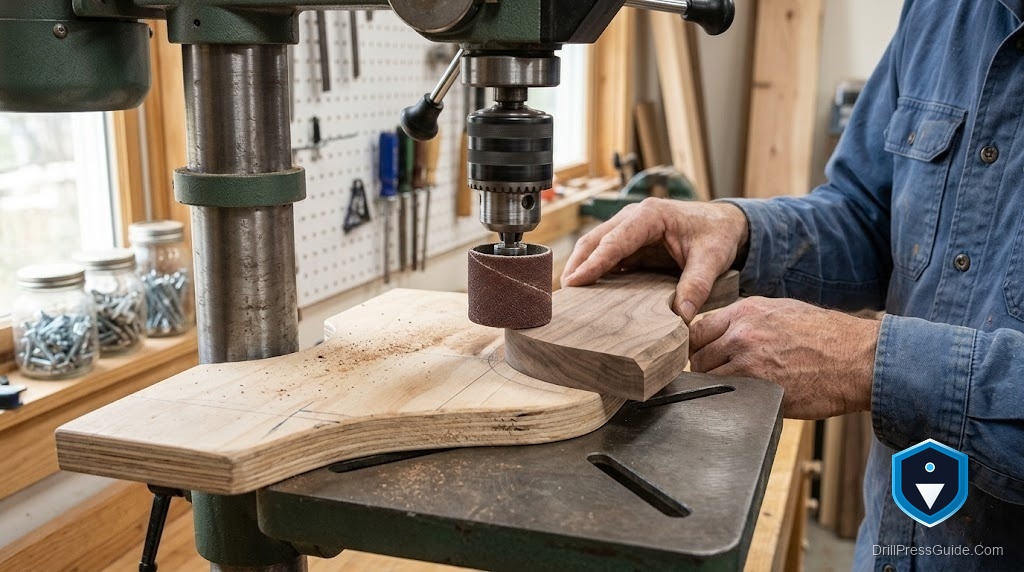
Sanding the inside of a curve is one of woodworking’s more tedious tasks. A hand-sanding block takes forever, a flexible sanding strip works inconsistently, and a dedicated oscillating spindle sander costs several hundred dollars. A drum sander attachment for your drill press sits in the middle: inexpensive, practical, and surprisingly effective if you approach it correctly.
The key word in that sentence is “correctly.” There’s a set of decisions - drum diameter, sleeve grit, spindle speed, table setup - where the right choices make this a genuinely useful operation and the wrong choices make it frustrating. This guide covers every one of them.
Picking the Right Drum Diameter
The most important decision you’ll make with drum sanding is matching drum diameter to the curve radius you’re working with. The rule is simple: the drum must be smaller in diameter than the smallest inside radius you’re sanding.
If the drum is larger than the radius, only the edge of the drum contacts the wood - you get uneven sanding, a faceted surface, and a drum that wears out fast.
Practical diameter guide:
- 1/2-inch drum: Tight inside radii, scrollwork, small ornamental profiles
- 3/4-inch drum: Chair back slats, bracket profiles, medium furniture curves
- 1-inch drum: Sweeping furniture curves, larger radius template work
- 1-1/2-inch drum: Gentle curves, wide workpiece edges, cleanup passes on softwood
Every kit below includes all four diameters. Start with the 3/4-inch as your default and adjust from there.
Choosing Sleeve Grit
Grit selection follows basic sanding logic:
- 60 grit: Aggressive removal. For getting fresh-from-the-bandsaw edges down to near-final shape. Leaves deep scratches you need to work out.
- 80 grit: Workhorse grit. Removes saw marks, cleans up router tearout, gets you to near-final surface with manageable scratches.
- 120 grit: Finishing grit for drum sanding. After 120, finish by hand.
- 240 grit: Fine finishing. Soft materials only at the drum - hard material at 240 grit on a drum loads sleeves fast.
For most projects, 80 grit to shape, 120 grit to refine is the right two-step sequence.
Setting the Right Speed
Surface feet per minute - not RPM alone - is what determines sanding quality. A 1-1/2-inch drum spinning at 1,200 RPM generates far more heat than a 1/2-inch drum at the same RPM. Drop your speed when you move to larger drums.
| Drum Diameter | Recommended Speed Range |
|---|---|
| 1/2” | 1,200 - 2,000 RPM |
| 3/4” | 800 - 1,500 RPM |
| 1” | 700 - 1,200 RPM |
| 1-1/2” | 500 - 900 RPM |
If your drill press has a digital speed readout, use it. If you’re using a belt-and-pulley machine, test your available speeds before buying drums.
Table Setup for Flush Sanding
The other critical variable: your drill press table needs a hole for the drum to drop through, so the abrasive sleeve sits flush with (or just below) the table surface. Without this, you can only sand the top portion of the drum’s usable height.
How to make a zero-clearance sanding insert:
- Cut a piece of 3/4-inch MDF to fit your drill press table.
- Cut or bore a hole 1/16-inch larger than your drum diameter.
- Clamp it flat to the table.
- Lower the drum into position, flush with the MDF surface, and lock the quill depth stop.
Swap inserts when you change drum diameters. Label each one so you’re not measuring every time.
The Drum Kits
WEN DS164 20-Piece Sanding Drum Kit
WEN DS164 20-Piece Sanding Drum Kit for Drill Presses
Four drums (1/2”, 3/4”, 1”, 1-1/2”), sixteen sleeve pieces in 80 and 120 grit. Mixed shank sizes (1/8” for smallest drum, 1/4” for the rest) for compatibility across different chuck types. This is the kit I’d recommend to someone setting up drill press sanding for the first time.
What I like: Four diameters covers everything in typical furniture work. 80/120 grit is the practical two-step combination for most curved work.
What I don’t like: Two sleeves per drum per grit is not a lot if you’re sanding hardwood repeatedly. Stock extra replacement sleeves before you start a big project.
LINE10 Tools 16-Piece Sanding Drum and Sleeves Set
LINE10 Tools 16pk Sanding Drum and Sleeves
Four drums in 1/2”, 3/4”, 1”, and 1-1/2” with twelve replacement sleeves in 60, 80, and 120 grit. All drums are 2 inches long and use 1/4-inch shanks. The extra grit - 60 to start aggressive removal - plus the 2-inch drum length make this a stronger kit for production work.
What I like: Three grits is the complete range for drum sanding. 2-inch sleeve length means more usable abrasive surface, slower wear rate, and a more stable drum in the chuck.
What I don’t like: All 1/4-inch shanks. Check your chuck’s minimum capacity before ordering.
BBITUOGG Pneumatic Drum Sander (3/4”, 1”, 1-1/2”)
BBITUOGG Pneumatic Drum Sander for Drill Press and Die Grinders
If you have an air compressor and die grinder, the pneumatic drum sander brings high RPM capability and is especially useful for sanding inside curves on metal or hard plastics where an electric drill press would generate too much heat at low RPM. Three drum sizes included: 3/4”, 1”, and 1-1/2”.
What I like: High-speed air power is the right tool for metal edge cleanup and detail sanding on hard materials. The drum sizes cover most curves.
What I don’t like: This is for pneumatic die grinders, not standard drill press chucks. Read the product details carefully - the shank size and speed requirements are different.
Note: For wood on a standard drill press, stick with the WEN or LINE10 kits. The BBITUOGG is a specialist option for air tool users.
Comparison Table
| Kit | Drums | Grit Range | Shank | Best For |
|---|---|---|---|---|
| WEN DS164 | 4 (1/2”-1-1/2”) | 80, 120 | 1/4” + 1/8” | First-time setup, wood |
| LINE10 16-piece | 4 (1/2”-1-1/2”) | 60, 80, 120 | 1/4” | Production work, hardwood |
| BBITUOGG Pneumatic | 3 (3/4”-1-1/2”) | Varies | Die grinder | Metal, air tool users |
Delta Drill Press Note
A “drum sander for drill press delta” search comes up often. The answer is that drum kits are not machine-specific. Any kit with a 1/4-inch shank drops into a Delta, a WEN, a JET, or any other drill press with a standard keyed chuck. What varies by machine is the available spindle speed range - confirm your Delta’s low-end speed covers the RPM ranges in the table above.
For aftermarket Delta drill press drum sander tables, the WEN DPA2513 auxiliary table works on Delta machines that have tables between 5 and 16 inches wide.
FAQ
Can I run a drum sander on a drill press without variable speed? You can, but results suffer on large-diameter drums. Fixed-speed machines often run at 1,700 RPM or higher. That speed is fine for the 1/2-inch drum but will burn wood with the 1-1/2-inch drum. A variable speed drill press or a multi-step belt system that reaches below 1,000 RPM is strongly preferred.
How do I stop sanding sleeves from loading with wood dust? Use a crepe rubber eraser or a rubber drum sanding cleaner. Run it against the spinning sleeve for a few seconds and it pulls the loaded dust and debris out of the abrasive. This revives a clogged sleeve and extends its usable life significantly.
What RPM should I run a 4-inch drum sander for drill press on a Delta? A 4-inch drum at drill press speeds would generate enormous surface feet per minute and burn almost any material. Standard drum sander kits max out at 1-1/2-inch diameter. If you’re thinking of a 4-inch drum for drum thickness sanding, you want a drum thickness sander - a different machine entirely.
Is there a large drum sander for drill press that does thickness sanding? No. A drum thickness sander is a dedicated machine with a conveyor belt and a precision-adjusted wide drum. A drill press cannot replicate this. The two operations are not comparable.
References
- WEN DS164: wenproducts.com
- LINE10 Tools 16-piece kit: amazon.com
- BBITUOGG pneumatic drum sander listing: amazon.com


