
Getting Better Results from a Mortise Attachment for Drill Press
The first square hole I ever cut looked like a raccoon had chewed it. I had bolted a cheap kit onto an old benchtop drill press, forced the lever down like I was trying to start a lawnmower, and watched the wood splinter while smoke curled off the chisel. I was convinced the whole idea was junk. It wasn’t. I was.
If you already own a drill press, adding a mortising attachment is one of the most satisfying upgrades you can make, right up until you rush it. The tool takes the rotary motion your press already produces and, with a hollow chisel wrapped around a spinning drill bit, turns it into clean, four-cornered mortises for real mortise and tenon joinery. The concept is clever and the payoff is genuine.
But I want to be honest with you from the start. A drill press with mortise attachment is a compromise, not a replacement for a dedicated machine. Once you accept that, you can get beautiful results. Fight it, and you will end up where I did, staring at a chewed-up board and blaming the tool.
How the attachment actually works
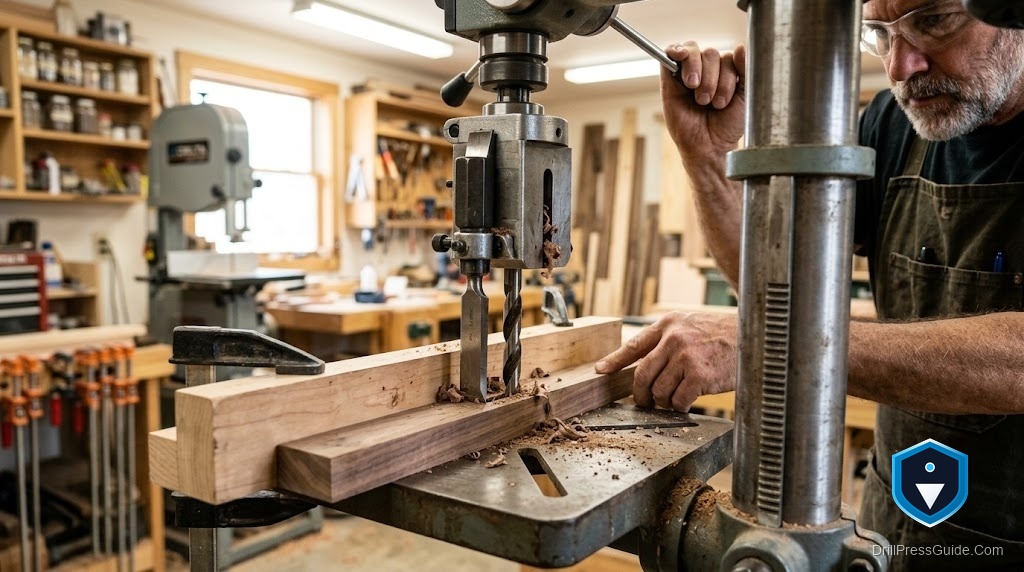
The magic lives in two parts working together. A brad-point drill bit spins inside a hollow chisel that has four sharpened edges. The bit clears the bulk of the waste as a round hole, and the square chisel shears the corners crisp. That is how you get a square hole from a round tool.
The attachment itself clamps to the quill housing of your press. A column collar or adapter locks the fence and chisel holder in place, and a hold-down keeps the workpiece from lifting when you retract the chisel. A fence guides your stock so each plunge lines up with the last. None of it is complicated, but all of it has to be square, because small errors stack up fast across a row of overlapping holes.
Matching the quill diameter is everything
This is where most people get burned, so read this twice. The attachment has to fit the quill diameter of your specific press. Good kits ship with a set of bushings, essentially concentric sleeves, so one kit fits many machines. You simply match your quill outside dimension to the nearest bushing inside dimension.
I like the Grizzly H7789 mortising attachment kit for exactly this reason. It comes with a stack of interchangeable bushings, a cast-iron chisel holder and fence, a hold-down assembly, and a quill alignment pin, plus four chisels in the everyday sizes. If your press is a common JET, Delta, Shop Fox, or Grizzly model, odds are strong one of those bushings drops right on.
The Shop Fox D4031 mortising attachment kit is a close cousin with a similar bushing set and a genuinely heavy, well-cast body. If you have looked at Delta, JET, Shop Fox, and Grizzly mortising kits and felt lost, know that most of them share this same bushing-and-adapter design under different paint.
Quality lives in the chisels, not the frame
Here is the truth nobody tells you. The frame barely matters. The chisels make or break every cut. A dull or poorly ground hollow chisel tears fibers, overheats, and wanders. A sharp, well-machined one glides.
Budget for a proper set of edges, and treat the chisels that ship in a kit as a starting point rather than a lifetime supply. A dedicated set like this hollow chisel and bit set covers the common quarter-inch, five sixteenths, and three eighths sizes that handle the vast majority of furniture joinery. Keeping the drill bit inside the chisel properly spaced, usually a hair of clearance so the bit spins free, is the single setup step that separates smooth cuts from smoking ones.
Setup, feed, and clearing chips
Go slow and let the tool cut. Plunge partway, back off to eject the waste, then plunge again. If you bury the chisel to full depth in one shove, chips pack inside the hollow, heat builds, and the chisel binds. That was my raccoon-hole mistake in a single sentence.
Clamp your stock hard against the fence, snug the hold-down, and cut a row of mortises by working from one end to the other with slightly overlapping plunges. For round or awkward stock, a companion 4-inch drill press vise gives you a second way to lock parts down when the fence alone is not enough.
Being honest about the tradeoffs
A dedicated hollow chisel mortiser is more rigid, has a longer, purpose-built lever, and lets you reposition stock quickly with a built-in cross-slide. An attachment on a drill press is less rigid, so deep cuts in hard maple will test both your arm and the machine. Repositioning is slower because you are nudging a fence rather than cranking a table. And you are limited by the quill travel of your press, which means deep mortises may need a flip or a second setup.
None of that makes the attachment a bad buy. It makes it an honest one. For occasional furniture work, it earns its keep. For production runs of tough joinery every week, save toward the standalone machine.
Verdict
If you already own a decent drill press and cut mortises now and then, buy the attachment and spend a little extra on chisels. The Grizzly H7789 mortising attachment kit is my pick for the widest machine compatibility thanks to its bushing set, with the Shop Fox D4031 mortising attachment kit a strong alternative for its heft. Pair either with a quality hollow chisel and bit set and you will cut joints you are proud of. Just remember the attachment rewards patience and punishes force.
- The attachment turns rotary motion into square holes using a hollow chisel around a spinning bit.
- Compatibility comes down to matching your quill diameter to the right bushing.
- Sharp, well-made chisels matter far more than the frame.
- It is a real compromise on rigidity, repositioning speed, and quill travel versus a dedicated mortiser.
FAQ
Is a drill press with mortise attachment good enough for furniture? For hobby and light furniture work, yes, it is genuinely capable. You get clean mortise and tenon joints if your chisels are sharp and you feed slowly. Just expect slower going in dense hardwoods.
What is the best mortise attachment for drill press use? The best one is the one whose bushing set fits your quill and whose chisels are well ground. Kits like the Grizzly and Shop Fox sets score high because their bushings fit a wide range of common presses. Beyond that, chisel quality decides your daily experience.
Is there a Delta drill press mortise attachment that fits older models? Many universal kits include a bushing that matches common Delta quill sizes, so a bushing-based kit is usually the safe route. Measure your quill outside dimension first, then match it to the nearest bushing. Older Delta presses with unusual quills may need the closest split bushing.
Can I build a DIY mortise attachment for drill press work? You can build a shop-made fence and hold-down jig, and many woodworkers do. What you cannot easily make at home is the precision chisel holder and bushings, so buy those and build the wooden guides around them. A DIY sliding base improves repositioning noticeably.
Will a kit work as a mortise attachment for Craftsman drill press models? Most Craftsman benchtop and floor presses use common quill dimensions, so a universal bushing kit typically fits. Confirm by measuring the quill collar before ordering. If the nearest bushing is slightly loose, a thin shim can true it up.
What is a mortise bit attachment for drill press and how is it different from a full kit? A bit attachment usually refers to just the chisel and drill bit pairing, while a full kit adds the holder, fence, bushings, and hold-down. If you already own the holder, you only need fresh chisels and bits. Most first-time buyers should start with the complete kit.
Do I need a mortise attachment jig for drill press repositioning? A jig is not required, but a simple sliding fence jig makes cutting a row of mortises far faster and more consistent. It gives you a repeatable stop and smoother lateral movement than nudging the fence by hand. It is the easiest upgrade to a basic setup.
References
- Grizzly Industrial, product documentation for mortising attachment kits
- Woodstock International (Shop Fox), owner manuals and specifications
- Fine Woodworking, articles on hollow chisel mortising technique
- Popular Woodworking, guides on mortise and tenon joinery
- ANSI and manufacturer safety guidance for drill press accessories


