Harbor Freight Drill Press Replacement Handle Crank: Diagnose the Fit Before Replacing Anything
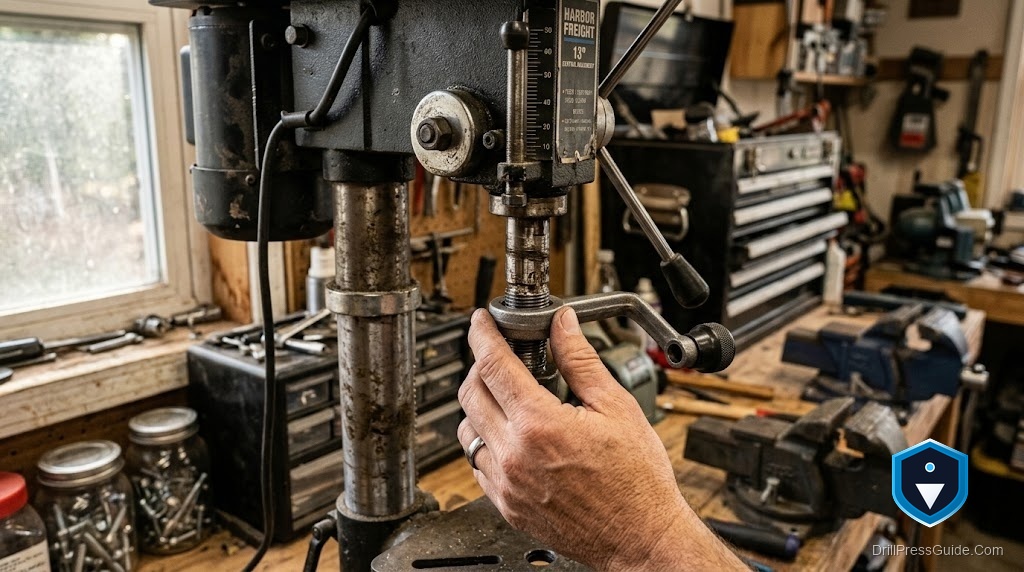
You reach for the feed lever, one arm spins loose in your palm, and the quill barely moves. Before you order a harbor freight drill press replacement handle crank, slow down and find out what actually failed. Most “broken handle” jobs I see are really a stripped set screw, a rounded hub bore, or a worn spindle shaft, and each one needs a different fix. Swap the wrong part and you will be back at the bench in a week with the same wobble.
A feed handle crank is the three-arm lever (sometimes a two-arm or a single crank) that turns the pinion to lower and raise the quill. On most Harbor Freight and Central Machinery bench presses, the arms thread into a central hub, and that hub locks onto the pinion shaft with a set screw or a cross pin.
Here is the short version. Check three things in order: the set screw, the hub bore, and the shaft. If the arms are fine and only the set screw or one arm is stripped, you do not need a whole new crank. If the hub bore is worn oval or cracked, replace the crank and match the bore to your shaft. Measure before you buy, because “universal” only means universal when the numbers line up.
Find out which part actually failed
Pull the plug first. A feed lever that spins the quill is not something you want waking up mid-inspection.
Now work through the parts in order:
- Loose arm only: One arm backed out of the hub. Thread it back in. If the threads are stripped, many hubs take a common metric arm you can buy on its own.
- Spins on the shaft: The set screw is stripped, missing, or riding on a rounded flat. Look for a shiny worn flat on the shaft where the screw should bite.
- Wobbles or rocks: The hub bore is worn oval, or the hub casting is cracked. That is a real crank replacement.
If the quill will not move even with a solid lever, the crank is not your problem. That points at a seized quill, a broken return spring, or a bound spindle, which is a separate repair.
Measure the bore before you buy anything
This is the step people skip, and it is why returns pile up. The crank has to match two numbers: the shaft diameter and the flat or pin that keeps it from spinning.
Pull the old crank and measure the shaft with calipers. Bench presses in the 12 inch to 17 inch class very often run a 22mm hub bore, while smaller table-raising cranks tend to run closer to 14mm. Do not assume. A caliper reading takes ten seconds and settles the question for good.
If you want one part that fits the common bench sizes, a universal 3-arm feed handle set with a 22mm bore hub covers a lot of the Z512, Z516, Z4116, and Z4120 style heads that Harbor Freight machines are built from. If your shaft measures closer to 14mm, buy a smaller crank instead. Forcing a 22mm hub onto a 14mm shaft leaves you shimming and chasing wobble forever.
Feed handle crank and table crank are not the same part
A drill press has two cranks, and people order the wrong one all the time. The feed handle moves the quill down and lets the return spring bring it back. The table crank raises and lowers the table on the column rack. They usually have different bore sizes and different swing. Know which one broke before you shop, or you will end up with a table crank where a feed handle should be.
Get your model and serial number first
Harbor Freight lists replacement parts online by machine, ships parts free, and treats part sales as final, so ordering the exact part the first time matters. The parts lists and diagrams printed in the owner’s manual are for reference only; the site is the source for what is actually stocked. Copy the model number and serial number off the plate before you call or search. If the part shows out of stock, the universal route above is your backup.
While the head is open, check the quill and chuck
Since the head is already exposed, look at the parts near the feed mechanism. If the chuck also needs to come off, most of these presses press a keyed or keyless chuck onto a Jacobs taper arbor, and that arbor sits in an MT2 Morse taper in the quill.
Open the chuck jaws all the way and look through the spindle access window (the slot in the quill). You can usually drive the arbor out with a taper drift pushed through that slot. To pull just the chuck off its arbor, seat two wedges or a chuck-removal tool against the chuck shoulder, rest the chuck on a wood block, and tap with a non-marring mallet. Never strike the chuck body with a steel hammer. A keyed chuck and a keyless chuck come off the same way, because the taper does the holding, not threads.
Quick wins while the guard is open
Check the belt on the step pulleys so your next speed change goes smoothly, confirm the table tilt lock holds and the pointer reads zero, and make sure the depth stop and drill guide move freely. Small stuff, but it costs you nothing while everything is already apart.
Installing the new crank
- Slide the hub onto the shaft and line the set screw up with the flat. Snug, not gorilla tight.
- Thread the arms in with a drop of medium threadlocker so they stop backing out.
- Run the quill through its full stroke by hand and confirm the return spring brings it back before you drill anything.
The verdict
Buy the crank only after you have measured, never before. A feed handle crank is one of the simplest fixes on the whole machine, but the wrong bore turns a ten-minute job into a return label and a second wait. Match the part, and you are back to drilling the same afternoon.
Four things to hold onto:
- Diagnose in order: set screw, then hub bore, then shaft.
- Measure the bore (often 22mm on 12 to 17 inch heads, closer to 14mm on smaller cranks).
- Match the feed crank, not the table crank.
- Order by model and serial number, or buy a universal set that matches your measurement.
FAQ
How do I know if I need a new crank or just a new set screw? Grab the arms and try to rock the hub on the shaft. If it rocks or the bore looks oval, replace the crank. If the arms are solid and it only spins freely, the set screw is stripped or missing, and that is a much smaller fix.
What size is the hub bore on a Harbor Freight bench drill press? Many 12 inch to 17 inch bench heads use a 22mm hub bore, but smaller table cranks often run near 14mm. Measure your shaft with calipers rather than trusting the listing, because the two sizes are close enough to cause a bad order.
Will a universal feed handle set fit my Central Machinery press? Usually, if the bore and shaft match. Universal 3-arm sets built for the Z512, Z516, Z4116, and Z4120 style heads fit a wide range of these machines, but the fit still comes down to your measured shaft diameter and the set screw seat.
Can I order the exact crank from Harbor Freight? Often yes, through the online replacement parts listings by model number. Part sales are treated as final, so confirm your model and serial number before ordering, and remember the diagrams in the manual are reference only.
My quill will not move even with a good handle. Is the crank bad? No. A crank only transmits motion. If the quill is stuck, look at a seized quill, a broken or unwound return spring, or a bound spindle instead.
Do I need to remove the chuck to replace the handle crank? No. The feed crank and the chuck are separate. You only touch the chuck if you are also servicing or replacing it while the head is open.
Should I use threadlocker on the arms? A drop of medium-strength threadlocker on each arm keeps them from vibrating loose over time. Skip the high-strength kind, or you will fight it the next time you service the head.
References
- Harbor Freight Tools, Replacement Parts (harborfreight.com/parts)
- Harbor Freight Tools, Owner’s Manual archive (manuals.harborfreight.com)
- PartSelect, Drill Press Handles (partselect.com)