
Is the Delta 17900 Drill Press Right for Your Shop?
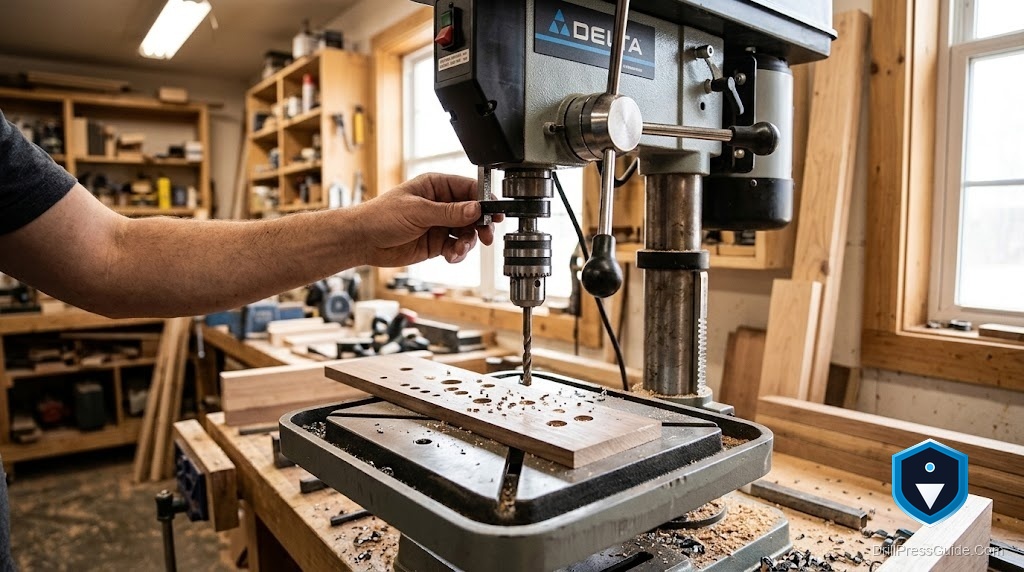
The Delta 17900 drill press (properly the model 17-900) is the machine a lot of serious hobbyists graduate to, and it has earned that reputation. It is a 16-1/2-inch floor press with a 3/4-HP motor, real cast-iron mass, and the kind of quill stroke and speed range that benchtop machines cannot match. On the used market it is one of the most sought-after Delta drill presses, which raises the real question: is it the right press for your shop, or more machine than you need? The answer depends on what you drill and whether you have the floor space. Here is how to decide.
The Delta 17900 drill press (model 17-900) is a 16-1/2-inch floor-standing drilling machine with a 3/4-HP induction motor, a 5/8-inch chuck, a Morse #2 spindle taper, a rack-and-pinion tilting cast-iron table, multiple belt speeds, and a long quill stroke, built for general-to-heavier drilling in wood and metal.
Short answer: the Delta 17900 is right for your shop if you want a floor press with real power, a long stroke, and cast-iron rigidity for woodworking and general metal, and you have the space for a floor machine. It is overkill for occasional light drilling, where a benchtop press is cheaper and smaller. On the used market, a clean 17-900 with Delta parts support is an excellent buy. Here is the detail.
What the 17-900 is
The 17-900 is a full-size floor drill press. Its specifications explain why people seek it out:
- 16-1/2-inch swing: 8-1/4 inches from the bit to the column, centering a hole in a 16-1/2-inch workpiece.
- 3/4-HP induction motor: Enough to drill large holes in hardwood and handle general metal work without bogging.
- 5/8-inch chuck on a Morse #2 spindle: Bigger capacity and solid, standard tooling.
- Rack-and-pinion tilting cast-iron table: Smooth height changes and angle drilling.
- Long quill stroke and multiple belt speeds: Deep holes in one pass and a speed range for wood and metal.
- Heavy cast-iron build: Mass that reduces vibration and improves accuracy.
It is a general-purpose floor press that leans toward heavier work than any benchtop machine.
Who it suits
The 17-900 suits the woodworker or general shop that has outgrown a benchtop press: someone drilling larger holes, deeper holes, or heavier stock, who wants cast-iron accuracy and a machine that will last decades. The power and stroke make big Forstner bits and hole saws practical, and the mass keeps things steady.
It does not suit a shop tight on floor space or one doing only occasional light drilling, where a benchtop press costs less and takes up a corner of a bench.
Setting it up right
- Level and stabilize the floor machine so it does not rock.
- Square the table with a rod in the chuck and a square, in two directions.
- Set the belt speed for the bit and material: slow for large bits and metal, fast for small bits in wood.
- Use the depth stop for repeatable and blind holes.
- Check the return spring for smooth quill return.
The honest flaws
Belt-change speeds. Speeds are set by moving the belt, not a dial. Fine for most work, less convenient if you switch constantly.
Floor space and weight. It is a heavy floor machine to move and place.
Used-market condition. No warranty on a used unit; condition and completeness are everything.
Not the highest top speed. Its range tops out below some benchtop machines, which matters only for very small bits at very high RPM.
Buying used and parts support
Most 17-900s are bought used, so inspect carefully: check spindle runout with a bit, pull the quill through its full stroke, start the motor and listen for a clean run, and check the table, column, and castings. A cracked belt or worn chuck are cheap, expected fixes; a cracked casting or dead motor are not. Delta parts support runs through Delta’s parts network and Sears PartsDirect by model and type number, and replacement chucks are available, such as a chuck that fits the Delta 17-900. See our used Delta drill press guide for the full inspection method and the Delta drill presses models, parts, and support guide.
How it compares
Against the laser-equipped Delta 18-900L, the 17-900 is the simpler, often-used-market sibling: same floor-press class, but the 18-900L adds a laser, a longer stroke, and an auto-tensioning belt. Against a benchtop like the variable-speed WEN 4212T, the 17-900 is a different class entirely, more power, more stroke, more mass, at the cost of size and (used) no warranty. Choose the 17-900 for floor-press capability and cast-iron value; choose a benchtop for light work and space savings.
The verdict
The Delta 17900 (17-900) is right for your shop if you want a floor drill press with genuine power, a long stroke, and cast-iron rigidity for woodworking and general metal, and you have the floor space for it. Its 3/4-HP motor, 5/8-inch chuck, Morse #2 spindle, and heavy build make large and deep holes routine, and Delta parts support keeps a used machine serviceable for decades. Its trade-offs, belt-change speeds, floor space, and used-market condition, are typical of the class. If your drilling is light and occasional or space is tight, a benchtop press is the smarter choice; if you have outgrown one, the 17-900 is one of the best used-market floor presses you can buy.
Frequently asked questions
What are the specs of the Delta 17-900 drill press? A 16-1/2-inch swing, a 3/4-HP induction motor, a 5/8-inch chuck on a Morse #2 spindle, a rack-and-pinion tilting cast-iron table, multiple belt-driven speeds, and a long quill stroke, in a heavy floor-standing cast-iron build.
Is the Delta 17900 the same as the 17-900? Yes. “17900” is just the model 17-900 written without the hyphen. It is Delta’s 16-1/2-inch floor drill press.
Is the Delta 17-900 good for metal? Yes, for general metal drilling. Its 3/4-HP motor and slow belt speeds handle steel and cast iron within reason; use a slow speed for large bits, a center punch, and steady feed. It is not a production metalworking machine.
Can you still get parts for a Delta 17-900? Yes, wear items like belts, chucks, and springs are available through Delta’s parts network and Sears PartsDirect by model and type number, plus matched generics. Replacement chucks that fit the 17-900 are readily available.
Does the Delta 17-900 have variable speed? No. It uses multiple belt-driven speeds set by moving the belt between pulley steps, not a variable-speed dial. Match the speed to your bit size and material.
Should I buy a used Delta 17-900 drill press? If it is complete and in good condition, it is an excellent floor-press value. Check spindle runout, quill travel, motor sound, and the castings, and budget for a belt and possibly a chuck. Avoid cracked castings and dead motors.
What is the difference between the Delta 17-900 and 18-900L? Both are floor presses in the same class. The 18-900L adds a laser alignment system, a longer 6-inch quill stroke, an 18-inch swing, and an auto-tensioning belt drive, while the 17-900 is the simpler 16-1/2-inch machine often found used.
References
- Delta Machinery, drill press models and parts support: https://www.deltamachinery.com
- Sears PartsDirect, Delta 17-900 drill press parts and diagrams: https://www.searspartsdirect.com
- Fine Woodworking, floor drill press guidance and reviews: https://www.finewoodworking.com


