1-1/2 HP Drill Press: A Practical Guide for the Workshop
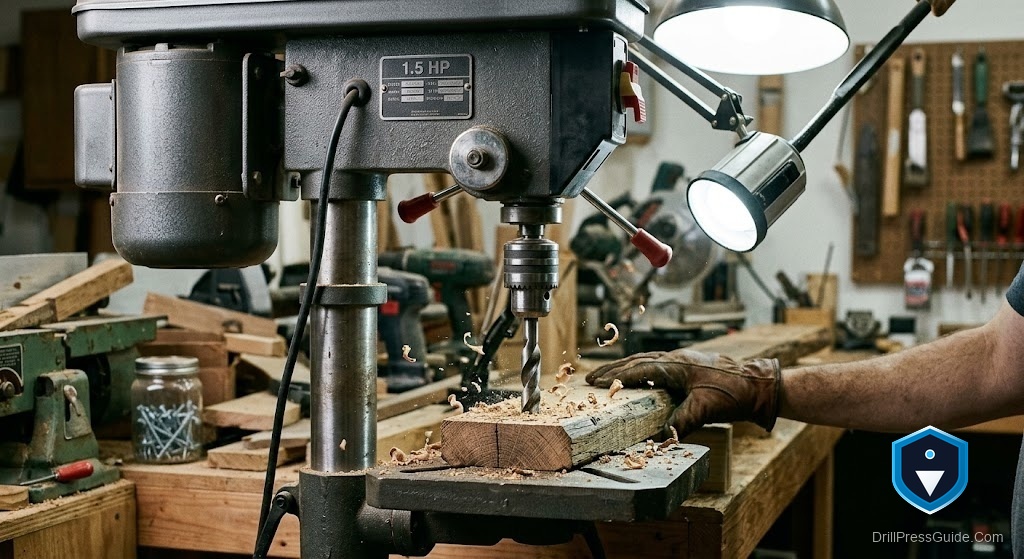
A 1-1/2 HP drill press sits at the powerful end of the shop drill press world, and most people who go looking for one are asking the same real question: do I actually need this much motor, or am I paying for a number I will never use? The honest answer is that 1-1/2 HP earns its place for specific work, large-diameter bits, frequent metal drilling, and long production runs, and is overkill for casual hole-drilling in wood. Understanding what the rating really delivers, and how it compares to the more common 1/3, 1/2, 3/4, and 1 HP machines, is the key to buying the right press instead of the biggest one. Here is a practical guide.
A 1-1/2 HP drill press is a heavier-duty drilling machine, almost always a floor-standing model, whose induction motor produces about one and a half horsepower for driving large-diameter bits, drilling metal, and sustaining repeated or production work, typically with a Morse-taper spindle, multiple belt speeds or variable speed, and a heavy cast-iron build.
Short answer: a 1-1/2 HP drill press makes sense if you regularly drill large holes (big Forstner or spade bits), work steel and thick metal, or run repeated production drilling. For general woodworking and household use, a 1/3 to 3/4 HP machine is plenty. Watch for “maximum developed” peak ratings that overstate continuous power, and match the motor to your actual work. Here is the full picture.
What horsepower actually does on a drill press
Horsepower on a drill press translates to how much cutting resistance the machine can overcome without bogging. More power matters most when:
- The bit is large. A big Forstner or a hole saw removes a lot of material at once, demanding torque at low RPM.
- The material is hard. Steel and cast iron resist cutting far more than softwood.
- The work is repetitive. Production drilling keeps the motor under sustained load, where a stronger motor runs cooler and lasts longer.
For small bits in wood and plastic, horsepower barely matters; speed and accuracy do. That is why the huge majority of home drilling is handled comfortably by modest motors.
The honest catch: peak versus continuous ratings
Before you chase a big number, know how drill presses are rated. Many consumer machines quote “maximum developed” or peak horsepower, the highest momentary output, not the continuous rating the motor sustains. A press advertised at a high peak figure may draw amps that tell a more modest story. A true 1-1/2 HP induction motor draws real current (well into the teens of amps on 120V, or runs on 240V), and heavy machines often run on 240V or three-phase power. When you compare machines, look at the motor’s amp draw and voltage, not just the horsepower headline. This is the single most common way buyers overpay for power they do not get.
How the HP tiers break down
- 1/4 to 1/3 HP: Small benchtop presses. Light drilling in wood, plastic, thin metal. The Delta 11-985 10-inch sits near the bottom of this range.
- 1/2 HP: General benchtop and smaller floor presses. Comfortable for most woodworking.
- 3/4 HP: The sweet spot for serious home floor presses. The Delta 17900 and Delta 18-900L live here and handle 2-inch holes in hardwood.
- 1 HP: Larger floor presses and heavier import machines, good for regular metal work.
- 1-1/2 HP and up: Production and metalworking territory. Geared-head and heavy floor machines for big bits, steel, and sustained use.
Notice that 3/4 HP already drills large holes in hardwood with ease. That tells you 1-1/2 HP is about sustained metal and production work, not everyday drilling.
Who actually needs 1-1/2 HP
You do if: you drill large-diameter holes in steel routinely, run production batches, use big annular or hole-saw cutters, or want a machine that never bogs under heavy continuous load.
You do not if: your work is woodworking, general assembly, or household repair. A 1/2 to 3/4 HP press will do everything you need, cost less, run on standard power, and take up less space.
What comes with the power
A genuine 1-1/2 HP machine usually brings the rest of a heavy press with it: a Morse-taper spindle (MT2 or MT3) for solid tooling, a heavy cast-iron column and table for rigidity, generous quill travel, and often either many belt speeds or a variable-speed or geared-head drive to hold torque at low RPM. It also brings weight (these are floor machines to move and place) and often a 240V or three-phase power requirement to plan for.
How it compares to stepping down
Against a 3/4 HP floor press, a 1-1/2 HP machine gives you headroom for steel and production but adds cost, weight, and often a 240V or three-phase supply. For most shops, a well-set-up 3/4 HP press like a Delta floor model or a variable-speed benchtop like the WEN 4212T covers the work with less fuss. Step up to 1-1/2 HP only when your drilling genuinely demands it.
The verdict
A 1-1/2 HP drill press is a specialist’s tool: the right call for large-diameter bits, regular metal drilling, and production runs, and unnecessary muscle for general woodworking and household work. Before buying, separate peak “maximum developed” ratings from continuous power by checking amps and voltage, and remember that even a 3/4 HP press drills big holes in hardwood comfortably. If your work is heavy and repetitive, the power, Morse-taper spindle, and cast-iron mass of a 1-1/2 HP machine are worth the cost, weight, and power requirements. If it is not, buy the 1/2 to 3/4 HP press that fits your work and spend the difference on good bits.
Frequently asked questions
Do I need a 1-1/2 HP drill press? Only if you regularly drill large-diameter holes, work steel and thick metal, or run production drilling. For general woodworking and household use, a 1/3 to 3/4 HP press is more than enough.
What is the difference between peak and continuous horsepower? Peak or “maximum developed” horsepower is the highest momentary output; continuous horsepower is what the motor sustains under load. Many consumer presses quote the peak figure, so check the motor’s amp draw and voltage for the real story.
Is 3/4 HP enough for a drill press? For almost all home and woodworking use, yes. A 3/4 HP floor press drills 2-inch holes in hardwood comfortably and handles general metal work. Step up to more power mainly for sustained metal drilling and production.
What power supply does a 1-1/2 HP drill press need? Many genuine 1-1/2 HP machines run on 240V single-phase or three-phase power rather than a standard 120V outlet. Confirm the motor’s voltage and phase and plan your shop wiring or a converter before buying.
What can a 1-1/2 HP drill press do that a smaller one cannot? It sustains heavy continuous loads without bogging, drives large-diameter bits and hole saws in steel, and runs production batches cooler and longer. For light drilling, the difference over a 1/2 to 3/4 HP press is minimal.
Which brands make 1-1/2 HP drill presses? Heavier-duty and industrial floor presses in this power class come from names like JET and other industrial suppliers, along with geared-head machines. Compare the actual motor amps and voltage across brands rather than the headline horsepower.
Is more horsepower always better on a drill press? No. Beyond what your work needs, extra horsepower adds cost, weight, and power-supply requirements without improving results. Accuracy, spindle travel, and correct speed matter more for most drilling than raw power.
References
- Fine Woodworking, understanding drill press power and motor ratings: https://www.finewoodworking.com
- Popular Woodworking, choosing a drill press: https://www.popularwoodworking.com
- Pro Tool Reviews, drill press motor and horsepower explainer: https://www.protoolreviews.com