
Removing the Drive Pulley on a Powermatic 1150 Drill Press Without Wrecking It
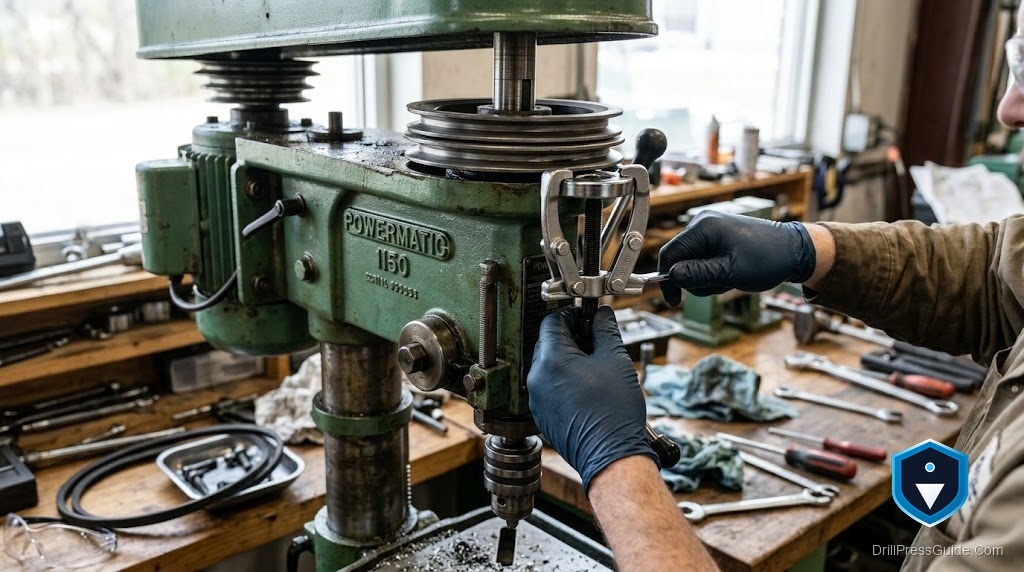
The Powermatic 1150 is built like it plans to outlive everyone who owns it, which is exactly why a stuck pulley feels like such an insult. Decades of grime and a little corrosion can weld a pulley to its shaft, and the wrong approach, usually a hammer, cracks the casting or bends the shaft. Powermatic 1150 drill press drive pulley removal is not hard, but it is unforgiving of impatience, and the difference between a clean job and a ruined part is mostly in the first two steps.
The drive pulley is the stepped pulley that transfers the motor’s power to the belt and, through it, to the spindle. It is held on its shaft by one or two set screws and almost always a key sitting in a keyway. Nothing comes off until both of those are dealt with.
Short answer: unplug the machine, back the set screws all the way out, remove the key from the keyway, then draw the pulley straight off with a two- or three-jaw gear puller. If it resists, a little penetrating oil and time beats any amount of force.
Find every fastener before you pull
The most common mistake is pulling against a set screw you did not see. On the 1150, look around the pulley hub for one or even two set screws, sometimes stacked in the same hole (a jam screw over a main screw). Back them completely out, not just loose.
Then look for the key. A small steel key sits in a slot between the shaft and the pulley bore, and it must be free to slide out or the pulley will not budge. Sometimes it lifts out once the set screw clears it; sometimes it needs to travel with the pulley a little before it releases.
Pull it, do not pound it
- Unplug the drill press.
- Soak the shaft-to-hub joint with penetrating oil and give it fifteen minutes. Old machines reward patience here.
- Fit a gear puller so its jaws grip behind the pulley and its center screw bears on the end of the shaft. A three-jaw gear puller set with a range of sizes lets you seat the jaws squarely, which is what keeps the pull straight.
- Tighten the puller screw slowly. You want steady pressure, not sudden force. Tap the puller screw lightly if it stalls, then keep tightening.
- As the pulley starts to move, keep it square so it does not cock on the shaft and gall.
The honest drawback of a low-end puller: the jaws can flex on a really stubborn pulley, and a flexing jaw slips. Who should skip it: if your pulley is already cracked and headed for the bin, you can be far more aggressive and may not need a quality puller at all.
If the pulley is damaged, replace it
If you pulled the pulley because it is cracked, chipped, or the grooves are worn shiny and slick, do not fight to reuse it. A multi-groove aluminum drill press pulley can replace a damaged stepped pulley, as long as you match the bore to your shaft, the number of grooves, and the overall diameter. The tradeoff is that an aftermarket pulley may need its set screw hole aligned to your keyway, so check that before final assembly. Anyone whose original pulley is still sound should simply clean it and reinstall it.
Reinstalling so the next person has it easy
Before the pulley goes back on, wipe the shaft clean and add a thin film of anti-seize. That one habit means the next removal, yours or someone else’s, is a two-minute job instead of an afternoon. Seat the key, slide the pulley to its original depth, and snug the set screw onto the flat or the key, not onto bare round shaft.
Patience is the real tool here
Getting a drive pulley off a Powermatic 1150 is a test of method, not muscle. Clear every set screw, free the key, and let a gear puller and a little penetrating oil do the work. Skip any of those and you risk turning a stuck pulley into a cracked one.
Three takeaways:
- Remove all set screws and the key before applying any pulling force.
- Use a gear puller and penetrating oil, never a hammer, on a pulley you want to keep.
- Add anti-seize on reassembly so the next removal is painless.
FAQ
How is the drive pulley held on a Powermatic 1150? By one or two set screws in the hub and a key in a keyway. Both must be removed before the pulley will slide off.
Can I remove the pulley without a gear puller? Sometimes, if it is not seized, gentle even prying works. But a gear puller pulls straight and square, which is what protects the shaft and casting.
Why will my pulley not come off after removing the set screw? There is likely a key still in the keyway, a second hidden set screw, or corrosion on the shaft. Check all three and apply penetrating oil.
Should I hammer the pulley off? No. Hammering can bend the shaft or crack the pulley. Use a puller and patience instead.
How do I choose a replacement pulley? Match the bore diameter to your shaft, the number of grooves, and the overall diameter and step spacing so the belt still lines up with the spindle pulley.
What is penetrating oil doing here? It seeps into the corrosion between the shaft and hub and breaks the bond, so the pulley slides instead of galling.
Do I need to align anything on reassembly? Yes. Seat the key, set the pulley to its original depth, and make sure the set screw lands on the flat or key so the pulley cannot spin on the shaft.
References
- Powermatic, machine manuals and parts documentation: https://www.powermatic.com


