
Drill Press 1/2 Spindle Replacement: A Workshop Troubleshooting Guide
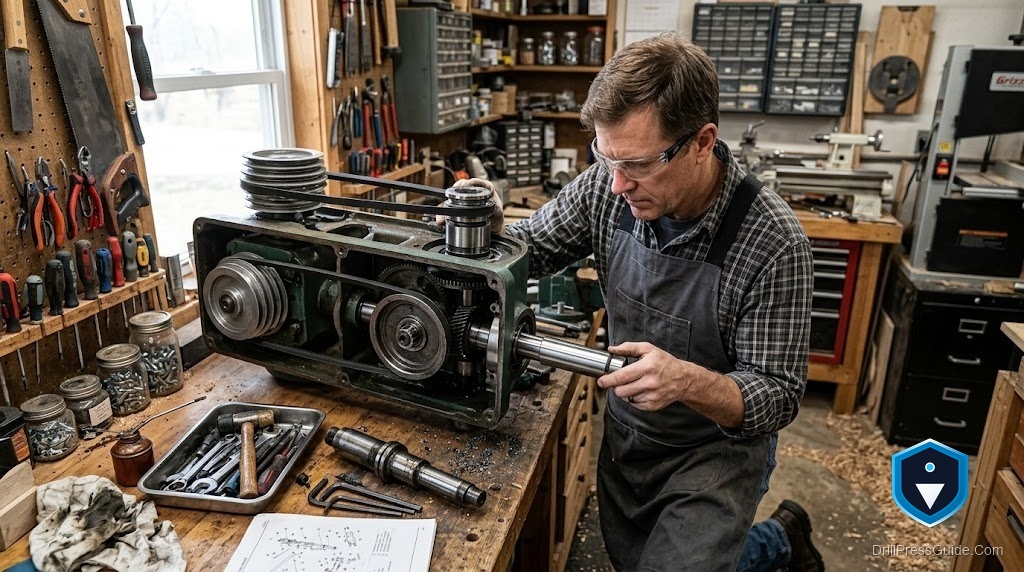
A press described by a 1/2 inch spindle usually means a benchtop machine with a 1/2 inch chuck capacity, and when the spindle itself is the problem, the symptoms are hard to ignore: a persistent wobble that survives a new chuck, rough or noisy rotation, or visible damage to the spindle shaft. A drill press 1/2 spindle replacement is a deeper repair than a chuck swap, but it is well within reach once you confirm the spindle is truly the fault and understand it comes out as part of the quill assembly.
The spindle is the rotating shaft that carries the chuck and rides inside the quill, which slides in the head. On a 1/2 inch capacity press the spindle and quill come out together, and the spindle turns on bearings pressed into the quill, so replacing the spindle usually means working with the whole quill assembly.
The direct answer: with the press unplugged, confirm the wobble is the spindle and not the chuck or a taper, then remove the chuck and arbor, release the quill return spring under control, withdraw the quill and spindle assembly, and replace the spindle or the assembly and its bearings. Diagnose before disassembly, since a chuck or taper fault is far more common than a bad spindle.
Diagnose before you disassemble
With the press unplugged, rule out the simpler causes first:
- Swap or reseat the chuck. Most wobble is a chuck or unseated taper, not the spindle. Confirm with a clean, dry, well seated chuck.
- Indicate the spindle directly. Put a dial indicator on the spindle nose (not the chuck) to see if the spindle itself runs out.
- Feel and listen for the bearings. Rough or noisy rotation points at spindle bearings, which may be the real fix rather than the spindle.
Removing the quill and spindle
- Remove the chuck with drill chuck removal wedges and drop the arbor with a taper drift.
- Release the quill return spring under control, wearing safety glasses.
- Free the quill lock and any retaining collar, then lower the quill fully and ease the quill and spindle assembly out of the head.
Replacing the spindle or bearings
- Press the old spindle out of the quill, supporting the quill so the bearings are not damaged.
- Fit a new drill press spindle bearing set, or the full spindle and quill assembly if the spindle is damaged.
- Reassemble, reset the quill return spring, and refit the chuck.
- Indicate the spindle nose again to confirm true rotation.
Where people go wrong
The first mistake is replacing the spindle for a wobble that was really the chuck or an unseated taper, a far more common cause. The second is releasing the quill return spring carelessly during teardown, letting it unwind fast. The third is pressing the spindle without supporting the quill, damaging the bearing bores.
The verdict
A 1/2 inch spindle replacement is a real teardown, so earn it with diagnosis first. Confirm the spindle itself runs out by indicating the nose, not the chuck, and rule out a chuck or taper fault. If the spindle or its bearings are truly at fault, remove the chuck and arbor, control the return spring, and withdraw the quill and spindle assembly to replace what is worn. Diagnose before you disassemble and the press returns to true, quiet rotation, without a deep repair that a simple chuck reseat would have solved.
Three takeaways:
- Indicate the spindle nose to confirm it, not the chuck.
- The spindle comes out with the quill assembly.
- Control the return spring during teardown.
FAQ
How do I replace the spindle on a 1/2 inch drill press? Unplug it, confirm the spindle itself runs out, remove the chuck and arbor, control and release the quill return spring, withdraw the quill and spindle assembly, then replace the spindle or its bearings and reassemble.
How do I know the spindle is the problem? Indicate the spindle nose directly, not the chuck. If the nose runs out or rotation is rough and noisy, the spindle or its bearings are suspect. A wobble at the chuck is usually a chuck or taper fault.
Isn’t wobble usually the chuck? Yes. A chuck or unseated taper is far more common than a bad spindle. Reseat or swap the chuck first before assuming the spindle is at fault.
Does the spindle come out on its own? No. It rides in the quill on bearings, so it comes out as part of the quill assembly, then the spindle is pressed out of the quill.
Do I need to touch the return spring? Yes. Release it under control before withdrawing the quill, since it stores energy and can unwind fast. Wear eye protection.
Should I replace the bearings too? If rotation was rough or noisy, yes. Often new spindle bearings are the real fix, or you replace the full spindle and quill assembly if the spindle is damaged.
How do I confirm the repair? Indicate the spindle nose again after reassembly. It should run true, and rotation should be smooth and quiet.
References
- Zoro Resource Hub, Morse vs. Jacobs Tapers. https://www.zoro.com/resourcehub/what-are-the-dimensions-and-angles-of-morse-tapers-and-jacobs-tapers/
- Occupational Safety and Health Administration, Woodworking eTool: Drill Presses. https://www.osha.gov/etools/woodworking/production/machines-tools/drill-press


