A Practical Guide to a Drill Press Return Spring Fix
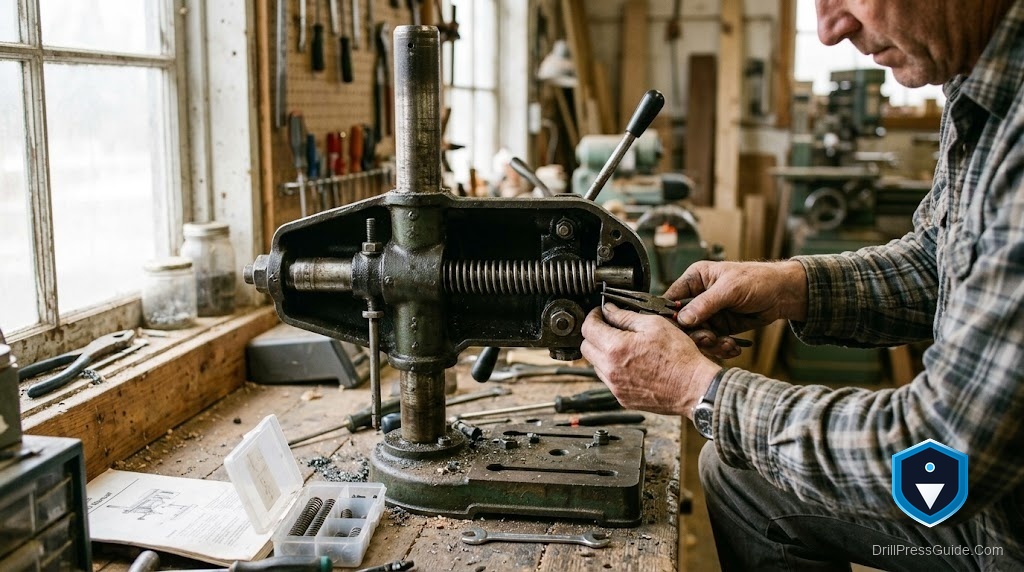
When the quill stops snapping back up on its own, or the handle whips around when you let go, the return spring is the culprit, and it is one of the more intimidating repairs on a drill press only because of how it is wound. The spring is a coiled spiral under tension inside a cap, and the fear of it flying loose keeps people from a repair that is genuinely simple with the right approach. A drill press return spring fix is about controlling that tension, not fighting it, and once you see how the cap and notches work the job loses its bite.
The return spring is a flat, spiral wound spring (a clock type spring) housed in a cap on the side of the quill assembly. It stores energy as you feed the quill down and returns the quill up when you release the handle. Tension is set by how far the cap is wound and held by notches or pins.
The direct answer: with the press unplugged, control the spring cap so it cannot unwind suddenly, release it from its notch, reset or replace the spring, then rewind to the tension that returns the quill smoothly and re engage the notch. The whole trick is never letting the cap spin free.
Understand the mechanism first
- The cap holds the tension. It sits over the wound spring and locks into a notch or on a pin. Let it spin and the spring unwinds violently.
- Notches set the tension. Moving the cap one notch tighter or looser changes how firmly the quill returns.
- The spring can fatigue or break. A spring that no longer returns the quill, or is visibly broken, needs replacing rather than just retensioning.
The fix, step by step
- Unplug the press and lower the quill partway, holding the feed handle.
- Note the cap position and mark it, so you know the starting tension.
- Loosen the retaining nut or screws while holding the cap firmly against its wind. Keep control at all times.
- Ease the cap out of its notch and let it unwind slowly under your control, not in a snap.
- Inspect the spring. If it is fatigued or broken, fit a matching drill press quill return spring.
- Rewind the cap to the marked position (or one notch tighter for a stronger return), seat it in the notch, and secure the nut.
- Test: feed the quill down and release. It should return smoothly and fully on its own.
Wear safety glasses throughout, since a spring under tension is the one part that can move fast.
Where people go wrong
The first mistake is loosening the retaining nut without holding the cap, letting the spring unwind and jump loose. The second is guessing the tension instead of marking the start position, then chasing the right feel by trial and error. The third is skipping eye protection while working on the one part designed to store and release energy.
The verdict
The return spring fix is only intimidating until you understand it is a controlled unwind, not a battle. Unplug the press, mark the cap, keep firm control as you release it from its notch, then reset or replace the spring and rewind to a smooth return. Wear eye protection the whole time. Respect the stored energy and control the cap, and this repair is quick, safe, and leaves the quill snapping back exactly as it should.
Three takeaways:
- Control the cap so the spring never unwinds suddenly.
- Mark the start position so you can reset the tension.
- Wear eye protection; this is the one part that moves fast.
FAQ
How do I fix a drill press return spring? Unplug the press, control the spring cap so it cannot spin free, release it from its notch, reset or replace the spring, then rewind to a smooth return tension and re engage the notch.
Why won’t my quill return on its own? Usually a fatigued, slipped, or broken return spring, or a cap that has lost tension. Inspect the spring and reset or replace it.
Is the return spring dangerous to work on? It stores energy, so an uncontrolled cap can unwind fast. Keep firm control of the cap, work deliberately, and wear eye protection, and it is safe.
How tight should the spring be? Just enough that the quill returns fully and smoothly on its own. Mark the start position, and if the return is weak, go one notch tighter.
Can I reuse the old spring? If it is intact and just needs retensioning, yes. If it is fatigued or broken, fit a matching replacement spring.
What if I let the spring unwind by accident? Rewind it carefully back into the cap following the coil direction, then reset the cap into its notch. Wear eye protection and take your time.
How do I set the tension after replacing the spring? Wind the cap to about the marked original position, seat it in the notch, secure the nut, then test the quill return and adjust one notch at a time.
References
- iFixit, How to adjust a quill return spring. https://www.ifixit.com/Guide/How+to+adjust+the+Kinzo+8E116+quill+spring/186701
- Occupational Safety and Health Administration, Woodworking eTool: Drill Presses. https://www.osha.gov/etools/woodworking/production/machines-tools/drill-press