
Lubricate Drill Press Column: A Workshop Troubleshooting Guide
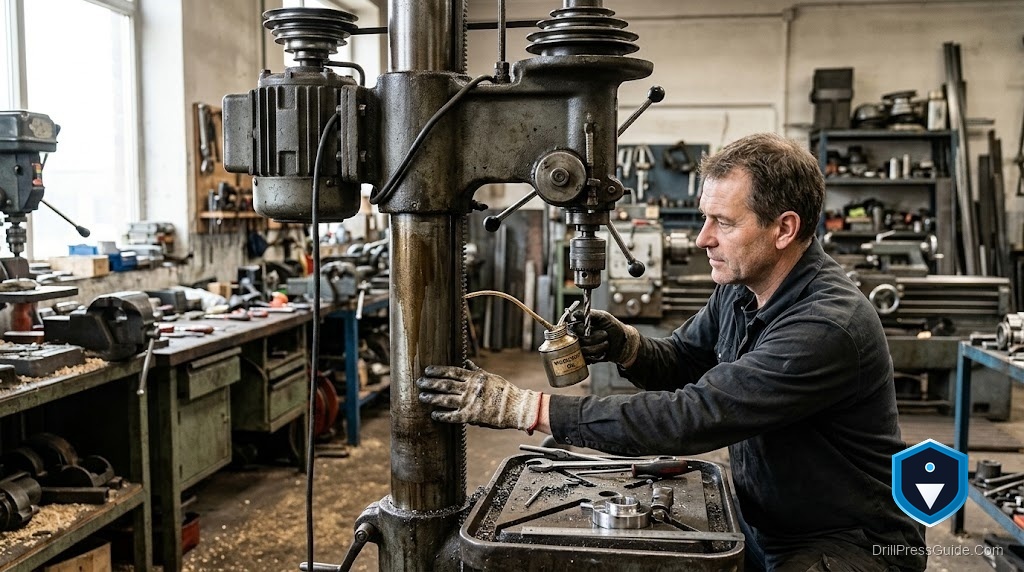
A drill press table that fights you as you crank it up and down, or a head that will not rotate smoothly, usually points at a neglected column. But lubricating a drill press column is not as simple as reaching for oil, because the wrong lubricant in the wrong place causes as many problems as it solves: a greasy column collects dust into grinding paste, and oil where a clamp needs to grip makes the head or table slip. Doing it right means cleaning first, choosing the correct lubricant, and keeping it off the surfaces that must hold.
The column is the steel post that carries the table bracket and head. It needs to let the table and head slide and rotate freely, while the clamps still lock them firmly, so lubrication is about smooth travel without sacrificing grip.
The direct answer: clean the column of rust and old grease first, then apply a dry film or light lubricant that leaves a slick but not greasy surface, keeping it off the clamp faces that must grip. A paste wax or dry lubricant is usually better here than oil, which attracts dust and can defeat the clamps.
Clean before you lubricate
With the press unplugged:
- Remove surface rust and old grease. A rust remover and abrasive pad takes the column back to clean steel, which is often all a dragging table needs.
- Wipe the column dry. Any old greasy film full of grit must come off, or new lubricant just traps more dust.
- Check the bracket bore and clamp faces. These should be clean too, but they must stay free of slippery lubricant so they can still grip.
Choose the right lubricant
- Paste wax. A thin coat of paste wax for tools leaves the column slick without a greasy film, so the table slides and the clamps still hold. A common favorite for this job.
- Dry film lubricant. A dry PTFE lubricant spray leaves a dry slick surface that does not attract dust, good in dusty shops.
- Light oil, sparingly. A very light wipe of oil works in a pinch but attracts dust and can migrate to clamp faces, so it is the least favored choice.
Applying it
- Unplug the press and clean the column as above.
- Apply a thin coat of paste wax or dry lubricant to the sliding length of the column.
- Buff off any excess so the surface is slick, not greasy.
- Keep lubricant off the clamp faces and the inside of the table bracket where it locks.
- Slide the table and rotate the head to confirm smooth travel, then lock them to confirm the clamps still grip.
Where people go wrong
The first mistake is lubricating over rust and grit, which grinds the column instead of freeing it. The second is using heavy oil or grease, which collects dust into an abrasive paste and can make the clamps slip. The third is getting lubricant onto the clamp faces, so the head or table no longer locks and creeps under load.
The verdict
Lubricating the column is a five minute job that makes a press feel new, as long as you clean first and choose the right product. Take the column back to clean steel, apply a thin coat of paste wax or a dry film lubricant, and keep it off the clamp faces. Smooth travel with firm locking is the goal, and heavy oil defeats both by trapping dust and slicking the clamps. Do it the clean, dry way and the table glides while everything still locks solid.
Three takeaways:
- Clean off rust and old grease before applying anything.
- Use paste wax or dry film lubricant, not heavy oil.
- Keep lubricant off the clamp faces so they still grip.
FAQ
How do I lubricate a drill press column? Clean the column to bare steel first, then apply a thin coat of paste wax or a dry film lubricant to the sliding length, buffing off excess and keeping it off the clamp faces.
What lubricant should I use on the column? Paste wax or a dry PTFE lubricant is best, leaving a slick but not greasy surface. Heavy oil or grease attracts dust and can make the clamps slip.
Why is my drill press table hard to crank? Usually surface rust or old greasy grit on the column. Clean it to bare steel first, which often fixes the drag before any lubricant.
Can I use oil on the column? A very light wipe works in a pinch, but oil attracts dust and can migrate to the clamp faces, so paste wax or dry lubricant is the better choice.
Why does my head slip after I oiled the column? Lubricant reached the clamp faces. Clean the clamp faces and bracket bore so they can grip again, and keep future lubricant off them.
Do I lubricate the whole column? Lubricate the sliding length where the table and head travel and rotate, but keep it off the surfaces the clamps grip.
How often should I do this? Whenever travel starts to drag or after cleaning off rust. In dusty shops a dry film lubricant stays clean longer than wax or oil.
References
- West Virginia University EHS, Drill Press Safety. https://www.ehs.wvu.edu/files/d/468960e4-730d-4a60-98ea-58ee020f4ab8/drill-press-safety.pdf
- Occupational Safety and Health Administration, Woodworking eTool: Drill Presses. https://www.osha.gov/etools/woodworking/production/machines-tools/drill-press


