Drill Press Spindle Pulley Removal: A Workshop Troubleshooting Guide
Sooner or later a repair sends you after the spindle pulley: a cracked pulley to replace, worn spindle bearings to reach, or a seized pulley that has to come off before anything else can happen. Drill press spindle pulley removal sounds simple, and it usually is, but the spindle pulley often sits differently from the motor pulley, sometimes pinned or keyed and sometimes doubling as part of the spindle drive. Knowing how yours is held on is what keeps removal from turning into damage.
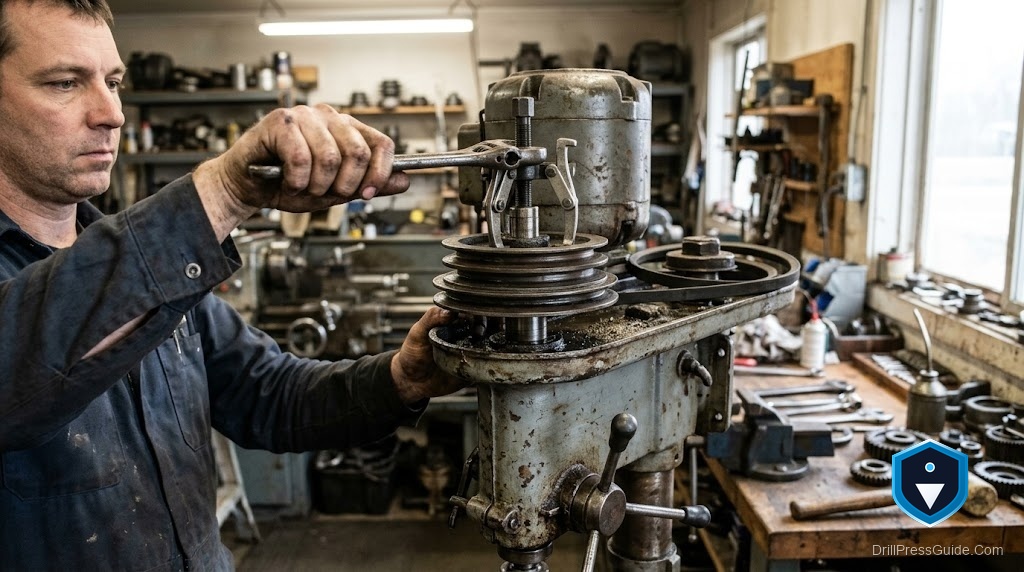
The spindle pulley is the stepped cone mounted at the top of the spindle or quill assembly, driven by the belt to turn the spindle. It is fixed to its shaft by a set screw on a flat, a key in a keyway, or occasionally a press fit, depending on the press.
The direct answer: with the press unplugged and the belt off, identify how the spindle pulley is retained (set screw, key, or press fit), release that retention, and draw the pulley off with a puller rather than prying. Support the spindle so you are not driving loads through the bearings.
Identify how it is held on
With the press unplugged and belt removed:
- Look for a set screw on the pulley hub, seated on a flat on the shaft. Back it out fully.
- Look for a key and keyway. A key must be freed before the pulley will slide.
- Suspect a press fit if there is no screw or key. This needs a puller and patience, never prying.
Also note whether the pulley is part of the spindle drive assembly, since on some presses lifting it involves the whole quill.
Removing the pulley
- Unplug the press and remove the belt.
- Back out the set screw or free the key.
- Fit a gear and pulley puller on the pulley and draw it up the shaft evenly. Support the spindle so the load does not pass through the bearings.
- Clean the shaft, flat, or keyway once the pulley is off.
If you are removing the pulley to reach worn spindle bearings, or to fit a machined drill press step pulley in place of a cracked die cast one, have those parts ready before you start.
Where people go wrong
The first mistake is prying the pulley off with screwdrivers, which cracks a die cast pulley and scores the shaft. The second is pulling without supporting the spindle, driving the removal load straight through the bearings and damaging them. The third is missing a hidden key or a second set screw, then wondering why the pulley will not move.
The verdict
Spindle pulley removal is a quick job once you know how the pulley is held on. Unplug the press, find the set screw, key, or press fit, release it, and draw the pulley off with a puller while supporting the spindle. Never pry, and never send the load through the bearings. Get the pulley off cleanly and whatever brought you here, a cracked pulley or worn bearings, is now within easy reach.
Three takeaways:
- Identify set screw, key, or press fit before pulling.
- Use a puller, never pry on the pulley or steps.
- Support the spindle so the load bypasses the bearings.
FAQ
How is a spindle pulley held on? Usually a set screw on a flat, a key in a keyway, or occasionally a press fit. Identify which before trying to remove it.
How do I remove a stuck spindle pulley? Release the set screw or key, then draw the pulley off with a gear or pulley puller while supporting the spindle. Do not pry it.
Why not just pry it off? Prying cracks die cast pulleys and scores the shaft. A puller draws the pulley off evenly without damage.
Why support the spindle during removal? So the pulling load does not pass through the spindle bearings, which can damage them. Back up the spindle as you pull.
Why won’t the pulley move after I loosened the screw? There may be a key, a second set screw, or a press fit. Recheck for all retention before applying more force.
Do I need to remove the belt first? Yes. Remove the belt so the pulley is free and nothing is under tension while you work.
Can I reach the spindle bearings this way? Often yes. Removing the spindle pulley is commonly the first step to reach worn spindle bearings for replacement.
References
- The Engineering ToolBox, Belts: Pulley Diameters vs. Speed. https://www.engineeringtoolbox.com/pulley-diameters-speeds-d_1620.html
- Occupational Safety and Health Administration, Woodworking eTool: Drill Presses. https://www.osha.gov/etools/woodworking/production/machines-tools/drill-press