
Getting Drill Press Depth Stop Upgrade Right: Fit, Tools, and Final Checks
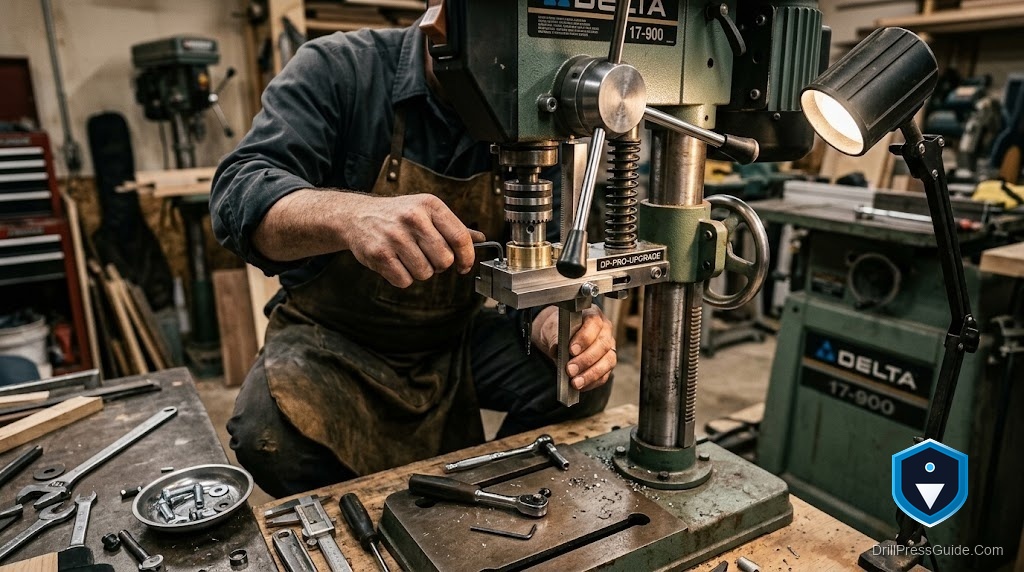
The factory depth stop on many presses is a single threaded rod with a pair of nuts you spin up and down, and it works until you need to drill fifty holes to exactly the same depth and the nuts creep. A drill press depth stop upgrade replaces that fiddly setup with something that locks positively and reads clearly, and it is one of those small changes that makes repeat work genuinely pleasant. Getting it right is about matching the upgrade to how your quill and depth mechanism are built, since presses vary more here than people expect.
A depth stop sets how far the quill can travel, so the bit stops at a consistent depth. An upgrade swaps the basic threaded rod and nuts for a positive locking collar, a graduated scale, or a quick set stop that holds without creeping under vibration.
The direct answer: identify whether your press uses a threaded rod with nuts, a rack style depth pointer, or a quill collar stop, then match an upgrade to that mechanism. The goal is a stop that locks positively and repeats, so match the thread or collar size to your machine before buying.
Know your depth mechanism first
With the press unplugged, look at how depth is currently set:
- Threaded rod with jam nuts. Two nuts on a rod beside the quill. The common upgrade is a better locking nut or a quick set stop on the same rod.
- Rack and pointer scale. A pointer moving over a scale. Upgrades here focus on a positive locking knob rather than a friction pointer.
- Quill collar stop. A collar on the quill itself. A machined replacement collar with a positive lock is the upgrade.
Matching the upgrade to your mechanism matters more than the brand of the part.
Match the part
Read the model number off the ID label and measure the relevant parts: the rod thread pitch and diameter for a rod type, or the collar bore for a collar type. A drill press depth stop upgrade needs to match that thread or bore to lock in place. If your current setup only creeps because the nuts loosen, a set of quality jam nuts and lock nuts sized to the rod may fix the repeatability without a full upgrade.
Fitting the upgrade
- Unplug the press.
- Note or photograph how the current stop is set and assembled.
- Remove the factory nuts, collar, or pointer stop.
- Fit the upgrade, threading or clamping it to match the original.
- Set a test depth and lock it.
- Drill several test holes and measure each. A good upgrade holds the same depth hole after hole without creeping.
Where people go wrong
The first mistake is buying an upgrade that does not match the thread pitch or collar bore, so it will not seat or lock. The second is expecting an upgrade to fix a worn quill; if the quill itself is loose, the depth will wander no matter how good the stop is. The third is over tightening a locking collar onto the quill and binding its travel.
The verdict
A depth stop upgrade is a small change with a big payoff for repeat drilling. Identify your mechanism first, match the thread or collar size, and choose an upgrade that locks positively rather than relying on friction. If creeping nuts were the only issue, quality lock nuts may be all you need. Set a depth, drill a few test holes, and confirm it repeats. Do that and every hole in the batch lands at the same depth without a second thought.
Three takeaways:
- Match the upgrade to your rod, rack, or collar mechanism.
- Match thread pitch or collar bore so it seats and locks.
- Confirm repeatability with test holes before trusting it.
FAQ
What does a depth stop upgrade do? It replaces a basic threaded rod and nuts with a positive locking stop that holds depth without creeping, so repeat holes land at the same depth.
How do I know which upgrade fits my press? Identify whether your press uses a threaded rod with nuts, a rack and pointer, or a quill collar stop, then match the upgrade and its thread or bore size to that mechanism.
Why does my depth stop creep? Usually jam nuts loosening under vibration. Quality lock nuts sized to the rod, or a positive locking upgrade, stop the creep.
Will an upgrade fix wandering depth from a loose quill? No. A worn or loose quill lets depth wander regardless of the stop. Address the quill first, then the stop.
Do I need to match the thread pitch? Yes, for rod type stops. The upgrade must match the rod’s thread pitch and diameter, or the collar bore for collar types, to seat and lock.
Can I just replace the nuts? Often yes. If creeping nuts are the only problem, quality jam and lock nuts restore repeatability without a full upgrade.
How do I test it? Set a depth, lock the stop, and drill several test holes. Measure each. A good stop repeats the same depth hole after hole.
References
- West Virginia University EHS, Drill Press Safety. https://www.ehs.wvu.edu/files/d/468960e4-730d-4a60-98ea-58ee020f4ab8/drill-press-safety.pdf
- Occupational Safety and Health Administration, Woodworking eTool: Drill Presses. https://www.osha.gov/etools/woodworking/production/machines-tools/drill-press


