Drill Press Spindle Replacement: The Checks That Prevent a Bad Repair
The spindle is the shaft that carries the chuck and delivers every bit of the motor’s turning to your bit. When it wears, the symptoms are the ones that make a press feel worn out: runout that no chuck swap fixes, a rumble that grows with speed, or a little side play that turns crisp holes into oval ones. A drill press spindle replacement brings the accuracy back, and the checks up front are what keep you from replacing a shaft when the bearings or arbor were the real problem.
The spindle is the shaft inside the quill that holds the chuck arbor at its nose and rides on bearings, driven at the top by the pulley. It works as a set with the quill and bearings, which is exactly why diagnosis matters before you buy.
The direct answer: confirm the fault is the spindle itself, not the bearings, the arbor, or the chuck, then match a spindle (often sold as a spindle and quill assembly) to your exact model. A quick indicator check separates these causes and saves you from an unneeded part.
The checks before you buy
With the press unplugged, run through these in order:
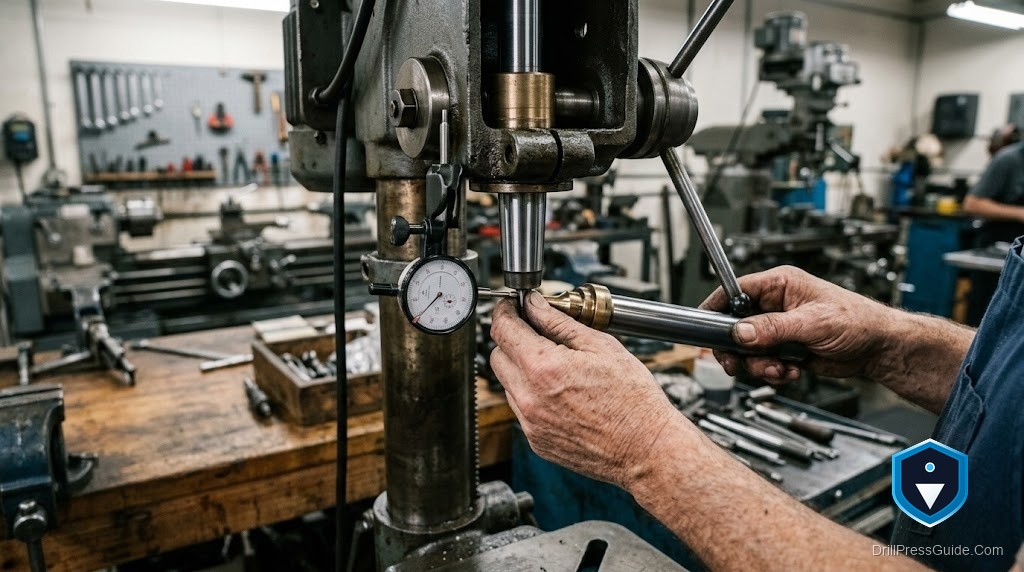
- Chuck a straight pin and indicate it. Runout that follows the chuck points at the chuck or arbor, not the spindle.
- Remove the chuck and indicate the spindle nose. Runout here, with the chuck gone, points at the spindle or its seat.
- Listen and feel for a speed related rumble. That is usually bearings, not the shaft.
- Rock the quill for side play. Play here is bearings or the quill fit, again not the shaft itself.
Use a dial indicator so you are measuring, not guessing.
Match the part
Read the model number, serial number, and manufacture date off the ID label. Spindles are model specific in length, taper, and bearing seats. The practical part to buy is often a drill press spindle and quill assembly, which arrives as a matched unit so you avoid pressing a spindle into a bare quill. If the checks pointed at bearings instead, spindle bearings by number are the smaller repair.
The replacement, step by step
- Unplug the press.
- Remove the chuck and arbor from the spindle nose.
- Relieve and remove the quill return spring under control.
- Remove the quill lock and depth stop hardware, then slide the quill and spindle out of the head.
- Press the old spindle and bearings out, supporting the casting so nothing cracks.
- Press in the new spindle and bearings, driving only on the correct race.
- Reassemble, rewind the return spring, refit the chuck, and indicate the runout.
Where people go wrong
The first mistake is buying a spindle when only the bearings were rumbling, which spends more and is harder to fit than a bearing swap. The second is fighting the return spring without controlling its stored tension. The third is pressing on the wrong bearing race during reassembly, which installs fresh runout into a new spindle.
The verdict
Spindle replacement is a solid repair when the shaft is truly worn, but it is not the first thing to reach for. Indicate the chuck, then the bare spindle nose, and decide whether bearings alone will fix the rumble. When the spindle really is the fault, a matched spindle and quill assembly is the simplest route. Respect the return spring, support the casting, press on the correct race, and indicate the result. Diagnose first and the press comes back quiet and true without an unneeded part on the shelf.
Three takeaways:
- Indicate the bare spindle nose to separate it from chuck and arbor faults.
- Bearings often fix a rumble that looks like a bad spindle.
- A matched spindle and quill assembly is the simplest buy.
FAQ
How do I know the spindle needs replacing? Runout that persists with the chuck removed and the spindle turned, or a scored, bent, or worn shaft, points at the spindle. A speed related rumble is usually bearings instead.
Should I replace the spindle or just the bearings? Often just the bearings. Replace the spindle only when the shaft itself is scored, bent, or worn at the bearing seats.
How do I find the right spindle for my press? Match by model and serial number. Spindles are specific in length, taper, and bearing seats, so a matched assembly is safest.
Why are my holes oval with a new chuck? The runout may be in the spindle or worn bearings, not the chuck. Indicate the bare spindle nose to find the source.
Can I press the spindle in at home? Yes, with an arbor press or bearing drivers, while supporting the casting. Press only on the correct race to protect the bearings.
Is the return spring involved? Yes. You must relieve and remove it to pull the spindle, so control its tension and wear eye protection.
How true should it run afterward? A few thousandths of runout is normal on a home machine. A visible wobble means a part is not seated or is still worn.
References
- Zoro Resource Hub, Morse vs. Jacobs Tapers. https://www.zoro.com/resourcehub/what-are-the-dimensions-and-angles-of-morse-tapers-and-jacobs-tapers/
- Occupational Safety and Health Administration, Woodworking eTool: Drill Presses. https://www.osha.gov/etools/woodworking/production/machines-tools/drill-press