
A Practical Guide to Drill Press Rack Replacement
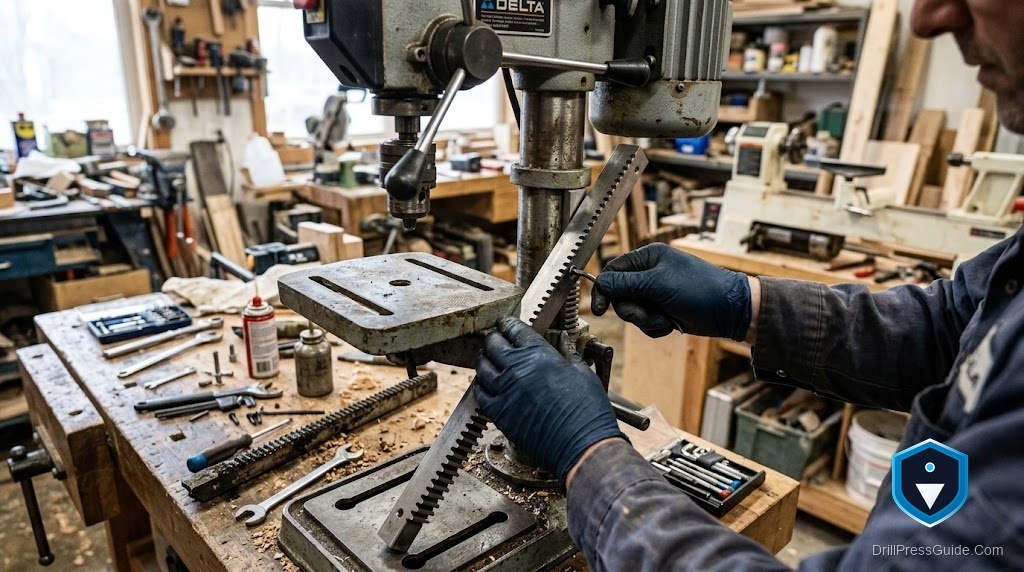
The rack is the toothed strip that lets the table crank up and down the column, and it is easy to forget it exists until it strips. Then the crank spins freely, the table sags, and raising it becomes a two handed shove. A drill press rack replacement restores that smooth, geared height adjustment, and the part that catches people out is not fitting the rack but understanding how it is held captive on the column by the collar and bracket.
The rack is a curved gear strip that wraps the column, held in place by a rack collar (a split ring) so it cannot slide off, while the pinion in the crank or table bracket meshes with its teeth to raise the table.
The direct answer: confirm the rack teeth are actually stripped rather than the pinion, then match a rack to your column diameter and length, and note how your collar retains it. Rack and pinion wear together, so inspect both before ordering just one.
Check the rack and the pinion together
With the press unplugged:
- Look at the rack teeth. Rounded, chipped, or flattened teeth mean a worn rack.
- Look at the pinion teeth in the crank or bracket. If the pinion is also chewed, replacing only the rack leaves you with a fresh rack meshing a worn pinion, which strips again.
- Check the collar. The rack collar keeps the rack captive on the column. A worn or missing collar can let the rack drift even if its teeth are fine.
Match the part
Read the model number, serial number, and manufacture date off the ID label. Racks are specific to column diameter, tooth pitch, and length. Measure your column’s outside diameter, since the rack wraps it. A matching drill press rack and pinion set is often the wiser buy than a rack alone, because the mating teeth are then fresh together. If the collar is the fault, a drill press rack collar sized to your column restores retention.
The replacement, step by step
- Unplug the press.
- Remove the table and its bracket from the column.
- Loosen or remove the rack collar that holds the rack captive.
- Slide the old rack off the column.
- Fit the new rack, seating it in the collar so it stays captive and the teeth face the pinion.
- Refit the table bracket so the pinion meshes the rack cleanly.
- Crank the table through full travel to confirm smooth, positive motion with no skipping.
Where people go wrong
The first mistake is replacing the rack while ignoring a worn pinion, so the new rack strips against old teeth. The second is ordering a rack without matching the column diameter and tooth pitch, so it will not seat or mesh. The third is losing track of the collar, which keeps the rack captive, and ending up with a rack that slides off the column.
The verdict
A rack replacement brings back the geared table adjustment that makes a drill press pleasant to use. Inspect the rack and pinion together, match the rack to your column diameter and tooth pitch, and pay attention to the collar that retains it. Replacing rack and pinion as a set is the surest path to teeth that mesh cleanly for years. Skip the pinion check and you will be back under the table when the new rack strips.
Three takeaways:
- Inspect the pinion too, since rack and pinion wear together.
- Match the rack to column diameter, pitch, and length.
- Mind the collar that keeps the rack captive on the column.
FAQ
What does the rack on a drill press do? The rack is the toothed strip on the column that the pinion meshes with to raise and lower the table. A collar holds it captive on the column.
How do I know the rack is stripped? The crank spins without raising the table, and the rack teeth look rounded, chipped, or flattened. Check the pinion teeth too.
Should I replace the rack and pinion together? Usually yes. They wear together, so a fresh rack meshing a worn pinion strips again. A matched set gives clean teeth on both.
How do I match a replacement rack? Measure the column’s outside diameter and note the tooth pitch and length, then match your exact model. The rack wraps the column, so diameter is critical.
What is the rack collar for? It keeps the rack captive on the column so it cannot slide off. A worn or missing collar lets the rack drift even with good teeth.
Why does my new rack skip? Usually a worn pinion meshing the new teeth, or the rack not seated correctly in the collar. Check both.
Where do I find my model number? On the ID label, usually on the head casting or column, with the serial and manufacture date.
References
- West Virginia University EHS, Drill Press Safety. https://www.ehs.wvu.edu/files/d/468960e4-730d-4a60-98ea-58ee020f4ab8/drill-press-safety.pdf
- Occupational Safety and Health Administration, Woodworking eTool: Drill Presses. https://www.osha.gov/etools/woodworking/production/machines-tools/drill-press


