Drill Press Crank Handle Replacement: Diagnose the Fit Before Replacing Anything
The table crank is the handle you use more than any other on the press, and it fails in slow motion. First it gets a little loose on the shaft, then it slips under load, and one day you crank and the table does not move at all. A drill press crank handle replacement is a quick repair, but the part that trips people up is not the handle itself. It is figuring out whether the handle is the problem or just the messenger for a stripped shaft or a chewed pinion underneath it.
The crank handle raises and lowers the table by turning a pinion that meshes with the rack on the column. The handle clamps or pins to that pinion shaft, usually with a set screw, a roll pin, or a keyed flat.
The direct answer: confirm whether the handle, the shaft, or the pinion is worn before ordering, then match the replacement to your exact model and shaft size. A handle that fits the shaft but turns a stripped pinion will feel fixed for a day and then slip again.
Find where the slip really lives
With the press unplugged, work through this in order:
- Handle loose on the shaft. Wiggle the handle. If it rocks on the shaft while the shaft stays put, the handle bore or its set screw is worn. This is the easy case.
- Handle turns but the table does not rise. The pinion teeth or the rack teeth are stripped. A new handle will not help here.
- Grinding as you crank. Debris in the rack or a bent shaft. Clean and inspect before buying anything.
Match the part to your model
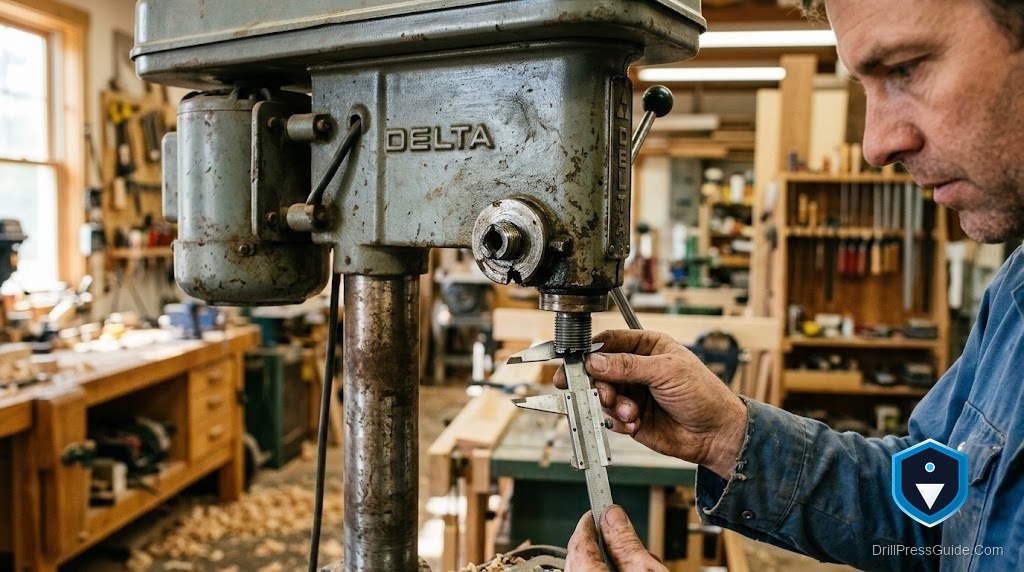
Read the model number, serial number, and manufacture date off the ID label. Crank handles vary in shaft bore diameter and in how they attach, so match the exact model where you can. A universal drill press crank handle works when it matches your shaft diameter and locking style, which is why measuring the shaft first saves a return. If the set screw stripped the flat on the shaft, a fresh set of machine handle set screws and knobs may be all you need.
The swap
- Unplug the press.
- Loosen the set screw or drive out the roll pin holding the handle to the shaft.
- Pull the handle off. If it is seized, work penetrating oil into the joint and rock it free.
- Clean the shaft and check the flat or keyway.
- Slide the new handle on, align it to the flat, and lock the set screw or reinstall the pin.
- Crank through the full travel to confirm smooth, positive motion with no slip.
Where people go wrong
The first mistake is replacing the handle when the pinion or rack teeth were stripped, so the new handle slips just as fast. The second is buying a universal handle without measuring the shaft bore, then finding it will not seat. The third is over tightening a set screw onto a rounded flat, which strips the shaft further instead of gripping it.
The verdict
A crank handle swap is one of the friendliest repairs on the machine, as long as you confirm the handle is the actual fault first. Check for a stripped pinion or rack before you buy, measure the shaft bore, and match the model or a universal handle to it. Lock it to a clean flat and you get years of positive cranking again. Skip the diagnosis and you will be back under the table next weekend.
Three takeaways:
- Confirm the handle is the fault, not a stripped pinion or rack.
- Measure the shaft bore before buying a universal handle.
- Lock the handle to a clean flat, not a rounded one.
FAQ
Why does my drill press crank handle slip? Either the handle is worn on its shaft, or the pinion and rack teeth it drives are stripped. Wiggle the handle to see whether it rocks on the shaft or the shaft turns without raising the table.
How do I remove a drill press crank handle? Unplug the press, loosen the set screw or drive out the roll pin, and pull the handle off the pinion shaft. Penetrating oil helps if it is seized.
Can I use a universal crank handle? Yes, if it matches your shaft bore diameter and locking method. Measure the shaft before ordering.
My new handle still slips. What did I miss? Usually the pinion or rack teeth are worn, not the handle. Inspect those teeth, because a fresh handle cannot fix a stripped gear.
Where do I find my model number? On the ID label, usually on the head casting or column, along with the serial and manufacture date.
How is the handle attached to the shaft? Commonly by a set screw onto a flat, a roll pin, or a keyway. Check yours before buying so the replacement matches.
Why won’t the set screw hold? The flat on the shaft may be rounded from a loose screw. A rounded flat needs dressing or a new shaft, since more torque only rounds it further.
References
- West Virginia University EHS, Drill Press Safety. https://www.ehs.wvu.edu/files/d/468960e4-730d-4a60-98ea-58ee020f4ab8/drill-press-safety.pdf
- Occupational Safety and Health Administration, Woodworking eTool: Drill Presses. https://www.osha.gov/etools/woodworking/production/machines-tools/drill-press