
Buffalo Drill Press: Vintage Models, Parts, and What Owners Should Know
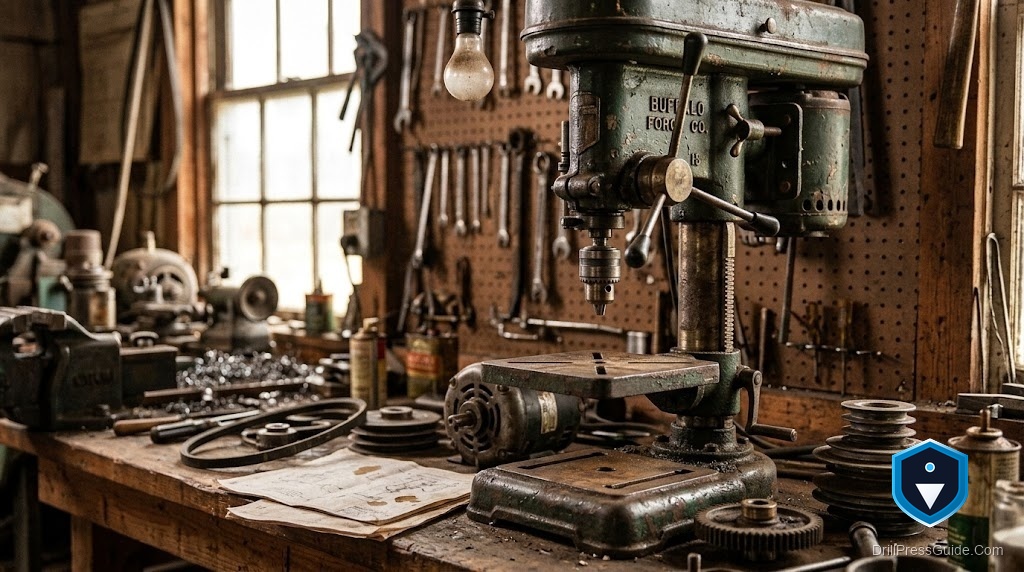
A Buffalo drill press is the kind of machine that outlives its owner. Buffalo Forge Company built industrial drills in Buffalo, New York for generations, and the ones still turning today are a testament to how they were made: heavy, simple, and endlessly repairable. If you have inherited one, bought one at auction, or are eyeing one in a shop, the good news is that these machines are worth keeping and that support still exists. The trick is knowing which model you have, understanding what makes these presses different, and knowing where parts and manuals come from. Here is what owners should know.
A Buffalo drill press is an industrial drilling machine originally built by Buffalo Forge Company of Buffalo, New York, spanning bench and floor models (such as the No. 15, No. 18, No. 21, and No. 22 camelback) with cast-iron construction, Morse-taper spindles, and belt or power-feed drives, still supported through Buffalo Machines Inc. and vintage-machinery resources.
Short answer: identify your Buffalo by model number (No. 15, No. 18, No. 21, No. 22, and others), understand it is a heavy vintage industrial machine with a Morse-taper spindle and often a power feed, and source parts and manuals through Buffalo Machines Inc. (bmt-usa.com) and VintageMachinery.org. These are excellent machines to restore and keep. Here is the detail.
The history and the models
Buffalo Forge Company built blacksmith equipment, blowers, and drilling machines, and its drill presses became shop staples. The line lives on: the drilling-machine business continues today as Buffalo Machines Inc. (bmt-usa.com), which is genuinely useful for owners because it means an active source of support. Common vintage models include:
- No. 15: A 15-inch bench drill, commonly around 1/3 HP, with a Morse-taper spindle. A frequently found size.
- No. 18: A larger machine with an MT3 spindle.
- No. 21 and No. 22: Heavier presses. The No. 22 is a camelback-style drill with a large drilling capacity (into the 1.5-inch range), a power feed, and a heavy column.
Buffalo presses commonly use a splined spindle (a 6-spline design on many models) and run at industrial speed ranges. The camelback machines, with their distinctive curved frame, are the classic heavy Buffalo look.
What makes a Buffalo different
- Weight and rigidity: These are cast-iron industrial machines, far heavier and more rigid than any benchtop press.
- Morse-taper spindles: MT2, MT3, and larger depending on model, so tooling is the industry-standard Morse taper.
- Power feed on larger models: The bigger Buffalos can feed the quill automatically, a production feature.
- Splined spindles: Many use a splined drive, which affects how the spindle and quill are serviced.
Parts and support
This is where Buffalo ownership is better than most vintage brands. Because the drilling-machine line continues as Buffalo Machines Inc., parts and support are still available through bmt-usa.com, an active source rather than only a scrapyard hunt. For manuals, specifications, and parts diagrams, VintageMachinery.org hosts Buffalo Forge documentation. Between the two, most owners can identify their model, get a manual, and source or fabricate the wear parts (belts, chucks, spindle bearings). Generic V-belts and Morse-taper chucks cover common needs; splined-spindle and power-feed parts are the model-specific items to source carefully.
What owners should check
- Model and serial number: Find the casting number or plate; it drives everything.
- Spindle and splines: Check runout and the condition of the splined drive; wear here is a bigger job.
- Power feed (if equipped): Confirm it engages and disengages cleanly.
- Bearings: Listen for rumble; industrial bearings are serviceable but model-specific.
- Motor and phase: Many are three-phase; confirm you can power it or plan a VFD.
- Belt: Aged belts are a given; match the size to your model.
The honest trade-offs
Weight and installation. These are heavy floor machines. Moving and placing one is a real project.
Three-phase power. Many need a converter or VFD for a home shop.
Model-specific parts. Splined spindles and power feeds need careful sourcing; generic parts only go so far.
Vintage condition. As-is machines vary; inspect thoroughly before committing.
How it compares
Against a modern floor press like the JET JDP-17MF or the Delta 17-900, a Buffalo trades modern convenience (variable speed, easy retail parts, single-phase power) for industrial mass, a power feed, and a machine that can be rebuilt indefinitely. If you want plug-and-play, buy new. If you want a heirloom industrial drill and enjoy keeping one running, a Buffalo is a superb choice, and one of the better-supported vintage brands thanks to Buffalo Machines Inc. Other prized vintage names in this class include Walker Turner and Atlas.
The verdict
A Buffalo drill press is a heavy, rebuildable vintage industrial machine that rewards owners who take the time to identify their model and understand what they have. Pin down the model number (No. 15, No. 18, No. 21, No. 22, or another), respect it as a Morse-taper industrial press often with a power feed and three-phase motor, and lean on Buffalo Machines Inc. and VintageMachinery.org for parts and manuals. The trade-offs are weight, power requirements, and model-specific parts, but few brands are better supported for their age. If you want a keep-forever floor drill and enjoy restoration, a Buffalo is hard to beat.
Frequently asked questions
Who made Buffalo drill presses? Buffalo Forge Company of Buffalo, New York, originally built them. The drilling-machine line continues today as Buffalo Machines Inc. (bmt-usa.com), which still supports the machines.
What are the common Buffalo drill press models? The No. 15 (15-inch bench), the No. 18 (with an MT3 spindle), and the heavier No. 21 and No. 22, the latter a camelback machine with a large drilling capacity and a power feed. Others exist across the range.
Can you still get parts for a Buffalo drill press? Often yes. Buffalo Machines Inc. (bmt-usa.com) continues the line and supports the machines, and VintageMachinery.org hosts manuals and diagrams. Generic belts and Morse-taper chucks cover common needs; splined and power-feed parts are model-specific.
Are Buffalo drill presses three-phase? Many industrial Buffalos are three-phase. Confirm the motor on your machine; a single-phase shop will need a phase converter or variable-frequency drive to run a three-phase unit.
What is a Buffalo camelback drill press? A heavy Buffalo press, such as the No. 22, with a distinctive curved cast-iron frame, a large drilling capacity, a power feed, and a heavy column, built for industrial work.
How do I identify my Buffalo drill press? Find the model and serial or casting numbers on the frame or ID plate, then match them to Buffalo Machines Inc. documentation or VintageMachinery.org listings for specifications and parts.
Are Buffalo drill presses worth restoring? Generally yes. They are heavy, rigid, rebuildable industrial machines, and among the better-supported vintage brands thanks to the continuing Buffalo Machines Inc. line.
References
- Buffalo Machines Inc., current Buffalo drilling machines and support: https://www.bmt-usa.com
- VintageMachinery.org, Buffalo Forge drill press manuals and diagrams: https://vintagemachinery.org
- Practical Machinist, vintage industrial drill press discussion: https://www.practicalmachinist.com


