
Drill Press Quill Return Spring Replacement: The Checks That Prevent a Bad Repair
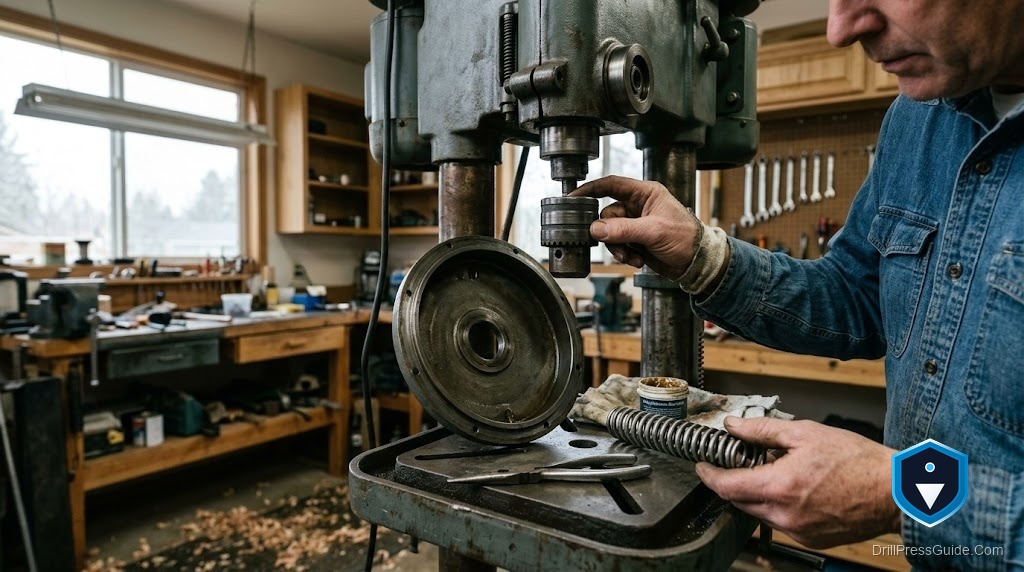
The day the return spring breaks, you know instantly. You pull the feed handle down, drill your hole, let go, and the quill just hangs there instead of snapping back up. Suddenly you are lifting the spindle by hand between every hole. A drill press quill return spring replacement fixes it in under an hour, but the spring is under real tension, and the people who rush it end up with a snapped coil across the shop or a knuckle full of spring steel. This is a repair that rewards a calm, deliberate hand.
The quill return spring is a flat, coiled clock spring (spiral spring) housed at the side of the head. It is wound under tension so that when you release the feed handle, it pulls the quill back up to its rest position. When it fatigues and snaps, the quill stops returning.1
The direct answer: identify your model, buy the matching spring assembly, and unwind the old spring’s tension in a controlled way before removing it, then install and rewind the new one to set return force. Never let a wound spring release on its own, and wear eye protection.
First, confirm it is the spring
A quill that will not return is almost always the spring, but rule out the simple cousins:
- Gummed up quill. Old grease and sawdust can make the quill sticky enough to hang. Clean and lightly lubricate the quill bore first.
- Loose or slipped spring. Sometimes the spring is intact but its end popped off the retaining pin, so it just needs re engaging and re tensioning, not replacing.
- Broken spring. If you can see the coil is snapped, it is replacement time.
Match the part to your machine
Springs and their housings are model specific. Read the model number, serial number, and manufacture date off the ID label, and match the spring assembly. Many 15 to 17 inch presses share a common style of drill press quill return spring that includes the housing and coil as one unit, which is the easier part to install than a bare coil you must thread yourself. Confirm the size and the mount before buying.
The replacement, done safely
- Unplug the press.
- Note the spring housing’s current rotational position. Mark it, so you know roughly how much tension to restore.
- Relieve the tension. Loosen the jam nuts or retaining cap while holding the housing, and let it rotate slowly to unwind. Control it the whole way. This is the step that hurts people who let it spin free.
- Disengage the spring end from its pin and remove the old housing.
- Fit the new spring assembly, engaging the spring end on the pin.
- Rewind to set tension. Rotate the housing in the winding direction the number of turns your machine needs (often a notch or two past neutral), then secure the jam nuts or cap.
- Test: the quill should return smartly on its own without slamming. Too little tension and it hangs, too much and it snaps up hard and makes fine feeding difficult. Adjust by a notch if needed.
Tools worth having
- Eye protection, non negotiable for spring work.
- A pair of locking pliers or vise grips to hold the housing while you wind, which several repair guides recommend for control.
- A cordless work light so you can see the spring pin clearly while engaging it.
Where people go wrong
The first and most dangerous mistake is releasing the wound spring without controlling it, which sends spring steel flying. The second is buying a bare coil when a housed assembly would have been far easier to fit. The third is over tensioning on reassembly, which makes the quill snap up so hard that precise feeding becomes a fight.
The verdict
A return spring swap is an hour of careful work, not a wrestling match. Confirm the spring is truly the fault, buy a housed assembly matched to your model, and treat the wound tension with respect on the way out and the way in. Set the return force so the quill comes back smartly but not violently. Done calmly, the press feels new again, and you keep all ten fingers.
Three takeaways:
- Rule out a gummed quill or a slipped spring end before buying.
- Control the tension on removal, and wear eye protection.
- Rewind to a smart, not violent, return, adjusting a notch at a time.
FAQ
How do I know my quill return spring is broken? The quill no longer returns to the top on its own after you release the feed handle. First rule out a gummed quill or a spring end that slipped off its pin.
Is replacing the return spring dangerous? It can be, because the spring is under tension and can snap loose. Control the housing as you unwind it and wear eye protection. Done carefully it is safe.
Should I buy a bare spring or a housed assembly? A housed assembly that includes the coil and housing is much easier to install than threading a bare coil. Match it to your model.
How much should I wind the new spring? Enough that the quill returns smartly on its own without slamming up. Start near the old setting, then adjust a notch at a time.
How do I find the right spring for my press? Match by model and serial number. Many 15 to 17 inch presses use a common housed spring style, but confirm the size and mount for yours.
Why does my quill snap up too hard after the repair? Too much spring tension. Back off the winding by a notch so fine feeding is comfortable again.
Can I just clean the quill instead of replacing the spring? If the spring is intact and the quill was only sticky from old grease, cleaning and light lubrication may fix it. Replace the spring only if it is broken or fatigued.
References
- iFixit, How to adjust a drill press quill spring. https://www.ifixit.com/Guide/How+to+adjust+the+Kinzo+8E116+quill+spring/186701
- Occupational Safety and Health Administration, Woodworking eTool: Drill Presses. https://www.osha.gov/etools/woodworking/production/machines-tools/drill-press
Footnotes
-
iFixit, drill press quill spring adjustment guide. ↩


