
A Practical Guide to Delta Drill Press Spindle Replacement
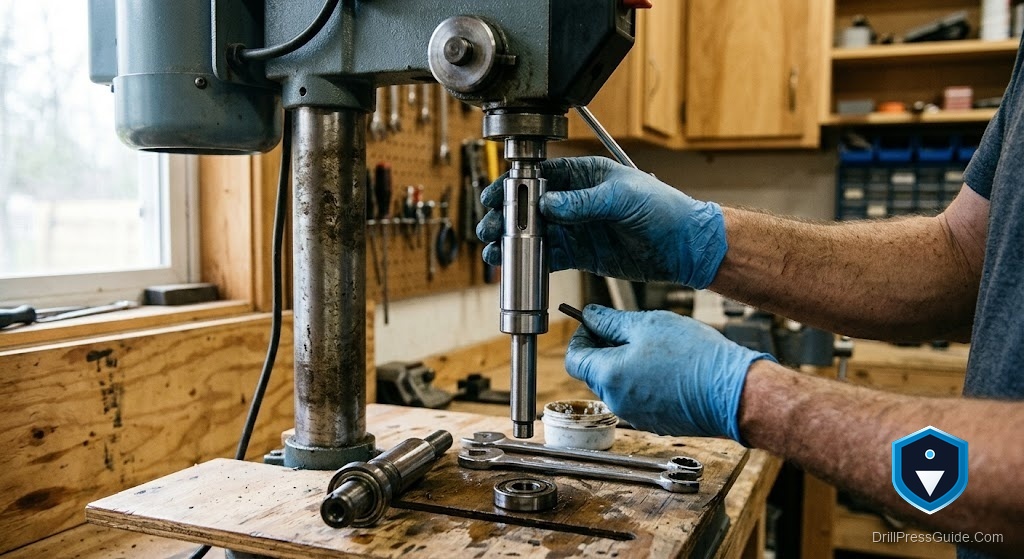
A spindle usually tells you it is failing long before it quits. There is a new rumble at high speed, a bit of side play when you tug the chuck, or holes that come out slightly oval no matter how carefully you clamp. By the time you are searching for a Delta drill press spindle replacement, the quill and bearings have probably been complaining for a while. The good news: this is a repair a patient owner can do at the bench. The catch: the spindle, quill, and bearings work as a set, so you have to know which part is actually worn before you order.
A spindle replacement means removing the spindle (the shaft that carries the chuck and rides inside the quill) and fitting a new one, often along with its bearings and return spring. On Delta presses the spindle lives inside the quill, which slides in the head casting, driven at the top by the pulley.
The direct answer: identify your exact Delta model, confirm whether the fault is the spindle, the bearings, or the quill, and buy the matching assembly. Guess wrong and you will have the head apart twice.
Find the model before anything else
Delta reused names across decades and factories, so the ID label is your first stop. Note the model number, serial number, and manufacture date from the label on the head or column. A parts diagram (an exploded view) for your exact model is worth finding, because the spindle, quill, and bearing part numbers differ between a vintage floor Delta and a recent benchtop unit.
Diagnose the real fault
Before ordering a spindle, figure out what is worn:
- Runout that follows the chuck points at the chuck or arbor, not the spindle.
- Side play in the quill (you can rock the chuck sideways) points at worn quill bearings or a worn quill bore.
- Rumble or grinding that changes with speed points at the spindle bearings.
- A spindle that will not return is usually the return spring, not the spindle itself.
Chuck a straight pin and run a dial indicator to separate chuck runout from spindle runout. This ten minute check decides whether you need a whole spindle or just bearings.
What you may need to buy
- A replacement drill press spindle and quill assembly for your model, if the shaft or quill is the problem.
- Drill press spindle bearings if only the bearings rumble.
- A quill return spring if the quill no longer retracts.
Matching the assembly to your model matters more than brand here, because the quill diameter and spindle length are model specific.
The teardown, in order
- Unplug the press.
- Remove the chuck and arbor from the spindle nose using a taper drift through the spindle slot.
- Release and carefully unwind the quill return spring. This part is under tension, so control it or it will bite. (There is a full spring guide worth reading if yours is broken.)
- Remove the quill lock and the depth stop hardware.
- Slide the quill and spindle down and out of the head casting.
- Press out the old bearings and spindle, then press in the new set. Support the casting so you do not crack it.
- Reassemble in reverse, rewind the spring to set return tension, and reinstall the chuck.
- Indicate the runout before you cut anything.
Where people go wrong
The biggest mistake is ordering a spindle when only the bearings were bad, which wastes effort and is harder to fit. The second is fighting the return spring without respecting its tension, which is how knuckles get hurt. The third is skipping the model lookup and receiving a spindle that is the wrong length or quill diameter.
The verdict
A Delta spindle replacement is within reach if you slow down and diagnose. Separate chuck runout from spindle runout, decide whether bearings alone will fix it, and match any assembly to your exact model using the ID label and an exploded view. Respect the return spring, support the casting during any pressing, and indicate the result. Done in that order, the press comes back quieter and truer than it has been in years.
Three takeaways:
- The ID label and an exploded view come before any purchase.
- Indicate a straight pin to tell chuck, spindle, and bearing faults apart.
- Bearings alone often fix the rumble, so do not overbuy a full spindle.
FAQ
How do I know if my drill press spindle needs replacing? If you feel side play or hear a speed related rumble, and a runout check shows the wobble comes from the spindle rather than the chuck, the spindle or its bearings are worn. A spindle that will not return is usually the spring, not the shaft.
Do I need to replace the whole spindle or just the bearings? Often just the bearings. Replace the full spindle only if the shaft itself is scored, bent, or worn at the bearing seats.
How do I find the right part for my Delta model? Read the model and serial number from the ID label, then match the spindle, quill, or bearings using an exploded parts diagram for that exact model.
Is the return spring dangerous to remove? It is under tension and can snap loose, so control it during removal and wear eye protection. Unwind it deliberately rather than letting it release on its own.
Why are my holes oval even with a new chuck? The runout may come from worn quill bearings or a worn quill bore. Indicate the spindle to confirm before replacing more parts.
Can I press bearings in at home? Yes, with an arbor press or careful use of sockets as drivers, while supporting the casting so it does not crack. Press on the correct race to avoid damaging the new bearing.
How much runout is acceptable after the repair? A few thousandths of an inch is normal on a home machine. A visible wobble means something is not seated or a part is still worn.
References
- The Engineering ToolBox, Belts: Pulley Diameters vs. Speed. https://www.engineeringtoolbox.com/pulley-diameters-speeds-d_1620.html
- Occupational Safety and Health Administration, Woodworking eTool: Drill Presses. https://www.osha.gov/etools/woodworking/production/machines-tools/drill-press


