
A Closer Look at the Bosch PBD 40 Benchtop Drill Press
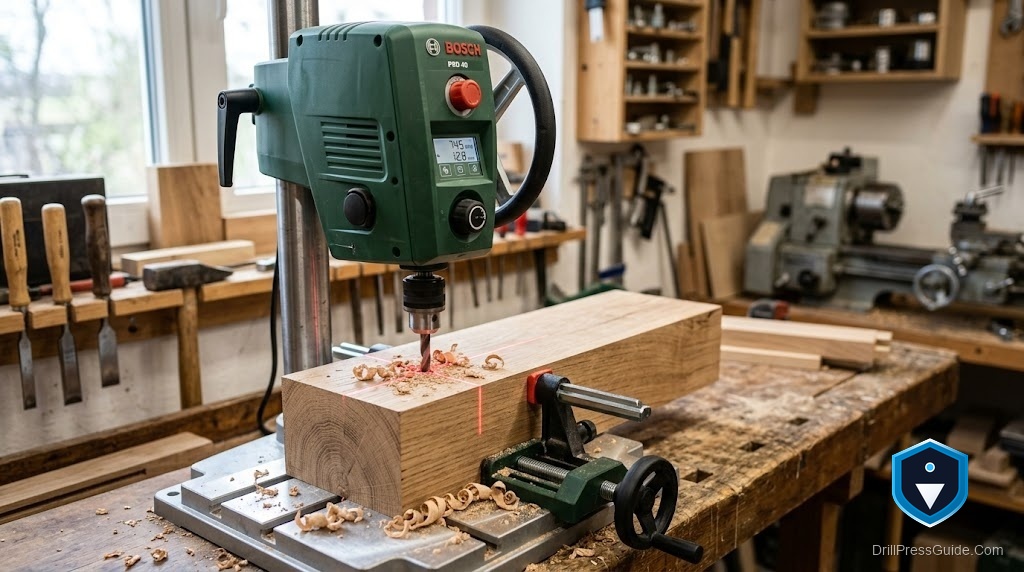
The Bosch PBD 40 is a 710W benchtop drill press designed for the European and international market, and the details of how it works explain why it has a devoted following among precision-oriented users. Most drill presses change speed by manually moving a belt across stepped pulleys, a process that takes a minute and requires reaching inside the machine. The PBD 40 skips all of that: it has a 2-speed electronic gearbox, a digital display showing actual spindle speed and drilling depth, and a keyless chuck with an auto-retighten feature. This closer look covers the machine’s actual construction, capacity figures, and what those design choices mean in daily use.
Specifications: 710W motor, 230V 50Hz power supply. Two speed ranges: 200 to 850 RPM in first gear and 600 to 2,500 RPM in second gear. Keyless chuck accepting 1.5 to 13mm (1/16 to 1/2 inch) shanks. Maximum drilling depth in wood: 40mm. Maximum drilling diameter in steel: 13mm. Spindle stroke: 90mm (approximately 3-1/2 inches). Machine weight: 11.2 kg (about 25 pounds). Total height: 650mm (25-1/2 inches). Base plate: 330mm by 350mm. Laser class 2 (650nm), less than 1mW for bit position guidance.
Straight answer: the PBD 40 is a thoughtfully designed benchtop press for precision drilling, with its standout features being the digital gearbox, speed and depth display, and auto-retighten keyless chuck. Its limits are the 230V power requirement (critical for North American shops), the 1/2-inch chuck capacity ceiling, and the 3-1/2-inch stroke.
The electronic gearbox and digital display
This is the feature that most differentiates the PBD 40 from conventional belt-drive presses. The two-speed gearbox gives you distinct speed ranges for different materials and bit sizes: first gear’s 200-850 RPM is appropriate for larger bits in metal and hardwood; second gear’s 600-2,500 RPM suits smaller bits and drilling in wood and plastics. Within each range, the electronic regulation maintains speed under load, which is a real advantage in metal where load varies as the bit enters and exits the cut.
The digital display shows the actual spindle speed and the current drilling depth on a clear readout, so you are not guessing at RPM from pulley positions or reading a depth stop scale. For repetitive work to consistent depth, the depth display simplifies setup.
The keyless chuck and auto-retighten
The 1.5-to-13mm keyless chuck accepts modern parallel-shank bits in the standard range and tightens without a key. The auto-retighten feature is Bosch’s term for a mechanism designed to prevent the chuck from loosening under the rotational force of drilling, which is the main failure mode of cheaper keyless chucks. In practice, users report it holds reliably for standard wood and metal drilling, though for very heavy cutting in hard material a keyed chuck’s grip is generally stronger.
The 1/2-inch (13mm) capacity is the ceiling: any bit with a shank larger than 13mm, including larger Forstner bits with full-diameter shanks, will not fit. This is a real limitation for furniture-scale woodworking.
Depth control and table
The depth stop with digital display is one of the PBD 40’s most practically useful features. Setting a consistent drilling depth for a batch of holes is straightforward: set the depth on the display, lock it, and drill. The rack-and-column table allows height adjustment, and the table includes a parallel stop accessory (included in the box) for consistent hole placement from a workpiece edge.
A quick-clamp accessory (also included) holds round stock, which is a useful addition for drilling into cylindrical workpieces like dowels and pipe.
Honest limitations
Four concrete limits to keep in mind:
- 230V only: Not sold in North America and requires a step-up transformer or 240V circuit. This is the first and most important check.
- 90mm stroke: Adequate for standard stock; limiting for thick material without repositioning.
- 1/2-inch capacity: Locks out large Forstner bits and other tooling above that shank size.
- Parts and support: Sold outside North America, so warranty service and parts sourcing require a European channel.
Conclusion: a precisely engineered compact press for 230V shops
The Bosch PBD 40 is the benchtop drill press for precision users in 230V markets who want digital feedback and easy speed changes over conventional belt-drive mechanics.
- 710W, 230V, 2-speed gearbox (200-850 / 600-2,500 RPM), digital speed and depth display.
- 1.5-13mm (1/16-to-1/2-inch) keyless chuck with auto-retighten.
- 90mm (3-1/2-inch) stroke; 40mm wood capacity, 13mm steel capacity.
- Class 2 laser guide; parallel stop and quick clamp included.
FAQ
What speeds does the PBD 40 offer? 200-850 RPM in first gear, 600-2,500 RPM in second gear. Speed is electronically regulated within each range.
How do I change the speed? By switching between the two gear settings on the electronic gearbox, with no belt adjustment needed.
What does the digital display show? Actual spindle speed (RPM) and current drilling depth.
What is the drilling stroke? 90mm, approximately 3-1/2 inches.
Does the PBD 40 work in North America? Only with a step-up transformer or 240V circuit. It is not sold through North American Bosch retail channels.
What chuck size does it use? A keyless chuck accepting 1.5-13mm shanks (approximately 1/16 to 1/2 inch). No key required.
What is the laser for? A Class 2 laser (650nm) projects a reference line for bit positioning before drilling.
References
- Bosch PBD 40 product page, Bosch DIY Australia: https://www.bosch-diy.com/au/en/p/pbd-40-0603b07040
- Bosch PBD 40 full specifications, 3DJake International: https://www.3djake.com/bosch-home-garden/bench-drill-pbd-40
- Bosch PBD 40 machine specifications and manual, HSBNE Hackerspace Wiki: https://wiki.hsbne.org/tools/woodshop/drill_press_bosch_pbd40
- Bosch PBD 40 Bench Drill Review, Raspberry Pi Magazine: https://magazine.raspberrypi.com/articles/bosch-pbd-40-bench-drill-review


