
Choosing and Using a Drill Press with 6-Inch Spindle Travel
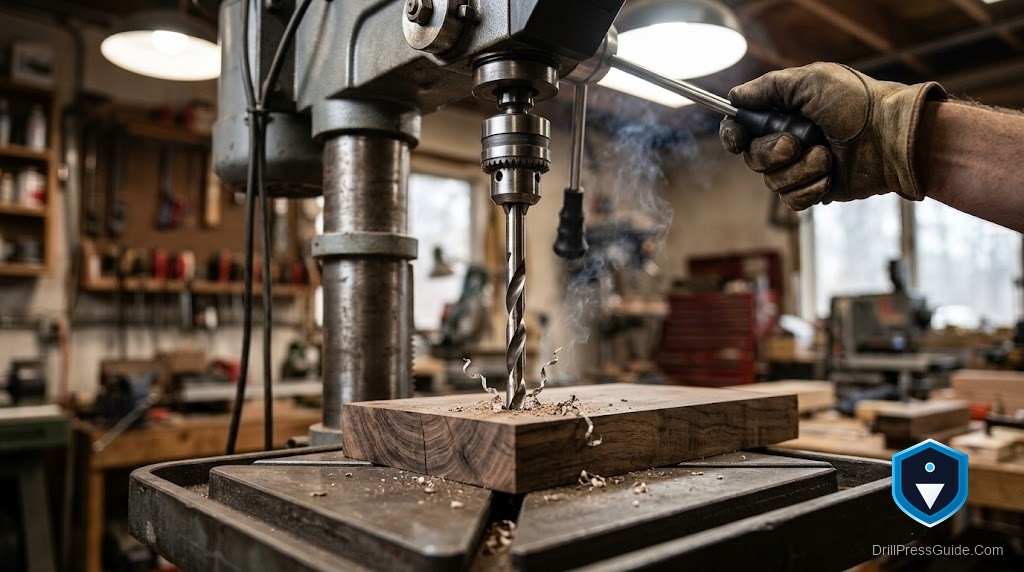
Six inches of spindle travel is a lot of quill stroke. It puts a drill press into the territory of heavy industrial and serious production work, where the ability to plunge 5 to 6 inches in a single stroke without repositioning the table is the difference between efficient production and constant interruption. If you are looking at a press with this much travel, you are either buying a large floor-standing machine for demanding shop work, or you are comparing specs and wondering how much travel you actually need. This guide covers both.
Spindle travel is the vertical distance the quill descends in a single stroke. Six inches means the bit can plunge 6 inches downward from its set starting position. That stroke depth handles through-holes in 5-inch thick stock in a single pass, deep mortises in very thick material, boring for large hardware in heavy timbers, and production deep-hole drilling where table repositioning would cost significant time. It is a spec that belongs on 20-inch and larger floor-standing presses and on specialized industrial machines.
Straight answer: 6-inch spindle travel is for heavy production work and large floor presses. If your work involves regular drilling in material over 4 inches thick, or deep-hole production operations, it is the right spec. For most general woodworking and light metalwork, 3 to 5 inches of travel covers the practical range, and paying for 6 inches you will not use is not necessary.
What 6 inches of travel handles
At 6 inches of stroke:
- Through-holes in stock up to about 5 inches thick in a single plunge.
- Deep mortises in very thick material, including heavy timber joinery.
- Boring for large-diameter hardware (lag bolts, through-bolts) in heavy timber.
- Production deep-hole drilling where maintaining table position across a batch is essential.
- Drill and counterbore operations in very thick metal plate with a single setup.
The practical advantage over 5 inches of travel is meaningful only in specific contexts: very thick stock, very deep holes, or high-volume production where every table repositioning adds up. For most shop work, the difference between 5 inches and 6 inches is felt only at the extremes.
Where 6-inch travel appears
Six-inch travel is characteristic of 20-inch floor-standing drill presses and larger industrial machines. Many radial arm drill presses in the industrial class carry 6 inches or more of quill stroke. Powermatic’s PM2800B and similar machines in the 18-to-20-inch swing range approach or reach this figure. The Delta 17-900 floor press family, a well-known vintage standard, lists 4-1/2 to 5 inches depending on the version; true 6-inch travel is typically found on larger production machines.
For any press at this travel depth, workpiece clamping is non-negotiable. A drill press vise with mounting lugs bolts to the table and provides the secure grip that long plunges in hard material require. A universal ratcheting chuck key keeps bit changes quick.
Setting up for 6-inch travel
With 6 inches of available stroke, table height and depth stop calibration are critical. Set the table so the bit reaches the workpiece surface at the appropriate point in the stroke, and set the depth stop precisely before running a batch of holes. Floor anchor bolts are essential on a machine in this class; the mass and leverage at full plunge depth make an unanchored press unsafe on hard material.
Choose bits matched to the press’s capacity and the material. At 6 inches of stroke, the spindle speed (RPM) selection from the speed chart matters: large bits in hard material require slow speeds, and the press’s speed range should include settings appropriate for the diameter and material you are working.
The honest flaws
Two honest points. First, machines with 6-inch travel are large floor-standing presses with significant mass and footprint; they are a serious shop investment in both money and space. Second, 6 inches of travel is overkill for most hobby and small-shop work; buying this much machine for occasional drilling in standard lumber is not cost-effective. Neither is a knock on the machines themselves, which are genuinely capable; both are reminders to match the machine to the work.
Who needs 6-inch travel, and who does not
You need 6-inch travel if your work involves regular deep-hole production, heavy timber joinery at scale, or material consistently thicker than 4 inches. This is a production shop and heavy-fabrication spec.
You do not need 6 inches if your work is general woodworking on standard to moderately thick stock. Five inches of travel covers furniture work and heavy joinery well; the extra inch of stroke rarely justifies the larger, more expensive machine in a typical small shop.
Conclusion: production-class travel for demanding work
Six inches of spindle travel is the right spec for heavy production and thick-stock work.
- It handles through-holes in stock up to about 5 inches thick in a single plunge.
- It appears on 20-inch and larger floor-standing presses and industrial radial-arm machines.
- Workpiece clamping and floor anchoring are non-negotiable at this travel depth.
- Most small-shop and hobby work is served by 3 to 5 inches; buy for what your work actually demands.
FAQ
How thick a workpiece can I drill through with 6-inch travel? About 5 inches in a single plunge with the table set correctly.
Do benchtop presses come with 6-inch travel? No. Six-inch travel is found on 20-inch and larger floor-standing presses and industrial machines.
Is 6-inch travel necessary for furniture work? Not for most furniture. Five inches covers heavy furniture joinery. Six inches is for heavy timber and production work.
What machines have 6-inch spindle travel? Large floor-standing presses (20-inch swing and above) and industrial radial arm drill presses. Check the specification sheet for the exact figure.
Should I anchor a press with 6-inch travel? Absolutely. Floor anchoring is essential at this stroke depth for safe operation in hard material.
How does 6-inch travel compare to 5-inch? Meaningful only at the extremes: very thick stock (over 4 inches) and high-volume deep-hole production. For most shop work, 5 inches is sufficient.
References
- Powermatic PM2800B 18-inch drill press specifications: https://www.powermatic.com
- JET floor drill press lineup and specifications, JET Tools: https://jettools.com
- Fine Woodworking, drill press buying guide: https://www.finewoodworking.com


