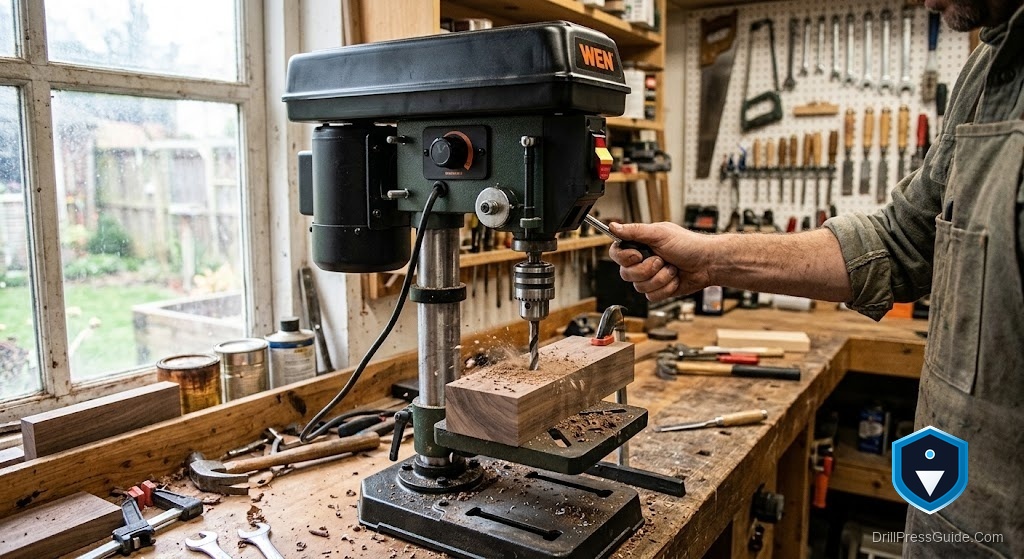
Drill Press with 4-Inch Spindle Travel: What It Is, Where It Fits, and What to Check
Spindle travel is one of the most overlooked specs when buying a drill press, and four inches is the number that separates capable benchtop machines from the ones that constantly force you to reposition the workpiece. If you are looking at a drill press with 4-inch spindle travel, you are in useful territory: that depth of quill stroke handles most through-hole drilling in standard stock thicknesses without repositioning, covers mortising attachments, and gives you room for boring operations that shorter-travel presses simply cannot reach. This guide explains what 4-inch spindle travel means in practice, what machines offer it, and what to check before buying.
Spindle travel (also called quill travel or quill stroke) is the maximum vertical distance the quill moves from its fully raised to fully lowered position. Four inches means the drill bit can descend 4 inches from its highest position to its lowest. This is distinct from the maximum depth of a hole you can drill in a given setup, since the starting position depends on how high the table is set. But 4 inches of stroke gives you genuine flexibility: you can drill through 3-inch thick stock, use longer bits without repositioning, and run a mortising attachment that needs several inches of plunge depth.
Straight answer: 4-inch spindle travel is a meaningful upgrade over the 2-to-3-inch travel typical of compact benchtop presses. It is common on mid-size benchtop presses (12-inch to 15-inch swing) and on floor-standing presses. If your work involves thick stock, repetitive deep holes, or mortising, it is worth prioritizing.
What work benefits from 4-inch travel
Four inches of stroke is enough to:
- Drill through 3-inch thick workpieces in a single plunge (with the table set correctly).
- Use a full-length twist bit without repositioning for standard-depth holes.
- Run a mortising attachment, which needs at least 2 to 3 inches of stroke to cut a useful mortise depth in a single setup.
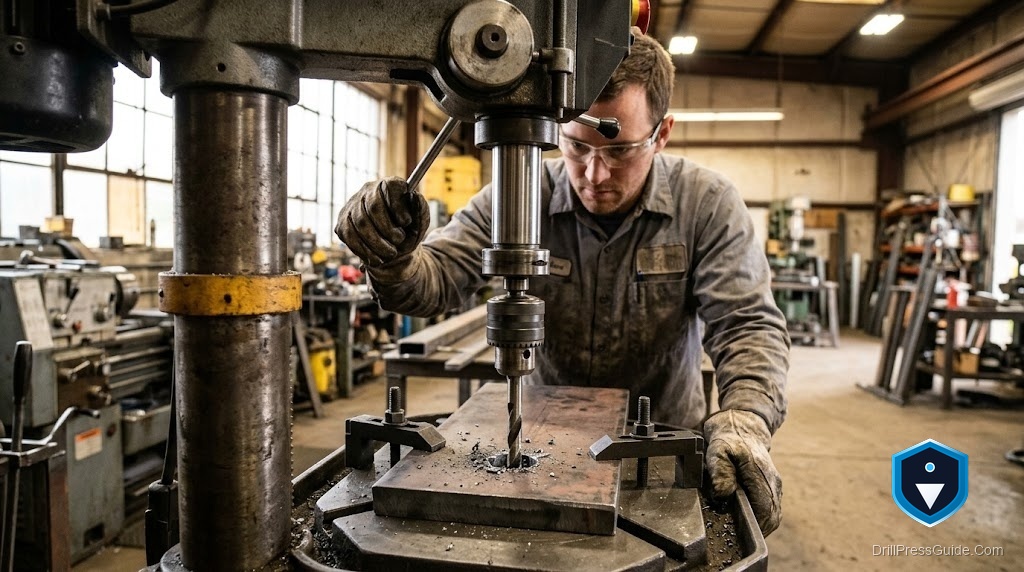
- Bore holes in thick metal plates or wood glue-ups without multiple table adjustments.
What it does not do is replace 5-inch or 6-inch travel for deep-column drilling or very thick stock. If your work regularly involves stock thicker than 3 inches or very deep holes, look at presses with 5-inch or greater travel.
Machines with 4-inch spindle travel
Four-inch spindle travel appears on several current and recent mid-size presses. Examples include the Grizzly G7948 (discontinued), which carried 4-3/4-inch travel, and the General International 75-030, which offered 3-1/8 inches (slightly under 4). JET’s JDP-17MF lists 4-3/8-inch travel. Current WEN 15-inch and 17-inch floor presses often fall in the 4-to-5-inch range. When comparing, confirm the exact travel figure from the specification sheet rather than estimating from the machine’s size.
A drill press vise is an essential accessory on any press with this travel range, since deeper plunges mean more torque on the workpiece; secure clamping is non-negotiable.
What to check before buying
- Confirm the spindle travel spec on the product sheet, not just the machine’s swing.
- Check the quill lock: a press with 4 inches of travel needs a positive, easy-to-reach quill lock for setting repeatable depth stops.
- Check the depth stop mechanism: does it allow repeatable depth settings without slipping under repeated use?
- Confirm the table height range is sufficient to use the full travel for thick-stock work.
The honest flaws
Two honest points. First, 4-inch travel on a benchtop press sometimes comes at the cost of a taller head assembly that raises the machine’s center of gravity; a securely mounted base or a heavy bench is more important at this travel length than with a compact press. Second, some presses advertise 4-inch travel but have a quill lock that slips under heavy pressure, which wastes the travel advantage; check reviews for quill-lock reliability before buying.
Who should prioritize 4-inch travel, and who can do with less
Prioritize 4-inch spindle travel if you regularly drill through stock thicker than 2 inches, use a mortising attachment, or need deep holes with repeatable depth stops. It is a real-world advantage for furniture work, joinery, and metal work with thick plate.
A press with 2 to 3 inches of travel is enough for through-holes in standard 3/4-inch and 1-1/2-inch stock, which covers light woodworking and most household repair. The extra travel costs money and adds machine height; do not pay for it if your work does not need it.
Conclusion: a meaningful spec for productive shop work
Four inches of spindle travel expands what a drill press can do without repositioning.
- It handles through-holes in stock up to about 3 inches thick in a single plunge.
- It enables mortising attachments and deeper boring operations.
- Confirm the travel from the specification sheet; it varies between models even within the same swing size.
- Check quill-lock reliability and depth-stop quality, which matter as much as the travel number.
FAQ
What is spindle travel on a drill press? The maximum vertical distance the quill moves from its fully raised to fully lowered position. Also called quill travel or quill stroke.
Is 4 inches of spindle travel enough for most shop work? Yes for most through-hole and mortising work on standard to thick stock. Heavy deep-column operations may need 5 inches or more.
How deep a hole can I drill with 4 inches of travel? Up to 4 inches in a single plunge from the set starting position. For holes deeper than 4 inches, you need to reposition the workpiece.
Does swing size predict spindle travel? Not reliably. Spindle travel is a separate spec; always check the specification sheet for the exact figure.
Why is the quill lock important? A reliable quill lock sets the depth stop for repeatable holes. At 4 inches of travel, a slipping quill lock wastes the travel advantage.
Can I use a mortising attachment on a press with 4-inch travel? Yes. Most mortising attachments need 2 to 3 inches of stroke to cut a useful mortise depth; 4-inch travel gives you room to work.
References
- JET JDP-17MF 16-1/2” Drill Press specifications, JET Tools: https://jettools.com/16-1-2-drill-press
- WEN drill press specifications and lineup: https://wenproducts.com/collections/drill-presses
- General drill press spindle travel and quill reference: https://www.finewoodworking.com