
Choosing and Using a Champion Blower and Forge Post Drill No. 102-3
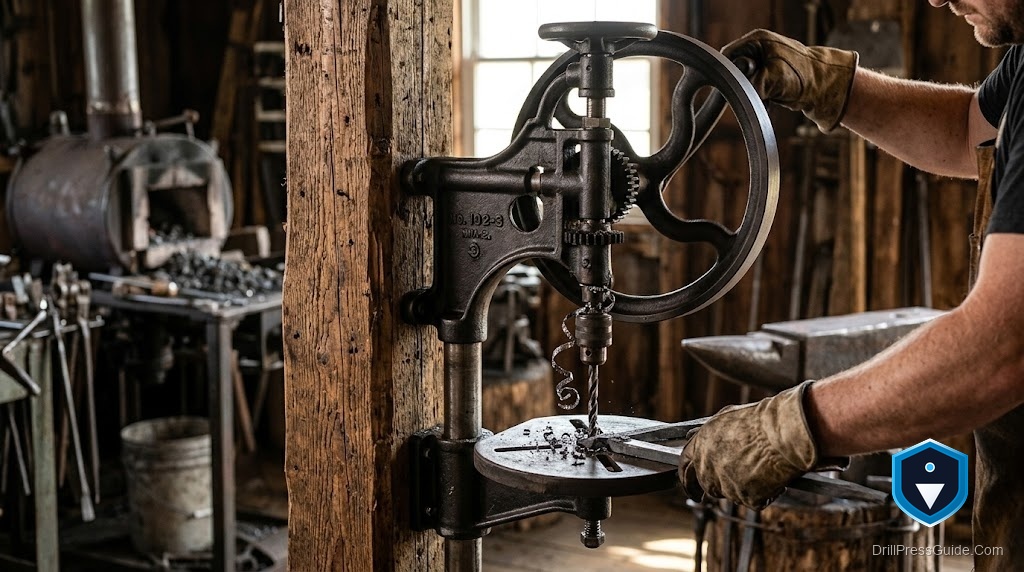
The Champion Blower and Forge No. 102-3 is not a drill press in the modern sense. It is a hand-cranked post drill, a purely mechanical device with no motor, designed to be mounted to a post or wall and driven entirely by hand through a flywheel and gear train. Champion Blower and Forge of Lancaster, Pennsylvania manufactured these from the late 19th into the early 20th century, and the No. 102-3 is one of the smaller models in their post-drill line. If you have one, or are thinking about buying one, knowing what it is and how it works is the starting point for using it well.
A Champion post drill is a self-contained hand-powered boring machine: you mount it to a solid post or wall, clamp your workpiece on the table, insert a drill bit into the chuck (which accepts standard straight-shank bits of the era), and turn the flywheel to drive the spindle. The feed is controlled by a rack-and-pinion quill advance worked by a separate handle. The No. 102-3 is described as drilling to the center of a 12-inch circle, which means it has a 6-inch throat (its “swing”) measured from the centerline of the spindle to the nearest obstruction.
Straight answer: the Champion No. 102-3 is a 19th-century antique hand tool. It is not suitable as a production drilling machine by modern standards, but in excellent condition it functions as designed, is a satisfying tool to use for light work in soft materials, and is a genuine piece of American industrial history.
What this machine is and is not
The No. 102-3 is a post drill: it mounts to a vertical post or wall bracket, not a floor stand, and it has no motor. The flywheel provides inertia to smooth out hand cranking, and the gear reduction multiplies your effort into spindle rotation. Early models are entirely hand-powered; some later examples were retrofitted with small electric motors by their owners, though the originals were not designed for this.
The chuck on a Champion post drill accepts straight-shank twist bits of the era. Modern parallel-shank bits in compatible diameters fit and work fine. The practical capacity in wood is reasonable for the spindle’s rigidity; these drills were used in blacksmith shops and light manufacturing to bore bolt holes in iron work and wood alike, though modern drilling in hard steel is better left to a powered machine.
Buying and condition checks
Buying a Champion No. 102-3 today means buying a used antique. Check these before paying:
- Spindle: Should turn smoothly without wobble. A bent or severely worn spindle is the most consequential defect.
- Rack and pinion (quill advance): Teeth should be intact with no missing segments.
- Chuck: Should open and close cleanly. Period chucks are replaceable with compatible straight-shank chucks if badly damaged.
- Flywheel: Cracks in the casting are a disqualifier. Surface rust is normal and cleanable.
- Mounting bracket: Should be complete and structurally sound.
Note the eBay market shows examples selling in the range of several hundred dollars depending on condition and completeness. A fully functional, rust-cleaned example commands a premium over a parts piece.
Using it
Mount the post drill to a solid vertical post or wall-mounted bracket; the mounting must be rigid, as any flex in the mounting transfers directly to drilling inaccuracy. Secure your workpiece firmly on the table. Insert a straight-shank bit, tighten the chuck, and crank the flywheel at a steady pace while feeding the quill with the advance handle. Let the tool cut at its own pace; forcing it risks bit breakage on harder materials.
Lubricate the gear train and spindle bearings with light machine oil before use and periodically during use. These machines were designed for oil lubrication and perform better with it.
The honest flaws
Two honest points. First, the No. 102-3 is a small post drill with a 6-inch throat and a hand-powered spindle, so its practical drilling capacity is limited compared to any modern electric press; do not expect to replace a floor-standing drill press with it. Second, antique chucks may not accept all modern bit shanks cleanly; test fit before committing to a bit style. Neither is a reason not to own one, but both set accurate expectations for what it does in a working shop context.
Who should own one, and who should look elsewhere
Own a Champion No. 102-3 if you appreciate historical tools, enjoy restoring and using antique machinery, or want a conversation piece that actually functions. In good condition it drills bolt holes in wood and soft metal accurately, and the experience of using a 19th-century American-made tool has genuine appeal.
Look elsewhere if you need a practical production drilling machine. An electric benchtop drill press handles volume work, harder materials, and repeatable depth stops far better than a hand-cranked antique.
Conclusion: a genuine American antique that works as designed
The Champion No. 102-3 is one of the original drill press concepts, a hand-cranked post drill built with care in Lancaster, Pennsylvania.
- It is a hand-powered post drill, not an electric machine, and mounts to a post or wall.
- The 6-inch throat (“12-inch circle”) describes its reach, not its speed capacity.
- Check spindle, rack, chuck, and flywheel carefully when buying used.
- Lubricate, mount solidly, and use at a steady hand-cranking pace for best results.
FAQ
Is the Champion No. 102-3 an electric drill press? No. It is a hand-cranked post drill with no motor. The flywheel provides inertia for smoother hand operation.
What does “drill to the center of a 12-inch circle” mean? It describes the machine’s throat, the distance from the spindle centerline to the nearest obstruction, which is 6 inches. This is the equivalent of modern “swing.”
What drill bits does it accept? Straight-shank twist bits of compatible diameter. Modern parallel-shank bits in compatible sizes fit and work.
Where do I mount a post drill? To a solid vertical post or a wall-mounted bracket. The mounting must be rigid; flex causes drilling inaccuracy.
Is it worth restoring and using? For light drilling in wood and soft materials, yes. For production work or hard materials, a modern electric press is more practical.
How old is a No. 102-3? Champion Blower and Forge made these post drills from the late 19th century into the early 20th century; a No. 102-3 is likely over 100 years old.
How do I lubricate it? Light machine oil on the gear train and spindle bearings, applied before use and periodically during extended use.
References
- VintageMachinery.org, Champion Blower and Forge Co. photo index and documentation: http://vintagemachinery.org/mfgindex/detail.aspx?id=165
- VintageMachinery.org, photo index entry: Champion Blower and Forge No. 102-3 Post Drill: http://vintagemachinery.org/photoindex/detail.aspx?id=13357
- Collectors Weekly, Champion Blower and Forge vintage post drill press: https://www.collectorsweekly.com/stories/71111-vintage-primitive-champion-blower-and-forg


