
Understanding the Dremel 220 01 Workstation Drill Press: Setup, Limits, and Support
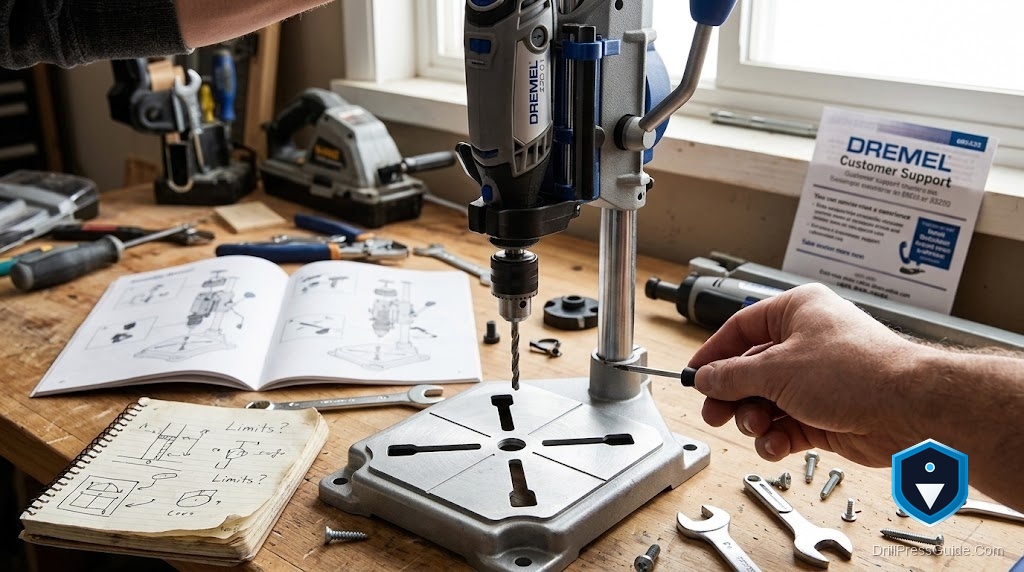
The Dremel 220-01 Workstation is not a drill press in the way most people picture one. There is no motor, no chuck, and no big cast table. Instead, it is a clever stand that turns a Dremel rotary tool you already own into a small, precise press for drilling, and doubles as a tool holder and a flex-shaft stand. Understanding the 220-01 means understanding what it can and cannot do once your Dremel is clamped in, because that is where its real capability, and its limits, live.
The Dremel 220-01 Workstation is a 3-in-1 attachment: an articulating drill press, a horizontal tool holder, and a flex-shaft tool stand. It clamps a compatible Dremel rotary tool and feeds it down for drilling, tilts for angled holes in 15-degree increments up to 90 degrees, holds the tool horizontally for sanding, polishing, and grinding, and includes a flex-shaft holder adjustable between 16 and 29 inches. The metal base has four clamping points and inch and metric markings, with on-board bit storage and cord clips. It is a current Dremel product.
Straight answer: the 220-01 is right if you own a compatible Dremel and want more accuracy and repeatability for small drilling, sanding, and polishing than freehand work allows. It is the wrong tool if you expect the power, depth, or rigidity of a real benchtop press, because everything it does is limited by the little rotary tool that powers it.
What it actually is
The key to using the Workstation well is remembering that it supplies no power of its own. Your Dremel rotary tool is the motor and the chuck; the 220-01 only holds it steady and feeds it. That is why it shines at precise, light tasks: drilling small, clean holes in wood, plastic, or thin material, sanding and shaping with drum accessories, and holding the tool horizontally for polishing. The articulating head, which tilts in 15-degree steps to 90 degrees, is genuinely useful for angled holes and for presenting work to a sanding drum.
The Dremel 220-01 Workstation is compatible with a range of Dremel rotary tools, so before buying, confirm your specific model fits the tool holder.
Setup, step by step
Assembly is quick and covered in the manual:
- Tube to base: Attach the column tube to the metal base and secure it with the supplied hardware.
- Press assembly: Slide the press (tool holder) onto the column and set the height with the adjustment lever.
- Accessory holder and clips: Install the crow’s-nest bit holder and the cord clips for tidy storage.
- Mount the base (optional): Bolt the base to your workbench through the base holes for stability during drilling.
- Fit your Dremel: Thread the rotary tool into the holder by its threaded nose collar, the same collar the Dremel accessory attachments use.
Once mounted, use the four clamping points and the base markings to position and hold your workpiece.
Limits, stated plainly
The honest limits all trace back to the rotary tool. Power is small, so this is for light drilling and shaping, not boring large holes or working steel. Chuck capacity is limited to what a Dremel collet or chuck accepts, roughly up to 1/8 inch shank, so bit size is capped. Rigidity is modest: the plastic-and-metal press has more flex than a cast-iron machine, so precision, while good for the class, is not benchtop-press territory. And drilling depth is shallow. These are not defects; they are the nature of a rotary-tool stand.
Support and upkeep
As a current Dremel product, the 220-01 is backed by Dremel’s warranty and support, and the manual is easy to find. There is little to maintain: keep the column and feed clean, do not overtighten the tool holder, and store bits in the on-board holder. The real consumables are on the Dremel side, bits, collets, and sanding drums, rather than the stand itself. If your rotary tool’s collet is worn, replacing it restores grip; the Workstation needs no belts or chucks of its own.
The honest flaws
Beyond the built-in limits, owners note two things. First, because the tool holder grips the Dremel by its nose collar, any play there shows up as runout, so seat the tool carefully. Second, the press flexes under firm pressure, so let the tool cut at its own pace rather than forcing it. Used gently, it is accurate for small work; pushed hard, it disappoints, exactly as you would expect from a rotary-tool stand.
Who should buy it, and who should skip it
Buy the 220-01 if you own a compatible Dremel and want cleaner, more repeatable small holes, plus a handy sanding and polishing stand, in a compact package. For hobbyists, jewelers, model makers, and electronics work, it adds real precision.
Skip it if you need to drill larger holes, work metal, or want the rigidity and depth of a true press; a benchtop drill press is the right tool then. And skip it if you do not own a compatible Dremel, since the Workstation is useless without one. Do not expect it to replace a real drill press.
Conclusion: a precise stand, not a press
The Dremel 220-01 Workstation turns a rotary tool into a small, versatile press, as long as you respect what a rotary tool can do.
- A 3-in-1 attachment: articulating drill press, tool holder, and flex-shaft stand.
- It supplies no power; your compatible Dremel rotary tool is the motor and chuck.
- Best for small, precise drilling, sanding, and polishing, not large holes or metal.
- Current product with Dremel support; confirm your rotary tool is compatible first.
FAQ
Is the Dremel 220-01 a real drill press? It is a stand that turns a compatible Dremel rotary tool into a small drill press. The rotary tool supplies the power and chuck.
What can it drill? Small, clean holes in wood, plastic, and thin material, limited by the Dremel’s small collet capacity (roughly up to 1/8-inch shanks).
Which Dremel tools fit it? A range of Dremel rotary models thread into the tool holder. Confirm your specific model’s compatibility before buying.
Can it drill at an angle? Yes. The articulating head tilts in 15-degree increments up to 90 degrees for angled holes and horizontal tool holding.
Does it work for sanding and polishing? Yes. Held horizontally, it acts as a tool stand for sanding drums, polishing, and grinding.
Do I need to bolt it down? For best stability during drilling, yes. The base has holes to mount it to a workbench.
Is it powerful enough for metal? Only the lightest work. It is not built for drilling steel or large holes; use a benchtop press for that.
References
- Dremel 220-01 WorkStation product overview, Dremel: https://www.dremel.com/us/en/p/220-01-26150220aa
- Dremel Work Station Model 220 Owner’s Manual (PDF): https://www.itm.com/pdfs/cache/www.itm.com/5000220-01/manual/5000220-01-manual.pdf
- Dremel 220-01 WorkStation specifications, Global Test Supply: https://www.globaltestsupply.com/product/dremel-220-01-workstationandtrade-


