
Delta Drill Press Model 11 990: What Owners Should Check Before Buying or Repairing
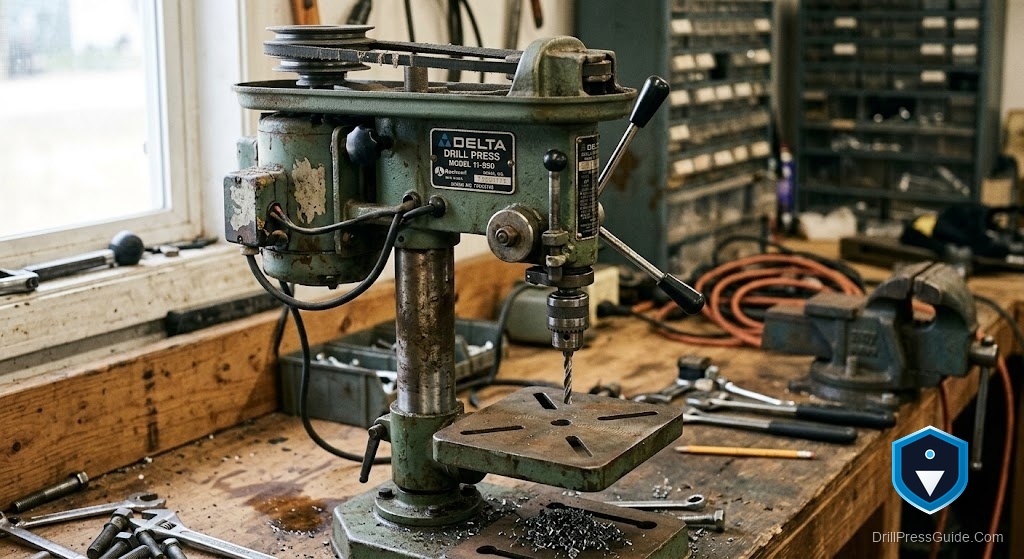
The Delta drill press model 11-990 has a strong reputation among people who own one, which is exactly why so many change hands secondhand. It is a 12-inch cast-iron bench press with a smooth induction motor, the kind of machine that keeps working for decades. But a good reputation does not guarantee a good individual machine, and a discontinued press can hide expensive problems. Before you buy or repair an 11-990, there are specific things worth checking, because on an out-of-production machine, condition and completeness decide everything.
The Delta 11-990 is a 12-inch benchtop drill press with a 1/3 HP induction motor on 115V (about 6 amps), five spindle speeds (620, 1,100, 1,720, 2,340, and 3,100 RPM), a 1/2-inch keyed chuck, and roughly 2-3/8 inches of spindle travel. It is discontinued, so its usefulness depends on the condition of the specific machine and on standard consumables for upkeep.
Straight answer: check the spindle and quill, the motor, the pulleys and belt, the table and column, and the machine’s completeness before committing. A complete, smooth-running 11-990 is worth owning and easy to maintain; one that is incomplete or mechanically rough is a repair project that may need parts you cannot find.
Before buying: the inspection checklist
Run through these in order, ideally with the machine running:
- Spindle and quill: Extend the quill and feel for smooth travel and minimal side-to-side runout. A rough or worn quill is the most expensive problem to fix and often the deal-breaker.
- Motor: It should start promptly, run quietly, and hold speed under a light load. Hesitation, humming, or excessive noise signals trouble.
- Pulleys and belt: Check the stepped pulleys for cracks (hard to replace) and the belt for glazing or cracking (cheap and expected).
- Table and column: Confirm the cast table is flat and un-cracked and the column is straight, with a clamp that locks the table solidly at height.
- Completeness: Verify the chuck, belt guard and cover, feed handle, and table-raising hardware are all present.
A press that passes all five is a keeper. One that fails several is worth only its salvageable parts.
Before repairing: what is worth fixing
If you already own an 11-990 or bought one needing work, the repair math is simple. Consumables and adjustments are worth doing: a new belt, a fresh chuck, cleaning and lubricating the quill, tightening the column clamp, and squaring the table all restore the machine cheaply. What is rarely worth it, on a discontinued press, is chasing model-specific structural parts, a cracked head casting, a damaged pulley, or a worn quill assembly, because those are scarce and can cost more in time and money than the machine is worth. Fix the easy things; walk away from the hard ones.
Parts and consumables
Because the 11-990 is discontinued, keep the wear items current with standard parts. Replace an aging V-belt by measuring the old loop and matching the size. Swap a worn 1/2-inch chuck for a 5/8-inch keyed chuck with an MT2 arbor once you confirm the spindle taper, and cover a lost key with a universal ratcheting chuck key. A drill press vise improves accuracy and safety on the table. For anything model-specific, match the full model and type against an archived Delta parts diagram before ordering.
The honest flaws
Two honest points. First, being discontinued means no warranty and no guaranteed structural spares, so a serious mechanical fault can be hard or impractical to remedy, which is why the inspection matters. Second, the 1/3 HP, five-speed design is capable but not powerful; it is a wood-and-light-metal machine, and no repair changes that. Buy and fix an 11-990 for what it is, a durable compact press, not for capacity it never had.
Who should buy or repair one, and who should not
Buy or repair an 11-990 if it is complete and mechanically sound (or needs only consumables), you want cast-iron durability, and your work suits a 12-inch bench press. It can serve for years with minimal upkeep.
Skip it if the spindle, motor, or castings are compromised, if it is missing structural parts, or if you need more power or modern features. A current variable-speed benchtop press or a floor machine is the better path then. Do not sink money into a rough 11-990 chasing parts that no longer exist.
Conclusion: inspect first, then decide
The Delta model 11-990 is worth owning when the specific machine checks out, and a liability when it does not.
- 12-inch swing, 1/3 HP induction motor, five speeds, 1/2-inch chuck, ~2-3/8-inch travel, discontinued.
- Before buying, check the spindle, motor, pulleys, table, and completeness.
- Before repairing, do consumables and adjustments; avoid chasing scarce structural parts.
- Buy or fix a complete, sound example; walk away from rough or incomplete ones.
FAQ
What should I check first on a used 11-990? The spindle and quill, for smooth travel and minimal runout. A worn quill is the most expensive fault to fix.
Is the 11-990 worth repairing? Yes for consumables and adjustments (belt, chuck, quill cleaning, table squaring). Rarely for scarce model-specific structural parts.
What are the spindle speeds? Five speeds: 620, 1,100, 1,720, 2,340, and 3,100 RPM, set by moving the belt across the pulley steps.
What chuck does it use? A 1/2-inch keyed chuck. Confirm your spindle taper before fitting a replacement.
Can it drill steel? Light metal, yes. The 1/3 HP motor is not built for heavy steel or large-diameter bits.
Where do I find parts diagrams? Archived Delta manuals and parts lists, organized by model and type. Match your full designation before ordering.
Is it still made? No. The 11-990 is discontinued, so support relies on used parts, archived diagrams, and standard consumables.
References
- Delta 11-990 12-inch Bench Drill Press Manual (PDF): https://www.mikestools.com/download/Delta_Drill_Press_Owners_Manuals/Delta_11-990.pdf
- Delta Drill Press owner’s manuals archive: https://www.mikestools.com/Delta-Drill-Press-Owners-Manuals
- Delta Machinery, manuals and parts support: https://www.deltamachinery.com/support/manuals


