
Before Paying for a Delta Drill Press 11 950, Compare These Cost Drivers
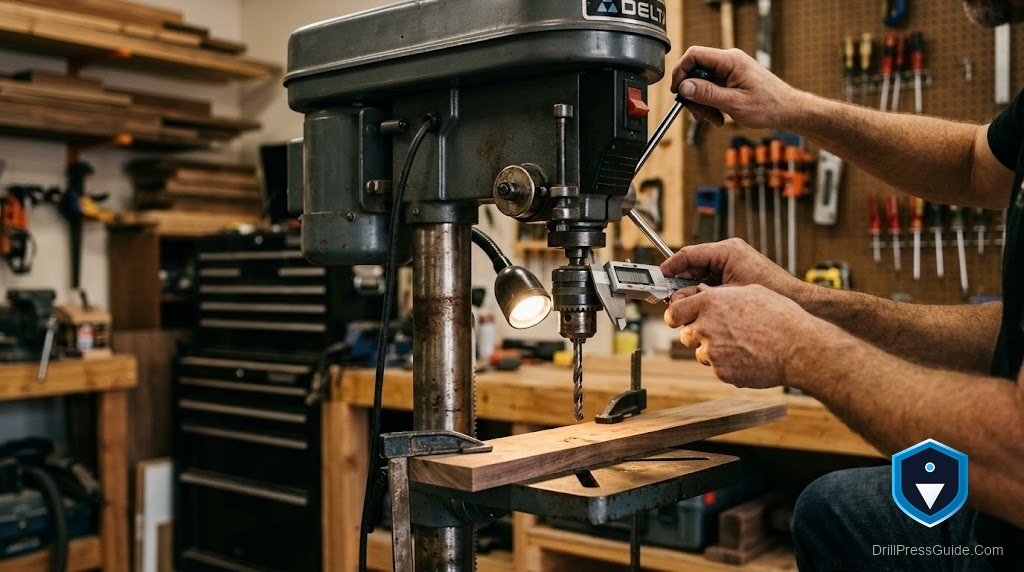
A Delta 11-950 shows up in a local listing, the photos look decent, and the temptation is to focus on the asking figure and little else. That is the wrong way to buy a discontinued machine. The 11-950 has not been sold new for years, so there is no reference price to anchor to, and what you should really be comparing is the set of factors that decide whether this particular press is worth your money. Before paying for a Delta 11-950, weigh these cost drivers, because they, not the number in the ad, tell you what you are actually getting.
The Delta 11-950 is an 8-inch benchtop drill press with a 1/3 HP induction motor on 110-120V, five spindle speeds (620, 1,100, 1,720, 2,340, and 3,100 RPM), a 4-inch throat, about 2 inches of quill feed, a small cast table around 6-1/2 inches, and a keyed chuck. It is discontinued, so its worth is set by condition, completeness, and parts availability rather than by any catalog price.
Straight answer: compare mechanical condition, completeness, capability fit, and parts support before anything else. A complete, smooth-running 11-950 with a sound motor and quill is worth pursuing; one that is incomplete or rough is a parts donor. The asking figure only matters after those four drivers check out.
Cost driver 1: mechanical condition
Condition is the single biggest factor in what an 11-950 is worth. Turn the machine on and feel it work:
- Quill and spindle: They should travel smoothly with minimal runout. A rough or worn quill is expensive or impractical to fix.
- Motor: It should start promptly, run quietly, and hold speed. Hesitation or noise is a serious warning.
- Pulleys: Look for cracks. Damaged pulleys are hard to source on a discontinued machine.
A press that passes these is worth pursuing. One that fails is worth only its salvageable parts, whatever the seller is asking.
Cost driver 2: completeness
Missing parts quietly destroy value on an old press. Confirm the machine has its chuck, its belt guard and cover, the table and its raising or clamping hardware, and the feed handle. Each missing piece either lowers what you should pay or turns into a hunt for scarce model-specific spares. A visibly complete 11-950 is worth far more than a cheaper one with gaps, because the gaps are exactly the parts you cannot easily replace.
Cost driver 3: capability fit
Compare the machine to your actual work before you value it. The 11-950 is an 8-inch, 1/3 HP bench press: excellent for small parts in wood and light metal, out of its depth with wide stock, deep holes, or heavy steel. If your work fits its lane, it is worth pursuing. If you will soon need 12-inch reach (the 11-990) or floor-press power, buying the 11-950 is paying for a machine you will replace, which is poor value no matter how little it costs. Match the press to the work first.
Cost driver 4: parts support
Factor in the cost and availability of what the machine will need. The routine items are cheap and in stock: a glazed belt is replaced by a direct-fit V-belt for the Delta 11-950, a worn chuck by a 5/8-inch keyed chuck with MT2 arbor once you confirm the spindle taper, and a lost key by a universal ratcheting chuck key. A drill press vise is an inexpensive way to improve accuracy on the small table. What you cannot easily buy are structural, model-specific parts, so the presence of those sound and complete is what justifies paying more.
The honest flaws to weigh
Two honest points before you pay. First, being discontinued means no warranty and no guaranteed factory spares, so a structural failure could be hard to remedy; that risk should lower your offer on any questionable example. Second, the 8-inch, 1/3 HP, five-speed design is durable but dated against a modern variable-speed press, so you are paying for cast-iron longevity, not features. Weigh both honestly against what the seller is asking.
Who should buy one, and who should skip it
Pay for an 11-950 if you have compared these drivers and the machine is complete, mechanically sound, and the right size for your small-parts work. That press can serve for years.
Skip it if it is incomplete or rough, if your work needs more reach or power, or if you want warranty-backed convenience; a current variable-speed benchtop press is the better value then. Do not let a low asking figure override a failed condition or completeness check.
Conclusion: compare the drivers, then the price
The worth of a Delta 11-950 is decided by four things, and the asking figure is not one of them until the rest check out.
- 8-inch swing, 1/3 HP induction motor, five speeds, ~2-inch quill feed, keyed chuck, discontinued.
- Weigh mechanical condition, completeness, capability fit, and parts support first.
- Routine consumables are cheap and available; structural spares are scarce.
- Buy a complete, sound, correctly sized machine; skip rough or incomplete ones regardless of price.
FAQ
Is the Delta 11-950 still sold new? No. It is discontinued, so its worth is set by condition, completeness, and parts availability rather than a catalog price.
What is the most important thing to check before paying? Mechanical condition, especially a smooth quill and spindle, a quiet motor that holds speed, and crack-free pulleys.
Why does completeness matter so much? Missing parts on a discontinued machine are often model-specific and hard to source, so gaps lower value sharply.
How do I know if it is the right size? The 11-950 is an 8-inch bench press for small parts. If you need wider reach or steel-drilling power, a larger press is a better buy.
What parts can I still get? The V-belt, chuck, and chuck key are standard consumables. A direct-fit belt is available, and any chuck must match the spindle taper.
What parts are hard to find? Structural, model-specific parts like castings, the quill, and pulleys, which is why a complete machine is worth more.
Does the asking figure matter at all? Only after condition, completeness, capability fit, and parts support check out. A low figure does not rescue a rough or incomplete press.
References
- Delta 11-950 8-inch Bench Drill Press Manual (PDF): https://www.mikestools.com/download/Delta_Drill_Press_Owners_Manuals/Delta_11-950.pdf
- Delta 11-950 Instruction Manual (ManualsLib): https://www.manualslib.com/manual/660558/Delta-11-950.html
- Delta Machinery, manuals and parts support: https://www.deltamachinery.com/support/manuals


