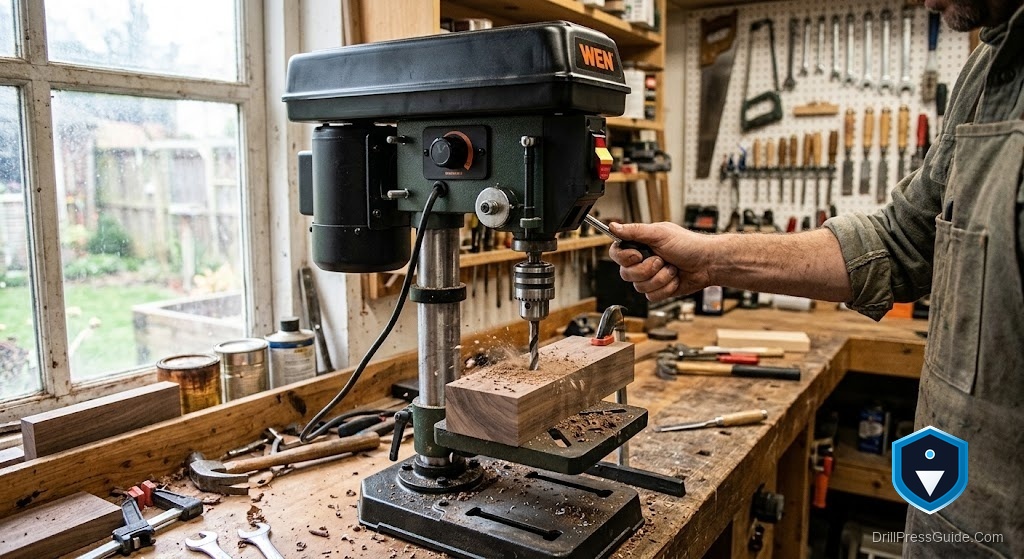
A Closer Look at the Delta 8-Inch Drill Press 11 950
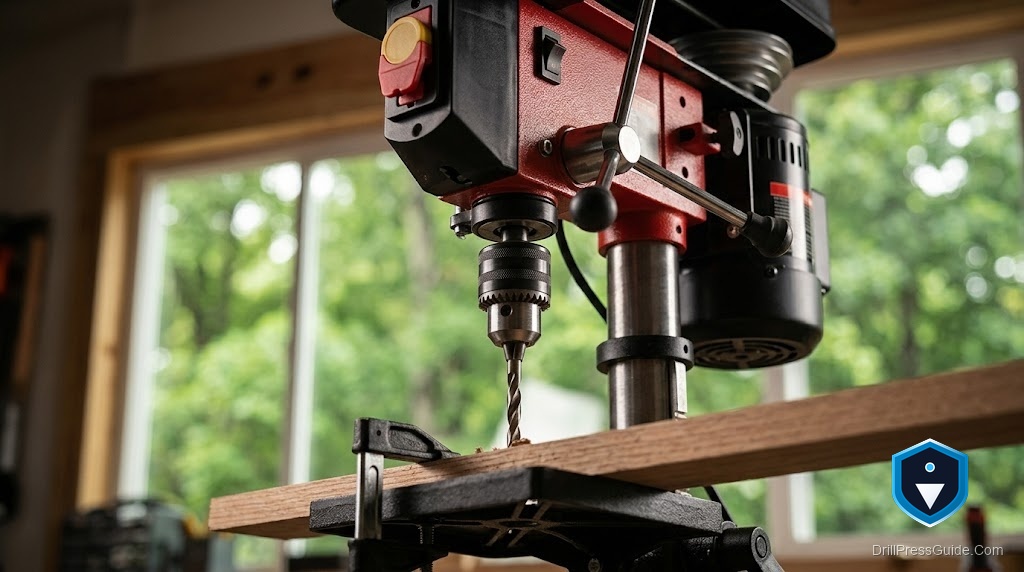
The Delta 8-inch drill press 11-950 has a small, loyal following, and once you spend time with one it is easy to see why. It is a compact bench press from an era when even entry machines were built with cast iron and induction motors, and that construction is exactly what has kept so many of them running long after the model left Delta’s catalog. A closer look at the 11-950, its build, how it stacks up against its 12-inch sibling, and what to watch for, tells you whether one of these survivors deserves a spot on your bench.
The Delta 11-950 is an 8-inch benchtop drill press with a 1/3 HP induction motor on 110-120V, five spindle speeds (620, 1,100, 1,720, 2,340, and 3,100 RPM) via a stepped-pulley belt, a 4-inch throat, about 2 inches of quill feed, a small cast table around 6-1/2 inches, and a keyed chuck. It is discontinued, so support comes from archived manuals, used parts, and standard consumables.
Straight take: the 11-950’s appeal is its build quality and simplicity, cast-iron and a smooth induction motor in a small package. It is worth a closer look, and worth buying used, if you want a durable compact press and understand that its 8-inch reach and short travel are the trade for that small footprint.
Build quality: why these last
What separates the 11-950 from disposable modern budget presses is what it is made of. The head and table are cast iron, which damps vibration and holds alignment, and the motor is an induction unit rather than a screaming universal motor, so it runs quietly and tends to last. The stepped-pulley belt drive is about as simple as a mechanism gets, with few parts to wear and nothing electronic to fail. This combination is why so many 11-950s are still in service: there is very little on the machine that time destroys, apart from the belt and chuck, which are replaceable.
That build is the machine’s real story. You are not buying features; you are buying a small, solid tool that was made to keep working.
The 11-950 next to the 11-990
The most useful comparison is to Delta’s 12-inch 11-990, its close relative. Both share the 1/3 HP induction motor and the same five-speed range, so their drilling character is nearly identical. The difference is reach: the 11-990’s 12-inch swing and larger table handle wider workpieces and a bit more quill travel, while the 11-950’s 8-inch swing and smaller 6-1/2-inch table are more compact. If bench space is tight and your parts are small, the 11-950 is the smarter fit; if you regularly work wider stock, the 11-990 is worth the extra footprint. Neither out-powers the other, so choose on size, not muscle.
What to watch for
Before committing to a used 11-950, check the mechanical basics: a smooth, low-runout quill; a motor that starts promptly and runs quietly; pulleys free of cracks; and a flat, un-cracked table with a column clamp that locks solid. These are the parts that decide whether the machine is a keeper or a donor. The consumables are easy: a replacement V-belt for the Delta 11-950 restores a glazed or cracked belt, a 5/8-inch keyed chuck with MT2 arbor replaces a worn chuck once you confirm the taper, and a universal ratcheting chuck key covers a lost key. A drill press vise squares small parts on the modest table.
The honest flaws
The 11-950’s limits come with its size. The small 6-1/2-inch table is cramped for larger work and usually wants an auxiliary top, the roughly 2-inch quill travel makes deep holes a staged job, and the 1/3 HP motor has no interest in heavy steel or large bits. And as a discontinued machine, structural spares are scarce, so a missing casting or pulley is a real problem, buy complete. These are honest constraints, not reasons to avoid the press, unless your work exceeds them.
Who should buy it, and who should skip it
Buy a used 11-950 if you value cast-iron build and a quiet induction motor in a compact press, your work is small parts and light drilling, and you find a complete, smooth-running example. It is one of the better small bench presses to still show up secondhand.
Skip it if you need wider reach (look at the 11-990), deeper holes, or steel-drilling power (look at a floor press), or if you want factory support and modern variable speed. Do not buy an incomplete 11-950 hoping its small-run castings will surface later.
Conclusion: a small survivor worth knowing
The Delta 11-950 earns its closer look through build quality rather than features.
- 8-inch swing, 1/3 HP induction motor, five speeds (620 to 3,100 RPM), 4-inch throat, ~2-inch quill feed.
- Cast-iron construction and a simple belt drive are why so many still run.
- Shares its drivetrain with the 12-inch 11-990; choose between them on reach, not power.
- Buy a complete, smooth runner; step up for wider, deeper, or heavier work.
FAQ
What makes the 11-950 worth a closer look? Its cast-iron construction, quiet induction motor, and simple belt drive, which together explain why so many still run decades on.
How does the 11-950 compare to the 11-990? They share the 1/3 HP motor and five speeds; the 11-990 adds 12-inch reach and a larger table, while the 11-950 is more compact.
What are the 11-950’s speeds? Five spindle speeds: 620, 1,100, 1,720, 2,340, and 3,100 RPM.
What should I check on a used one? Quill smoothness and runout, motor start and noise, crack-free pulleys, and a flat table with a solid-locking column clamp.
What consumables does it need? A matching V-belt, a keyed chuck sized to the spindle taper, and a chuck key, all standard and available.
How deep can it drill? About 2 inches per pull, limited by quill feed, so deep holes need staged plunges.
Is it good for steel? Light metal only. The 1/3 HP motor is not built for heavy steel or large-diameter bits.
References
- Delta 11-950 8-inch Bench Drill Press Manual (PDF): https://www.mikestools.com/download/Delta_Drill_Press_Owners_Manuals/Delta_11-950.pdf
- Delta 11-950 Instruction Manual (ManualsLib): https://www.manualslib.com/manual/660558/Delta-11-950.html
- Delta 11-990 12-inch Bench Drill Press Manual (sibling comparison, PDF): https://www.mikestools.com/download/Delta_Drill_Press_Owners_Manuals/Delta_11-990.pdf