Delta 11 990 Drill Press Cost: How Size, Condition, and Parts Support Matter
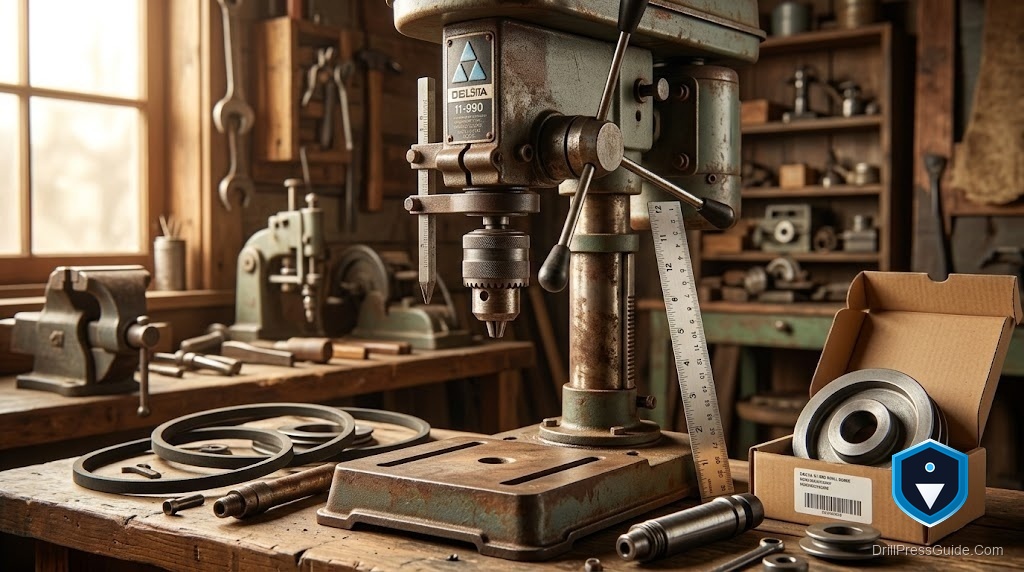
When people search the cost of a Delta 11-990 drill press, they are almost always looking at the used market, because the 11-990 is discontinued and no longer sold new. That changes the question entirely. Instead of comparing sticker prices, you are judging what a particular used machine is worth to you, and that comes down to three things: the size and capability you actually need, the condition of the specific press in front of you, and whether the parts it needs are still available. Understanding those cost drivers is how you avoid overpaying for a tired machine or walking away from a bargain.
The Delta 11-990 is a 12-inch benchtop drill press with a 1/3 HP induction motor on 115V, five spindle speeds (620, 1,100, 1,720, 2,340, and 3,100 RPM), a 1/2-inch keyed chuck, and roughly 2-3/8 inches of spindle travel. It is discontinued, so its real-world cost is set by the used market and by what condition and parts support each example brings.
Straight answer: the value of an 11-990 tracks its completeness and mechanical health far more than its age. A complete, smooth-running machine with a sound motor, quill, and pulleys is worth pursuing; one missing castings or with a rough spindle is a parts donor no matter how tempting it looks. Judge the machine, not the label.
Size and capability as a value driver
The 11-990’s 12-inch swing is its main advantage over Delta’s smaller 8-inch presses like the 11-950. That extra reach, to the center of a 12-inch board, plus a larger table and slightly more spindle travel, makes it more versatile for real project work. If your work genuinely uses that capacity, the 11-990 is worth more to you than a smaller press. If it does not, you would be paying for reach you will never use, and a smaller machine represents better value. So the first cost question is honest: does your work need 12 inches of swing?
The 1/3 HP motor and five speeds place it firmly in the wood-and-light-metal class. It is not a heavy-steel machine, and no amount of condition changes that, so do not value it as something it is not.
Condition: the biggest variable
Condition swings the worth of a used 11-990 more than anything else. Check these before committing:
- Spindle and quill: Feel for runout and rough travel. A smooth, tight quill is essential; a worn one is expensive or impossible to fix.
- Motor: It should start promptly, run quietly, and hold speed. A hesitant or noisy motor is a major mark against value.
- Pulleys and belt: Cracked pulleys are hard to replace; a glazed belt is cheap and expected.
- Table and column: Look for a flat, un-cracked table and a straight column with a clamp that locks solidly.
- Completeness: Missing chuck, guard, or table-raising hardware all reduce what the machine is worth.
A press that passes these is worth real money. One that fails several is worth only what its good parts are.
Parts support and ongoing cost
Because the 11-990 is discontinued, factor in the cost of the parts it will need. The good news is that the routine wear items are cheap and available: an aging V-belt is replaced by measuring the loop and fitting the matching size, a worn 1/2-inch chuck is swapped for a 5/8-inch keyed chuck with MT2 arbor once you confirm the spindle taper, and a missing key is a universal ratcheting chuck key. A drill press vise is an inexpensive accuracy upgrade. What is not cheap or easy is anything model-specific and structural, so budget your offer around whether those parts are present and sound.
The honest flaws that affect value
Two honest points. First, discontinuation means no new-machine warranty and no guaranteed factory spares, so a used 11-990 carries the risk that a structural part could fail with no easy replacement; that risk should temper what you pay. Second, the 1/3 HP, five-speed design is capable but dated next to a modern variable-speed press, so you are buying cast-iron durability, not convenience. Value it accordingly.
Who should buy one, and who should skip it
Pursue an 11-990 if you want a 12-inch cast-iron bench press, you have inspected a complete and smooth-running example, and you value durability over modern features. That machine can be a genuine long-term keeper.
Skip it if the press is incomplete or mechanically rough, or if you want warranty-backed convenience and low-friction parts support; a current variable-speed benchtop press is the better value there. Do not let a low asking figure lure you into a machine that needs parts you cannot get.
Conclusion: judge condition and completeness, not the label
The worth of a Delta 11-990 is decided by the specific machine, not by its name.
- 12-inch swing, 1/3 HP induction motor, five speeds, 1/2-inch chuck, ~2-3/8-inch travel, discontinued.
- Value it higher only if your work genuinely uses the 12-inch capacity.
- Condition of the spindle, motor, pulleys, and castings is the biggest value driver.
- Routine consumables are cheap and available; structural parts are not, so inspect before buying.
FAQ
Is the Delta 11-990 still sold new? No. It is discontinued, so its cost is set by the used market and by the condition of each example.
What determines a used 11-990’s worth? Completeness and mechanical health above all, then whether your work actually needs its 12-inch capacity.
What should I inspect before buying? Spindle and quill smoothness, motor start and noise, pulley and belt condition, a flat un-cracked table, and completeness.
What parts are easy to get? The V-belt, chuck, and chuck key are standard consumables. Match the belt by measuring and confirm the spindle taper for a new chuck.
What parts are hard to get? Model-specific structural parts like castings, the quill, and pulleys, which is why completeness drives value.
How does it compare to the 11-950? The 11-990 has a larger 12-inch swing and table versus the 8-inch 11-950, making it more versatile if you need the reach.
Is it powerful enough for steel? It handles light metal. The 1/3 HP motor is not built for heavy steel or large bits regardless of condition.
References
- Delta 11-990 12-inch Bench Drill Press Manual (PDF): https://www.mikestools.com/download/Delta_Drill_Press_Owners_Manuals/Delta_11-990.pdf
- Delta Drill Press owner’s manuals archive: https://www.mikestools.com/Delta-Drill-Press-Owners-Manuals
- Delta Machinery, manuals and parts support: https://www.deltamachinery.com/support/manuals