
Delta 1/3 HP Drill Press: Specs, Capacity, Parts, and Owner Notes
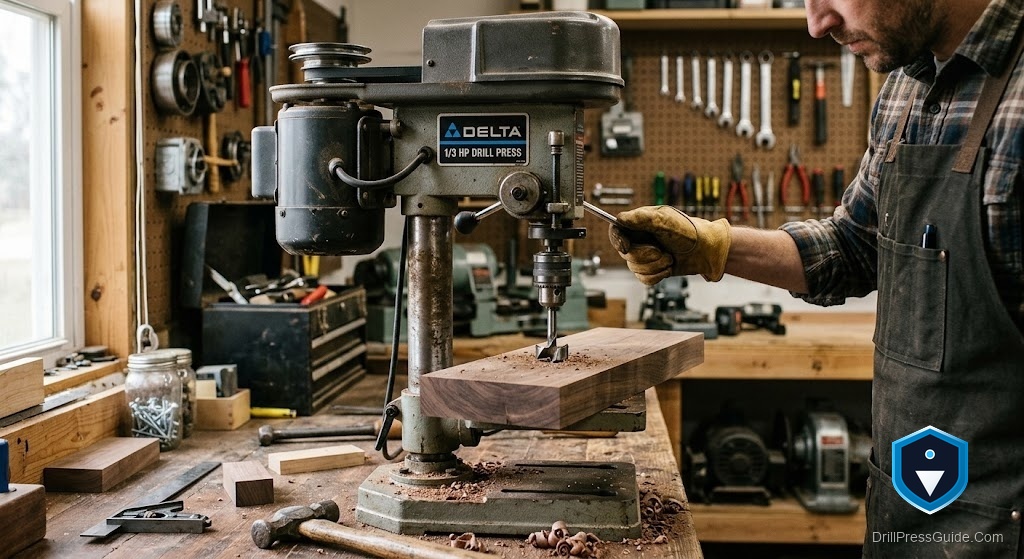
If you have ever used a Delta benchtop drill press in a school shop, a maker space, or a friend’s garage, there is a good chance it was a 1/3 HP machine. This is the power rating behind Delta’s most common bench presses, the 8-inch 11-950 and the 12-inch 11-990 among them, and it is the class that quietly did the bulk of hobby and light-shop drilling for years. Knowing the specs, capacity, and parts picture of the Delta 1/3 HP drill press tells you most of what you need to buy, use, or maintain one.
The Delta 1/3 HP drill press is a benchtop machine built around a 1/3 horsepower induction motor running on 110-120V, driving a five-speed stepped-pulley system with spindle speeds of 620, 1,100, 1,720, 2,340, and 3,100 RPM. It appears in the 8-inch model 11-950 and the 12-inch model 11-990, both with cast-iron heads and tables, keyed chucks, and a couple of inches of quill travel. These models are discontinued, so parts come from Delta’s network, archived manuals, and standard consumables.
Straight answer: the 1/3 HP class is ideal for wood and light-to-moderate metal on a bench. Its five speeds and induction motor cover ordinary drilling well, but the modest horsepower and short quill travel are real limits. Identify your specific model (11-950 or 11-990) for exact parts, and treat belts, chucks, and keys as the routine wear items.
Specs and what they mean
The five spindle speeds are the heart of using one well. The chart, printed inside the belt cover, tells you which pulley steps give each speed: 620 RPM at the low end for large bits and metal, up to 3,100 RPM for small bits in wood. The 1/3 HP induction motor runs quietly and smoothly, which is a genuine advantage over the noisy universal motors on some budget presses, and it has enough torque for everyday holes.
Capacity is where honesty matters. The 8-inch 11-950 reaches the center of an 8-inch board with a small 6-1/2-inch table and about 2 inches of quill travel; the 12-inch 11-990 reaches a 12-inch board with more table and a bit more travel. Both are bench machines sized for parts, not for tall or heavy workpieces.
Parts and consumables
Because these models are discontinued, the smart approach is to keep the wear items current with standard parts. The V-belt is the first thing to replace on an aging press; for the 8-inch 11-950, a replacement V-belt for the Delta 11-950 matches directly, and for other models you should measure the loop before ordering. The keyed chuck wears over time; a 5/8-inch keyed chuck with MT2 arbor replaces it once you confirm the spindle taper, and a lost key is handled by a universal ratcheting chuck key. A drill press vise makes the small table safer and more accurate.
The honest flaws
The 1/3 HP class has two limits worth stating plainly. First, power: it is fine for wood and light metal, but push a large hole saw or bore big holes in thick steel and it will bog. Match the bit to the motor. Second, the short quill travel, around 2 inches on the smaller models, caps how deep you can drill in a single pull, so deep holes need staged plunges. Neither flaw is a dealbreaker for the work these presses were built for, but both define the ceiling, and no belt or chuck upgrade raises it.
Who should own one, and who should not
Choose a 1/3 HP Delta if you do hobby woodworking, general household drilling, or light metalwork on a bench, and you find a complete, running 11-950 or 11-990. The smooth induction motor and cast-iron build make it a pleasant, accurate machine for its class.
Skip it if you regularly drill large holes in steel or need deep single-pull holes; a 3/4 HP floor press serves better. And avoid an incomplete used machine missing its pulleys, quill, or castings, since those are the hard parts to source. Do not expect bench-class 1/3 HP power to behave like a floor machine.
Conclusion: the everyday bench press, understood
The Delta 1/3 HP drill press is the workhorse of the bench-press world, and knowing its class makes ownership simple.
- 1/3 HP induction motor, five speeds (620 to 3,100 RPM), in the 8-inch 11-950 and 12-inch 11-990.
- Best for wood and light-to-moderate metal; the power and ~2-inch travel are the limits.
- Replace belts, chucks, and keys as routine wear items; identify your model for exact fit.
- Step up to a 3/4 HP floor press for heavy steel or deep holes.
FAQ
Which Delta models are 1/3 HP? The common benchtop models include the 8-inch 11-950 and the 12-inch 11-990, both built around a 1/3 HP induction motor.
What are the spindle speeds? Five speeds: 620, 1,100, 1,720, 2,340, and 3,100 RPM, set by moving the belt across stepped pulleys.
What can a 1/3 HP Delta drill? Wood and light-to-moderate metal. Large holes in thick steel will bog the motor and are better suited to a floor press.
What belt does the 11-950 use? A V-belt matched to the 8-inch model; a direct replacement is available. For other models, measure the old belt before ordering.
What chuck and taper does it use? A keyed chuck on a Morse taper or JT33-style mount depending on the model. Confirm the spindle taper before replacing it.
How deep can it drill in one pass? Around 2 inches on the smaller models, limited by quill travel, so deep holes need staged plunges.
Are these models still made? No. The 11-950 and 11-990 are discontinued, so parts come from Delta’s network, archived manuals, and universal consumables.
References
- Delta 11-950 8-inch Bench Drill Press Manual (PDF): https://www.mikestools.com/download/Delta_Drill_Press_Owners_Manuals/Delta_11-950.pdf
- Delta 11-990 12-inch Bench Drill Press Manual (PDF): https://www.mikestools.com/download/Delta_Drill_Press_Owners_Manuals/Delta_11-990.pdf
- Delta 11-950 Instruction Manual (ManualsLib): https://www.manualslib.com/manual/660558/Delta-11-950.html


