
Powermatic 1150 Drill Press Specs: A Detailed Technical Reference
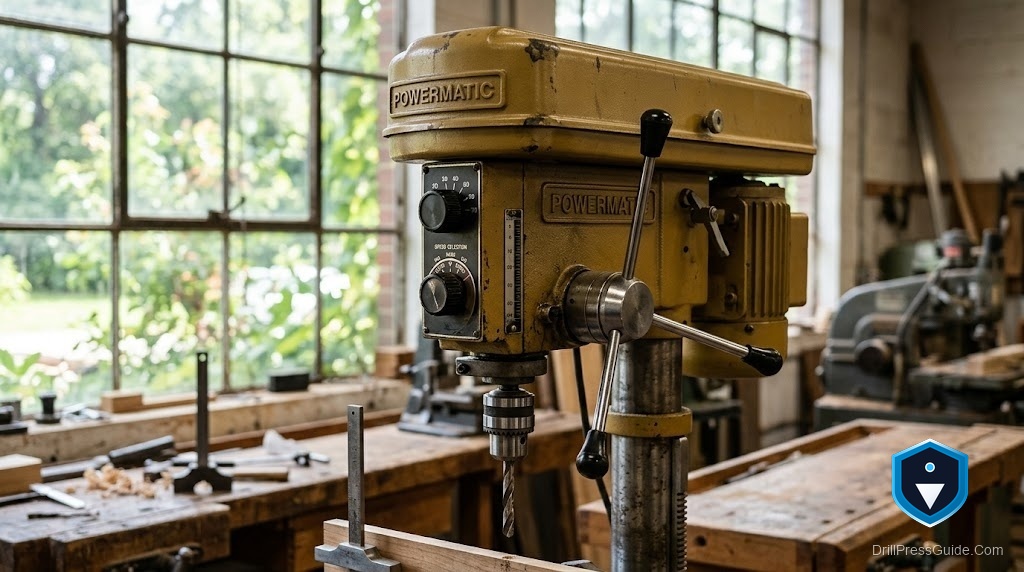
If you’re comparing the Powermatic 1150 to other machines, or verifying specifications for tooling or workholding decisions, this is the reference you need. We cover the full technical spec set, point out the key differences between the 1150 and its variants, and flag the specifications that matter most for real shop decisions.
Full Specification Table
| Specification | Powermatic 1150 / 1150A |
|---|---|
| Swing | 15 inches |
| Throat depth | 7-1/2 inches |
| Spindle travel (quill) | 4-3/4 inches |
| Number of speeds | 16 |
| RPM range | 170 – 3,050 RPM |
| Lowest RPM | 170 RPM |
| Highest RPM | 3,050 RPM |
| Motor | 1 HP, 115V/230V single phase |
| Spindle taper | MT3 |
| Chuck capacity | 5/8 inch |
| Chuck taper | JT33 |
| Table size | 15” × 16” |
| Table tilt | ±45° |
| Table material | Cast iron |
| Table height adjustment | Rack and pinion |
| Column diameter | 3-3/8 inches (verify for your model year) |
| Machine height | Approximately 66 inches |
| Machine weight | Approximately 218 lbs |
Key Specs in Context
4-3/4” Spindle Travel
This is the most underappreciated spec on the 1150. Most home-shop drill presses offer 2 to 3 inches of quill travel. The 1150’s 4-3/4 inches lets you drill deep holes in thick stock, use long boring bits, and run mortising attachments — operations that are simply impossible on smaller machines.
MT3 Spindle Taper
MT3 is a heavier interface than MT2. It provides a more rigid arbor-to-spindle connection, which matters when you’re running 1-inch and larger boring bits. The tradeoff: MT3 tooling is slightly more expensive than MT2.
For the chuck:
- An MT3 chuck arbor assembly is the correct spindle interface
- Pair it with a JT33 keyed chuck for a complete assembly
170 RPM Minimum Speed
The low end of 170 RPM is what allows the 1150 to run large-diameter hole saws and annular cutters in steel — operations that would stall a 1/3 HP consumer machine at 600 RPM. For metalwork on a serious scale, this spec alone justifies the machine.
16-Speed Range
Sixteen discrete speeds across that 170–3,050 RPM range gives you fine-grained control over cutting conditions. For materials like acrylic, brass, aluminum, mild steel, stainless, cast iron, hardwood, and softwood, each has an optimal speed window for clean holes and long bit life.
1150 vs. 1150A: What Changed
Powermatic updated the 1150 to the 1150A. The changes vary by production year, but generally include:
- Updated motor mounting and head casting
- Revised depth stop design
- Updated table locking mechanism
Parts from the 1150 do not universally cross to the 1150A. Verify your variant before ordering.
Workholding for the 1150’s Table
At 15” × 16”, the 1150’s table is large enough for serious work. A 4-inch drill press vise is the standard recommendation. For production work, a Palmgren vise provides better hold-down force.
Drive Belt Upgrade
A link belt on the 1150 is a direct improvement — lower vibration, easier tension adjustment, no splice joint pulses. Worth doing whenever the head cover comes off for any reason.
SEO Metadata


