
Understanding the Delta 16.5 Drill Press Model 17-900: Setup, Limits, and Support
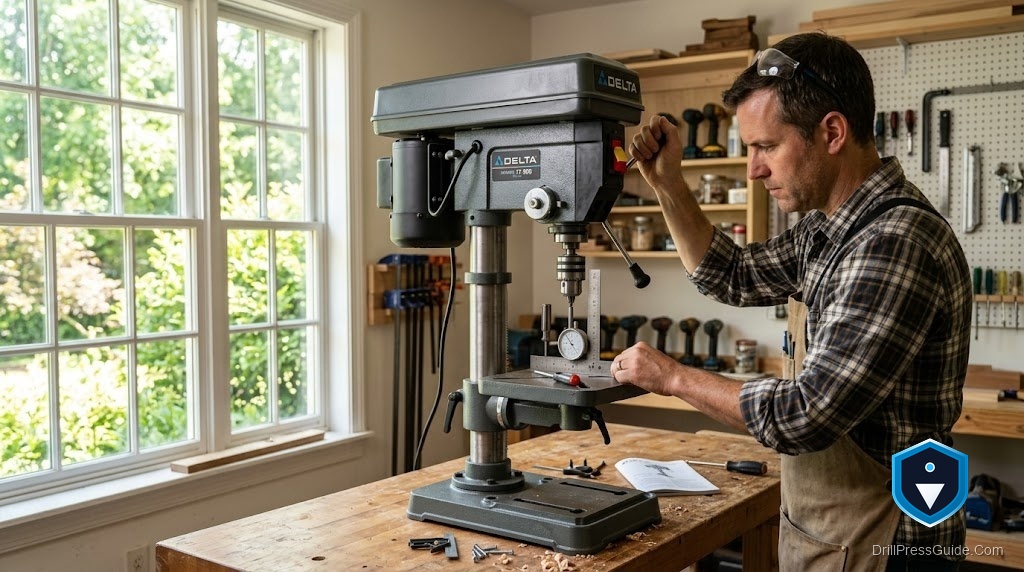
I still remember the first time I fired up a belt-drive floor drill press in a real woodworking shop. The smell of machine oil, the satisfying thunk of the quill engaging, the sense that this machine was built to outlast everyone in the room. The Delta 17-900 carries exactly that feeling — and if you’ve landed here, you’ve probably either just bought one, are thinking about buying one, or inherited one from a shop that closed down and want to know what you’ve got.
Let me give you the full picture: specs, quirks, setup, belt and chuck replacement, parts sourcing, and an honest comparison to two serious competitors.
What Is the Delta 17-900, Exactly?
The Delta 17-900 is a 16½-inch swing, 16-speed belt-drive floor-standing drill press. “Swing” means the distance from the column to the spindle centerline, doubled — so you can drill to the center of a 16½-inch-wide workpiece. It was manufactured under the Delta brand (later folded into Porter-Cable’s parent, then Stanley Black & Decker) and was a staple of small professional shops and serious home workshops for years.
The “16-speed” designation refers to the combination of two step-pulleys and a flat V-belt, which gives you a broad RPM range — typically 250–3,050 RPM depending on belt position. That range lets you drill small-diameter holes in steel at slow speeds and run large Forstner bits in wood at moderate speeds without burning the bit or the workpiece.
Full Specs: Delta 17-900
| Spec | Value |
|---|---|
| Swing | 16½ inches |
| Spindle travel (quill stroke) | 3â…› inches |
| Chuck size | â…-inch capacity, JT33 taper |
| Speeds | 16 (via two step-pulleys) |
| RPM range | 250–3,050 RPM |
| Motor | ¾ HP, 120V/60Hz |
| Table size | 13¼ × 11¼ inches |
| Table tilt | 45° left/right |
| Table adjustment | Rack-and-pinion height, rotation 360° |
| Column diameter | 3â… inches |
| Depth stop | Adjustable with lock nuts |
| Overall height | ~66 inches |
| Weight | ~175 lbs |
Model Variants: 17-900 vs. 17-900L vs. 18-900L
Delta made several iterations of this machine over the years, and the suffix letters matter.
17-900 — The base model. Standard ¾ HP motor, 16-speed, JT33 chuck taper. This is the most common unit you’ll find on the used market.
17-900L — The “L” indicates an updated production run with a slightly revised table-lock mechanism and improved rack-and-pinion casting. Functionally identical to the 17-900 for most users. Parts largely interchange.
18-900L — Bump up to 17 inches of swing and a slightly beefier column casting. The motor remains ¾ HP on most configurations. If you find an 18-900L, treat it like a 17-900L with slightly more table reach.
The key practical difference between runs is the switch toggle location. Earlier 17-900 units use a paddle-style switch on the left side of the head casting; later units moved to a push-button with a safety key. Both can be replaced with aftermarket safety switches that meet current UL standards.
Setup Checklist
If you’ve just received or uncrated a 17-900 (or are setting up a used one), work through this list before you drill a single hole.
- Level the base. Use a machinist’s level on the table surface. Shim the base feet if needed — an unlevel machine transmits stress unevenly to the column.
- Check column alignment. Drop a long reference rod in the chuck and use a dial indicator against the column. The column should be perpendicular to the table within .002” over 6 inches.
- Inspect the V-belt. Look for cracking, glazing, or fraying. A worn belt slips under load and throws off speed. This link-belt style replacement is worth having on hand — it installs without removing the motor or spindle and runs quieter than a solid belt on older step-pulleys.
- Seat the chuck. See the chuck section below.
- Set the depth stop. Thread the two depth-stop lock nuts onto the quill stop rod and set your reference depth before drilling.
- Test the table clamp handle. The table should lock solidly with one firm motion. If it creeps under load, the clamp bolt thread is likely worn — an easy fix with a hardware-store replacement bolt.
- Confirm the table alignment pin. The table has a pin that indexes it to 90° when you return it from a tilt. Make sure it engages cleanly.
- Lube the rack-and-pinion. A light coat of paste wax (not grease — grease collects sawdust) on the rack teeth keeps the table raising handle moving smoothly.
Belt Replacement Procedure
The 17-900 uses a standard A-section V-belt. Replacing it takes about 20 minutes once you’ve done it once.
- Unplug the machine. Non-negotiable.
- Open the belt cover by releasing the two spring latches on the top of the head casting.
- Loosen the motor mount bolts — typically two or four bolts on the motor plate. Slide the motor toward the spindle to create slack in the belt.
- Remove the old belt by walking it off the step-pulleys.
- Route the new belt over both pulleys in the speed configuration you want. The chart inside the belt cover shows which pulley groove combination gives which RPM.
- Tension the belt by sliding the motor away from the spindle until you have about ½-inch of deflection at mid-span under moderate thumb pressure.
- Retighten the motor mount bolts, close the cover, and test.
If the solid belt is difficult to install (common on machines where the motor plate has seized), the link-belt option is genuinely easier — you feed it through the gap between the pulleys without needing to move the motor as far.
Chuck Replacement and the JT33 Taper
The Delta 17-900 uses a JT33 (Jacobs Taper #33) spindle. This is a self-releasing Morse-style taper — meaning the chuck seats by friction and releases by a sharp upward knock.
To remove the chuck:
- Lower the quill fully and lock it.
- Insert the chuck removal wedge (or a flat-blade screwdriver) between the chuck body and the spindle housing, and give it a sharp tap. The chuck will drop — have a rag underneath.
To install a replacement chuck:
- Clean both the spindle taper and the chuck taper socket with a clean cloth. No oil.
- Seat the chuck by hand, aligning the taper.
- Drop the quill smartly to drive the chuck home. Some machinists tap the chuck key in each jaw slot lightly to confirm seating.
A quality 5/8” JT33 chuck like this Jacobs-pattern replacement fits the 17-900 spindle correctly and holds runout to under .003” — adequate for woodworking and light metalwork. You’ll also want a proper chuck key that matches your chuck’s key ring diameter; mismatched keys round off the key socket surprisingly fast.
Depth Stop Calibration
The 17-900’s depth stop is a simple but effective system: a threaded rod attached to the quill, with two lock nuts that contact a fixed stop block.
- Lower the quill to your target depth with a drill bit in the chuck and the bit touching your workpiece surface.
- Thread the lower lock nut down until it contacts the stop block.
- Snug the upper lock nut against the lower one to lock the setting.
- Test with a scrap piece. Adjust as needed.
For repetitive through-holes, add a small magnetic LED work light aimed at the table — seeing exactly where the bit contacts the work surface makes depth calibration much faster and more reliable.
Parts Sourcing
This is where older Delta machines get tricky. Delta power tools are now under Stanley Black & Decker, and parts support is handled through eReplacementParts.com — the most reliable source for OEM parts using the 17-900 model number. You can also search the Porter-Cable parts database since the two brands shared components post-merger.
What you’ll realistically need over the life of the machine:
- V-belt (A-section, 42” or 44” depending on variant) — generic hardware-store belts work fine
- Switch toggle/safety switch — eReplacementParts has these; confirm your voltage before ordering
- Quill spring — the return spring inside the head casting; replacements are available but require partial head disassembly
- Table bracket — the cast iron piece that rides the column; cracks are a write-off
- Chuck — see above; aftermarket JT33 chucks are widely available and often better than the OEM
Comparison: Delta 17-900 vs. JET J-2500 vs. WEN 4212T
| Feature | Delta 17-900 | JET J-2500 | WEN 4212T |
|---|---|---|---|
| Swing | 16.5” | 15” | 10” |
| Speeds | 16 | 12 | 5 |
| Motor | ¾ HP | ¾ HP | ⅔ HP |
| Chuck taper | JT33 | JT33 | JT33 |
| Table | 13¼×11¼” | 14×14” | 7.5×7.5” |
| Floor/Bench | Floor | Floor | Bench |
| Price (new) | Discontinued | ~$600–700 | ~$170–200 |
| Parts availability | Moderate (OEM)/Good (generic) | Good | Good |
| Best for | Mid-size shop, used market | New purchase, production shop | Hobbyist, limited space |
Verdict: If you’re buying new and have the budget, the JET J-2500 is the cleaner choice — better support, current production, strong dealer network. If you find a 17-900 on the used market for $150–300 in good shape, it’s a better machine than anything new in that price range. The WEN 4212T is a legitimate beginner machine but is outclassed by the 17-900 in every meaningful dimension.
Common Problems and Fixes
Runout at the chuck: Usually a worn or damaged JT33 taper on the spindle, or a chuck that’s taken a side-load hit. Replace the chuck first; if runout persists, the spindle needs inspection.
Table won’t lock: Worn clamp bolt thread or a stripped clamp handle. Hardware-store bolt replacement is a 15-minute fix.
Belt squealing: Glazed belt surface or misaligned pulleys. Try dressing the belt with a rubber eraser before replacing. Check pulley alignment with a straightedge.
Switch won’t stay on: Worn toggle contacts. Replace with an aftermarket safety paddle switch — they’re inexpensive and this is a worthwhile safety upgrade on any older machine.
Quill won’t return: Weak or broken quill spring. Requires head disassembly but is a common repair — replacement springs are available through eReplacementParts.
FAQ
Q: What does “16.5 inch swing” actually mean in practice? A: It means you can drill to the center of a board up to 16.5 inches wide. For most furniture and cabinet work, this is more than enough.
Q: Is the 17-900 good for metal drilling? A: Yes, with appropriate bits and slow speeds. Use cobalt or HSS bits, apply cutting oil, and use the lower speed ranges. The ¾ HP motor handles light ferrous metalwork without complaint.
Q: Can I use a keyless chuck on the JT33 spindle? A: Yes. Any keyless chuck with a JT33 taper mount will fit. Quality varies widely — avoid no-name keyless chucks for anything beyond light woodworking.
Q: What belt size does the 17-900 take? A: Most 17-900 variants use an A-section belt, typically 42” or 44” — check your existing belt’s markings before ordering. The link belt option works with both sizes.
Q: Is the 17-900 still supported by Delta? A: Direct Delta support is limited. eReplacementParts.com is the most reliable source for OEM parts. Generic replacements (belts, switches, chucks) from hardware stores or Amazon cover most maintenance needs.
Q: How does the 17-900 differ from the 17-900L? A: The 17-900L has a revised table-lock casting and minor production improvements. Parts largely interchange. For most purposes, treat them as the same machine.
Q: What’s the quill spring replacement like on the 17-900? A: Moderate difficulty — requires removing the head casting cover and dealing with a spring under tension. Follow a video walkthrough your first time; it’s doable for a patient DIYer.
Q: Can I add a laser guide to the 17-900? A: Yes. Aftermarket laser guides mount to the chuck housing or table post. They’re a convenience feature, not a precision tool, but useful for layout work.
Q: Is a WEN 4212T a reasonable substitute if I can’t find a 17-900? A: For casual drilling it works, but you lose swing capacity, speed range, and table size. If you’re outfitting a real shop, save up for a JET or find a used Delta.
Q: Where can I find the owner’s manual for the 17-900? A: Delta’s support site (deltamachinery.com) and eReplacementParts.com both host PDF manuals. A Google search for “Delta 17-900 manual PDF” also turns up hosted copies on woodworking forums.
Final Word
The Delta 17-900 is a machine from an era when production quality in mid-range American power tools was genuinely high. The castings are heavy, the rack-and-pinion is smooth, and the 16-speed range gives you real flexibility. Its only real weaknesses are parts availability and the fact that it’s no longer made — meaning every unit you find comes with some unknown history.
Buy one in good condition, replace the belt and chuck if there’s any doubt, and it’ll drill holes reliably for another 30 years. That’s a better value proposition than most new machines at the same street price.
SEO Metadata


