Delta Rockwell Drill Press: How the Range Breaks Down
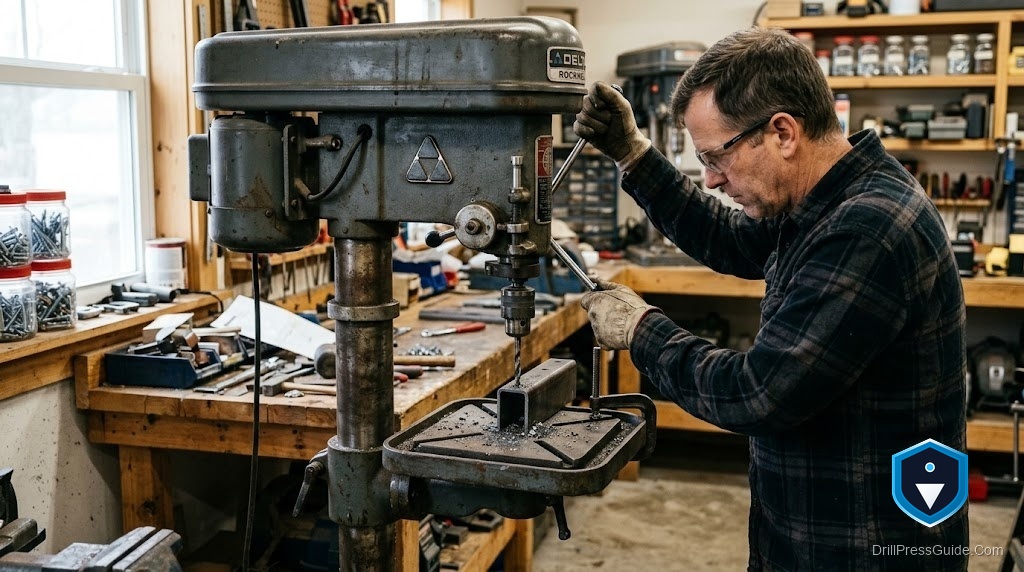
If you have been shopping vintage tools, you have seen the name in two forms: Delta, and Delta Rockwell. They are the same lineage. For a stretch of the 20th century, Delta’s machines were sold under the Rockwell Manufacturing umbrella, and the drill presses from that era, the 15-inch and 17-inch machines especially, are some of the most sought-after vintage presses on the used market today. They were built when cast iron was cheap and machines were made to last, and many are still running. Understanding how the range breaks down helps you recognize a good one when you see it.
A Delta Rockwell drill press is a vintage drill press built by Delta under the Rockwell Manufacturing name during the mid-20th century, spanning 14-inch, 15-inch, and 17-inch swings in benchtop and floor-standing configurations, known for heavy cast-iron construction, and identified by model numbers such as 15-655 and 17-600.
Short answer: the Delta Rockwell range breaks down mainly by swing (14, 15, and 17 inch) and by drive type (stepped-pulley fixed-speed versus variable-speed models). The 15-inch machines like the 15-655 are versatile shop presses, and the 17-inch machines like the 17-600 are heavier floor presses for larger work. All are discontinued, so condition and parts availability decide whether a given machine is worth buying. Here is how to read the range.
The 15-inch machines: the versatile middle
The 15-inch Delta Rockwell presses are the heart of the range and the ones most shoppers encounter. The 15-655 is a representative example: a 15-inch swing, roughly 7-1/2-inch throat depth, a 12-by-18-inch table, an MT2 spindle taper, and a variable-speed drive delivering a wide range (some configurations run 450 to 4,700 RPM). Motor options ranged from 3/4 HP up to 1-1/2 HP depending on configuration, and heavier versions were built for near-industrial duty.
These machines came in both bench and floor forms and in fixed-speed and variable-speed versions. The variable-speed models use a mechanical variable-speed drive that adjusts within a range, a premium feature in their day. Some feature a 6-inch spindle stroke, which is generous even by modern standards.
The 17-inch machines: the heavy floor presses
Step up to 17 inches and you get more swing and more mass. The 17-600 is a representative floor press: a 17-inch swing, a 3-1/2-inch column, a roughly 17-1/8-by-12-5/8-inch table, a 5-inch spindle travel, an MT2 taper, 5 speeds, a 1-HP motor, 115/230V wiring, and around 400 pounds of iron. These are serious floor machines built for larger work and heavier drilling, and they anchor a shop the way a modern 17-inch or 18-inch floor press does.
The 14-inch and utility machines
Delta Rockwell also built smaller 14-inch presses and lighter “utility” 15-inch models with smaller motors (down to 1/2 HP). These suit lighter work and smaller shops. As with the rest of the range, the model number and ID plate tell you exactly what you have, so record it before shopping parts or manuals.
Reading the drive type: fixed versus variable speed
The single most useful distinction when shopping is the drive:
Fixed-speed (stepped pulley): Change speed by moving a belt across stepped pulleys. Simple, reliable, and easy to service. High-speed models ran sets like 700, 1,150, 1,750, 2,750, and 4,250 RPM.
Variable-speed: A mechanical variable-speed drive adjusts speed continuously within a range, often while running. More convenient, but the drive mechanism needs periodic service and is a wear point to inspect on a used machine.
Knowing which you are looking at tells you both how it operates and what to check before buying.
Parts and support
Because these are discontinued, parts come from a mix of sources. Sears PartsDirect and eReplacementParts list parts for some Delta models. Specialty suppliers like Hammerscale make reproduction parts specifically for Delta Rockwell 14-, 15-, and 17-inch presses (bearing kits, feed levers, and more). M&M Tool Parts stocks some older Delta components, and VintageMachinery.org hosts scanned manuals and parts lists. For the modern Delta lineup and current parts, see our Delta drill press models and parts guide and Delta replacement parts guide.
What to check before buying
Given the age, condition is everything:
- Spindle runout: Spin a bit by hand and watch the tip for wobble. A worn chuck is cheap to fix; a bent arbor or worn spindle is a bigger job.
- Quill action: Smooth full travel with clean spring return.
- Variable-speed drive (if fitted): Cycle it through its range and listen for smooth operation; a rough or stuck drive needs service.
- Motor: Quiet, smooth start.
- Table and column: Firm locking, no deep rust that affects flatness or height adjustment.
The honest trade-offs
No warranty, unknown history. These are decades-old machines. Condition and prior care are the whole story.
Parts hunting. Common wear items are available, but some model-specific parts require patience and specialty or reproduction suppliers.
Weight. The 17-inch floor machines are heavy (around 400 pounds), which is great for stability but a real consideration for moving and placement.
The verdict
The Delta Rockwell drill press range breaks down cleanly by swing and drive type: 14-inch and utility machines for light work, versatile 15-inch presses like the 15-655 for general shop use, and heavy 17-inch floor machines like the 17-600 for larger work. All are vintage, all reward a careful pre-purchase inspection, and all can be kept running with a mix of Sears PartsDirect, reproduction parts from suppliers like Hammerscale, and the VintageMachinery archive. Buy one when the cast-iron quality and low used cost outweigh the lack of warranty and the parts hunt. For a current machine with a warranty, look at the modern Delta lineup instead.
Frequently asked questions
What is a Delta Rockwell drill press? A vintage drill press built by Delta under the Rockwell Manufacturing name in the mid-20th century, in 14-, 15-, and 17-inch swings, known for heavy cast-iron construction and long service life.
What is the difference between Delta and Delta Rockwell? They are the same lineage. Delta’s machines were sold under the Rockwell Manufacturing name for a period, so “Delta Rockwell” refers to Delta presses from that era.
What is the Delta Rockwell 15-655? A 15-inch variable-speed drill press with roughly a 7-1/2-inch throat, a 12-by-18-inch table, an MT2 taper, and a wide speed range, built in bench and floor versions with motors from 3/4 to 1-1/2 HP.
Can you still get parts for a Delta Rockwell drill press? Yes, from a mix of sources: Sears PartsDirect and eReplacementParts for some parts, reproduction specialists like Hammerscale for 14/15/17-inch parts, M&M Tool Parts, and VintageMachinery.org for manuals.
What should I check when buying a used Delta Rockwell drill press? Spindle runout, quill action, the variable-speed drive if fitted, motor condition, and table and column locking and rust. Condition is the whole value proposition on a discontinued machine.
Are Delta Rockwell drill presses good? Yes. They are heavy, well-built cast-iron machines that many owners still run daily. Quality is high; the trade-offs are age, no warranty, and some parts hunting.
How do I identify my Delta Rockwell drill press? Find the model number on the ID plate (for example 15-655 or 17-600) and use it to look up manuals and parts on VintageMachinery.org, Sears PartsDirect, or reproduction-parts suppliers.
References
- VintageMachinery.org, Delta / Rockwell drill press manuals and parts lists: https://vintagemachinery.org
- Hammerscale Technologies, reproduction Delta Rockwell drill press parts: http://www.hammerscale.com
- Sears PartsDirect, Delta drill press parts: https://www.searspartsdirect.com