
Baileigh DP-3814B Benchtop Drill Press: Specs, Capacity, Parts, and Owner Notes
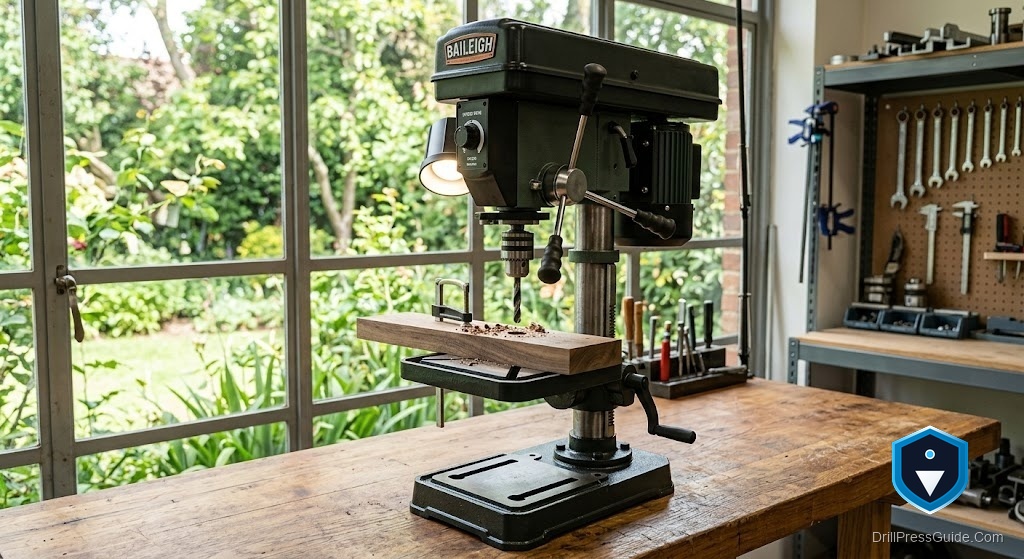
If you’ve ever wrestled with a wobbly import drill press—chasing runout, fighting a vague depth stop, squinting at a belt chart taped inside the head—you already know what you’re buying when you step up to a Baileigh. The DP-3814B is Baileigh’s mid-range benchtop offering, and it punches well above its weight class for a machine that sits on a bench rather than a floor. Let me walk you through what it actually is, what it actually does, and whether it belongs in your shop.
What Is the Baileigh DP-3814B?
Baileigh Industrial is a Green Bay, Wisconsin–based manufacturer that got its name making metal fabrication machinery—tube benders, ironworkers, press brakes. When they moved into woodworking and general-purpose shop machinery, they carried that same heavy-iron philosophy with them. The DP-3814B reflects that: it’s a 14-inch (technically “3814” = 38 cm / ~15” swing) benchtop drill press built to closer tolerances than your average big-box import.
It’s not a production machine. It’s not a Clausing or a Powermatic 2800. But for a serious hobbyist, a small production shop, or a luthier/knifemaker who needs consistent results every day, it lands in a sweet spot that the $300–$400 import market simply doesn’t reach.
Full Specs at a Glance
| Spec | Value |
|---|---|
| Swing | 15 inches (380 mm) |
| Spindle Travel (Quill) | 3-1/8 inches |
| Spindle Taper | MT#3 |
| Chuck Capacity | JT33, up to 5/8 inch |
| Chuck Included | Yes (Jacobs-style, 5/8”) |
| Motor | 3/4 HP induction, 110V single-phase |
| Speed Range | 12 speeds, ~250–3,000 RPM |
| Table Size | 13” x 13” |
| Table Tilt | ±45° left/right |
| Table Swivel | 360° on column |
| T-Slots | Yes (3, standard 5/16”) |
| Depth Stop | Micro-adjustable with lock |
| Work Light | LED |
| Laser Guide | Dual-line cross-hair |
| Spindle Lock | Yes |
| Net Weight | ~95 lbs |
| Footprint (Head) | 17” x 8” |
That MT#3 taper is worth pausing on. Most benchtop machines ship with MT#2 or JT33 directly in the quill. MT#3 gives you legitimate tooling options—shell mill adapters, Jacobs tapers, ER32 collet chucks—without adapters stacking up and killing your runout. If you ever want to drift into light milling or simply use precision drill chucks, MT#3 is the right foundation.
What Makes the DP-3814B Stand Out vs. Cheaper Imports
Walk into any big-box store and you’ll find 12–15” benchtop drill presses in the $250–$450 range. Some are fine. Most are fine enough for occasional use. Here’s where the Baileigh separates itself:
1. Column and Head Casting Quality The column on cheap imports is often thin-wall tubing, and the head casting is—generously—optimistic about its rigidity. The DP-3814B uses a heavier column diameter and a head casting that doesn’t flex when you apply feed pressure. You won’t feel the head nodding when you lean on the quill handle.
2. Quill Bearings and Runout Baileigh spec’s spindle runout at less than 0.002 inches TIR. In practice, owners report measuring 0.001–0.003” out of the box with a test indicator. That’s not CNC-machining precision, but it’s absolutely acceptable for drilling, reaming, and light mortising work. Import machines at half the price can ship with 0.005–0.010” runout.
3. The Depth Stop This sounds like a small thing until you’re drilling 200 identical shelf-pin holes and the third stop-collar you’ve bought from the hardware store spins loose again. The Baileigh uses a machined depth stop with a positive lock and micro-adjust capability. Set it once, trust it.
4. Variable Belt Drive 12 speeds across a true range of ~250 to 3,000 RPM via step-pulley V-belt drive. The belt changes are quick with the tension release lever, and the pulley alignment is good from the factory.
5. Work Light and Laser The dual-line laser and the LED work light aren’t gimmicks on this machine—they’re positioned usefully and the laser lines actually converge accurately near the chuck center with minimal adjustment. Many owners use the laser only for rough positioning and then lock down with a fence, but it’s well-executed for what it is.
Honest Limitations
No machine is without compromise. Here’s what I’d tell a friend before they ordered:
- It’s heavy for a benchtop. At ~95 lbs, you won’t be moving it casually. Plan the location before you set it down.
- The table isn’t cast iron. It’s a thick steel stamping. For most work this is fine, but if you need a guaranteed flat reference surface you’ll want to check it with a straightedge.
- No spindle speed readout. Unlike some competitors that include a digital tachometer, the DP-3814B uses a speed chart. Measure your RPM with a cheap tach if you’re doing precise material-specific work.
- Parts availability. Baileigh is good about support, but it’s not a Sears with 40 years of aftermarket inventory. Budget for buying a spare V-belt when you purchase the machine.
- Price. At its MSRP, it costs roughly twice a comparable WEN or Rikon. That premium is earned, but it’s real.
How It Compares: Baileigh DP-3814B vs. JET JDP-15B vs. Powermatic PM2800B
| Feature | Baileigh DP-3814B | JET JDP-15B | Powermatic PM2800B |
|---|---|---|---|
| Swing | 15” | 15” | 15” |
| Motor | 3/4 HP | 3/4 HP | 1 HP |
| Spindle Taper | MT#3 | MT#3 | MT#3 |
| Speeds | 12 | 12 | Variable (VS) |
| Table | Steel | Cast Iron | Cast Iron |
| Digital Readout | No | No | Yes |
| Approximate Price | ~$700–$900 | ~$650–$750 | ~$1,200–$1,500 |
| Warranty | 1 year | 2 years | 5 years |
The JET JDP-15B is the most natural competitor. JET has decades of dealer support and the JDP-15B has a cast iron table where the Baileigh uses steel—that matters to machinists and luthiers who use the table as a reference. The JET’s two-year warranty also edges out Baileigh’s one year. That said, owners who’ve run both report the Baileigh has a slight edge in spindle smoothness out of the box.
The Powermatic PM2800B is a tier above both. The variable-speed system, cast iron table, and five-year warranty justify the price premium for a production environment. If you’re drilling 40 hours a week, step up to the Powermatic. If you’re drilling 4 hours a week, the Baileigh keeps up fine.
Accessories Worth Adding
Once you’ve set the machine up and gotten comfortable with it, a few low-cost upgrades transform the experience:
Chuck Upgrade The stock chuck does the job, but if you ever notice drift or you’re doing precision reaming, swapping to a JT33 keyed chuck is an easy upgrade—it seats directly on the MT#3 via a JT33 adapter and gives you more positive grip across the full 5/8” range.
Spare Chuck Key Buy a spare chuck key and zip-tie it to the cord. You will lose the original one. Everyone does.
Link Belt The stock V-belt is adequate, but a link belt eliminates the flat-spot vibration you sometimes get from a belt that’s been sitting coiled in a box. The difference in smoothness at low speeds is immediately noticeable.
Drill Press Vise The T-slots take a standard 5/16” T-bolt. A WEN 3” vise drops right in and gives you real workholding for metal or small parts without a lot of drama. For larger pieces, the 4” drill press vise is worth the few extra dollars.
Work Light The built-in LED is decent but directional. A magnetic LED work light that clamps to the column gives you shadow-free illumination right where you need it. Alternatively, a gooseneck LED mounts to the bench and is repositionable mid-task.
Who Is the Baileigh DP-3814B Best For?
- Woodworkers and furniture makers who drill dozens of times per session and need repeatable depth.
- Knifemakers and bladesmiths who need runout control for pin and rivet holes.
- Luthiers who drill bridge pin holes, tuner holes, and truss rod routes and cannot tolerate wobble.
- Small production shops running a single operator who needs one machine to handle 8 hours a day without drama.
- Serious hobbyists who’ve outgrown their import machine and don’t want to spend full Powermatic money.
It is not ideal for:
- Occasional use (just get a WEN or Rikon and call it a day).
- Heavy repetitive production (step up to the Powermatic or a floor-standing Clausing).
- Anyone who needs a digital speed readout to dial in materials precisely.
Frequently Asked Questions
Q: What chuck size does the Baileigh DP-3814B use? A: The machine uses a JT33 taper chuck with a 5/8-inch capacity. The spindle is MT#3, so you can swap in various aftermarket chucks or tooling holders using a JT33-to-MT3 adapter.
Q: Is the DP-3814B good for metal drilling? A: Yes, within reason. At 250 RPM minimum, you can comfortably run larger bits in mild steel and aluminum. For production metal drilling, look at the Baileigh DP series floor models, but for occasional metalwork it performs well.
Q: Can I replace the stock belt with a link belt? A: Absolutely, and many owners recommend it. The belt access door makes the swap straightforward. A standard FHP link belt in the correct width and length fits without modification.
Q: Does the laser actually work well? A: Better than most. The dual-line system is pre-aligned from the factory and converges close to center. Expect to do a small calibration when you first set it up, but it holds after that.
Q: Where do I find replacement parts? A: Contact Baileigh Industrial directly through their website (baileighindustrial.com) or their dealer network. Parts availability is good for current models; older discontinued Baileigh machines can be more challenging.
Q: What’s the warranty? A: One year from date of purchase through an authorized Baileigh dealer.
Q: How does it ship? A: Typically freight on a pallet. Budget for a liftgate charge if you don’t have a loading dock, and plan for two people to move the crate.
Q: Can the table hold a cross-slide vise? A: Yes. The T-slots accept standard 5/16” T-bolts. A cross-slide or drill press vise bolts down easily.
Q: Is 3/4 HP enough? A: For benchtop work—wood, plastics, aluminum, light steel—yes. You won’t bog it down in normal use. For aggressive large-diameter Forstner bits in hardwood, slow your RPM and take your time.
Q: How does it compare to older Baileigh benchtop models? A: Earlier Baileigh benchtop presses (DP-1500VS, DP-1512B-HD) used a similar design philosophy but slightly different speed ranges and belt configurations. The 3814B is the current iteration and reflects incremental improvements in the quill assembly and depth stop.
Final Verdict
The Baileigh DP-3814B is a machine you buy when you’re tired of fighting your equipment and want to spend your shop time making things instead of compensating for runout and slipping stops. It’s not perfect—the table could be cast iron, the warranty could be longer, and the price requires a real budget conversation. But if the budget is there, it’s a machine that earns its keep every single day.
SEO Metadata


