Dremel 220-01 Workstation Drill Press: Honest Review and Setup Guide
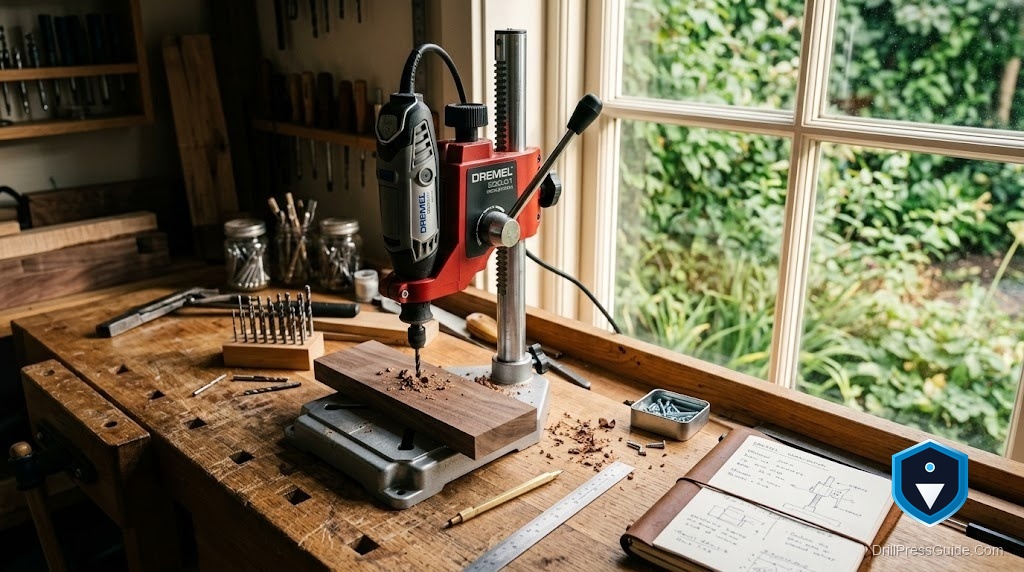
The Dremel 220-01 Workstation arrived at my bench in a slim box, and I set it up in about ten minutes. If you already own a Dremel rotary tool and you have ever tried to drill a straight, repeatable hole by hand, this accessory is the obvious next step. It turns your rotary tool into a compact drill press with an adjustable table, a depth stop, and a plunge mechanism, all without a new motor to buy or a wall outlet to claim.
Here is the short version: the Dremel 220-01 is a bench-mounted accessory, not a standalone tool. It works with most Dremel corded rotary tools and several cordless models. It holds the tool vertically, lets you plunge to a set depth with both hands free to guide the workpiece, and packs down small when the project is done. It is genuinely useful for small, precise work. It also has limits that matter, and I want you to know them before you decide.
What the 220-01 actually is
The Workstation is a cast-plastic frame with a column, a table, and a plunge arm. Your Dremel rotary tool clips into the holder at the top. You press down on the arm to plunge the bit, and a depth stop set by a thumb wheel limits how deep it goes.
There is a table that adjusts up and down and a work surface designed for small parts. A flexible shaft attachment port also lets you use the Workstation as a router table or a shaping station when you swap the head, which is a nice touch.
None of that changes the fundamental reality: it is a guide for a small, high-speed rotary tool, not a true floor press or bench press. The force you can apply, the workpiece size, and the bit diameter are all bounded by the Dremel’s power and the frame’s reach.
Specs and what they mean in practice
| Spec | Dremel 220-01 Workstation |
|---|---|
| Type | Drill press attachment for Dremel rotary tools |
| Compatible tools | Most Dremel corded rotary tools, select cordless |
| Drilling depth (max) | About 1-1/2 inches |
| Table | Adjustable height |
| Depth stop | Thumb wheel, adjustable |
| Flex shaft port | Yes |
| Chuck | Uses Dremel collet/chuck on the rotary tool |
| Bit size | Up to about 1/4 inch through the Dremel collet |
The 1-1/2 inch maximum drilling depth is honest for most Dremel bits and accessories, but longer bits can reach deeper. The working constraint is often the collet, since Dremel collets are small by design.
What it does well
Small, straight holes are where this setup shines. Drilling through thin wood, plastic, PCB boards, and craft materials is clean and repeatable because the Workstation holds the tool at a true 90 degrees and the depth stop means every hole is the same depth.
For jewelry work, model making, and light woodworking, the Workstation removes the hand-steadying problem entirely. You still need sharp bits and appropriate speed settings on the Dremel, but the frame handles the rest.
The dual-function table (drill press and router/shaping station) is also a real advantage for a small shop where one accessory that does multiple jobs earns its footprint.
The honest flaws, and who should skip it
The plastic frame flexes slightly under load, especially at the column and pivot. For very small bits at high speed in thin material, that flex is not a problem. For anything approaching 1/4 inch in harder material, it introduces a small amount of wobble that a cast-iron bench press does not.
The other limit is table size. Workpieces larger than a few inches will overhang, and overhang on a light plastic frame either tips the table or rocks the whole unit. You need a heavy workbench underneath and, for anything bulky, a clamp to hold the stock flat.
Do not buy this if you want to drill wood trim, furniture parts, or any material that a 3/8-inch bit in a real press handles. The Dremel 220-01 is an accessory for a rotary tool, and it shares that tool’s ceiling. The right buyer is someone who already owns a Dremel and needs precise small holes without buying a whole new machine.
Compatible rotary tools
The 220-01 was designed around most standard Dremel corded rotary tools. It works with the Dremel 3000, 4000, 4300, 8220, and similar models. Confirm your tool’s body shape against the Workstation’s holder before buying, since off-brand rotary tools or very new cordless models may not seat properly.
If you do not already own a Dremel, the Dremel 4300 rotary tool is the model most users pair with the Workstation. It has adjustable speed from 5,000 to 35,000 RPM, 5 attachments, and 40 accessories in the kit, and its universal holder design fits the 220-01 without adapters. Its high speed ceiling and kit depth also give you the most flexibility across different materials.
For the Workstation itself, the Dremel 220-01 Workstation is the standard version and the one most Dremel owners reach for. It includes the base, column, drill press head, and the flex shaft port, and the setup is mostly tool-free.
Accessories worth adding
A universal chuck key, such as a chuck key designed for small drill chucks, helps if you are using a small keyed chuck attachment instead of the standard Dremel collet. Not every user adds a chuck, but those who drill thin metal benefit from the firmer grip it provides. Confirm the key matches your collet or chuck size before ordering.
Good lighting is essential for fine work. A flexible LED gooseneck lamp clamps to the workbench or to the column and puts light exactly where the bit enters the material. For the kind of detailed, precise work the 220-01 enables, eliminating shadows saves a lot of misplaced holes.
The verdict
The Dremel 220-01 Workstation is a smart buy for Dremel owners who want vertical accuracy and depth control in a compact footprint. It does not replace a real drill press. It makes your rotary tool capable of jobs that frustrate free-hand drilling.
Three things to carry:
- Own a compatible Dremel before you buy the Workstation. The tool is the engine, the 220-01 is the frame.
- Use it for small, precise work in thin or soft materials. The frame flexes on anything heavier.
- Secure large workpieces with a clamp to the bench, not just the Workstation table.
FAQ
What rotary tools does the Dremel 220-01 work with? Most Dremel corded rotary tools, including the 3000, 4000, and 4300. Check your tool’s body shape against the holder before buying. The 4300 is the most commonly paired model.
Can the Dremel 220-01 drill wood? Yes, thin to medium wood with small bits. It is not suited for thick hardwood or large-diameter bits that a real bench press handles.
How deep can the Dremel 220-01 drill? About 1-1/2 inches with standard Dremel bits. The depth stop lets you set and repeat that depth across multiple holes.
Is the 220-01 good for PCB drilling? Yes. Small, precise holes in circuit boards are exactly what it excels at, and the depth stop prevents blowout on the bottom layer.
Do I need a separate chuck? Not necessarily. The Workstation uses the Dremel’s standard collet. A small keyed chuck attachment improves grip for some users, especially in metal.
Can the 220-01 flex shaft port be used for routing? Yes. With a Dremel flexible shaft and appropriate accessories, the Workstation converts to a router or shaping table. It is a useful second mode for small projects.
What is the difference between the 220-01 and larger Dremel press versions? Dremel has released updated models with slight dimensional and feature changes. The 220-01 remains the classic single-column design. Newer versions may vary in column height or accessory compatibility, so check current compatibility if you have a newer Dremel body.
What are the alternatives to the Dremel 220-01? For small work, a WEN or SKIL benchtop drill press offers more rigidity at a higher price. The Workstation is competitive for anyone who already owns a Dremel and wants the smallest, lightest footprint.
References
- Dremel 220-01 Workstation product page, Dremel: https://www.dremel.com/us/en/products/drill-press/220-01-workstation-p-26150220ja
- Dremel 220-01 instruction manual (PDF): https://www.dremel.com/content/dam/dremel-bam/pdf_files/en/instruction-manuals/220-01-18_web.pdf