
Porter-Cable 3.2-Amp 5-Speed Bench Drill Press Review (PCXB620DP): An Honest Take
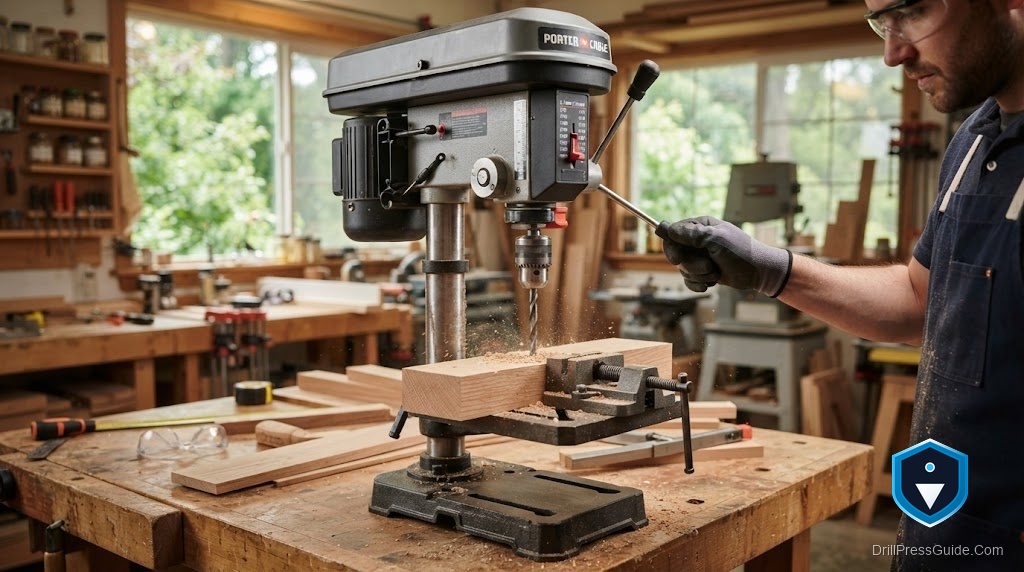
You cleared a corner of the bench, stacked some maple for a shelf, and you want holes that go straight down instead of wandering the way they do with a handheld drill. That is the job this Porter-Cable 3.2-amp 5-speed bench drill press review is built around. I have run the PCXB620DP through pine, hardwood, aluminum, and thin steel, and I want to tell you where it earns its footprint and where you will feel the limits before you give it a permanent spot.
A bench drill press is a stationary tool that clamps to a workbench, spins a chuck on a fixed vertical column, and lets you feed the bit down with a lever for square, repeatable holes. The Porter-Cable PCXB620DP is a compact cast-iron machine in that class, built on a 3.2-amp motor with five belt-driven speeds.
So should you buy it? Yes, if you want a rigid cast-iron benchtop press for wood and occasional light metal, and you like having a low bottom speed for larger bits. The five speeds run from 610 to 2800 RPM, the keyed chuck takes up to 1/2 inch, and the quill travels 2 inches, which covers most home-shop drilling. It is not the machine for heavy repeated steel work, and the table is smaller than the marketing photos suggest.
What are the real specs of the PCXB620DP?
Here is what you actually get, pulled from the current PORTER-CABLE listing at Lowe’s and the use and care manual.
| Spec | Porter-Cable PCXB620DP |
|---|---|
| Motor | 3.2 amp, 120V (about 0.4 hp) |
| Speeds | 5, from 610 to 2800 RPM |
| Chuck | 1/2 inch keyed |
| Spindle travel | 2 inches |
| Swing | 10 inches (reaches the center of a 10-inch piece) |
| Table | Cast iron, about 6-1/2 by 7-1/2 inches, tilts 45 degrees left and right, rotates 360 degrees |
| Table lift | Rack and pinion crank |
| Work light | LED under the head, runs on 2 AA batteries |
| Body | Cast iron head, table, and base |
The number that matters most here is that 610 RPM bottom speed. Big Forstner and hole-saw bits want to turn slowly, and a lower floor speed means you can push a 1-inch bit through hardwood without scorching it.
How does the PCXB620DP handle wood and metal?
It handles wood well and light metal acceptably, and that is my honest verdict: this is a wood-first press that will tolerate aluminum and thin steel if you slow it down and use cutting oil. Chucking a 3/8-inch bit and boring shelf-pin holes in oak, the cast-iron head stayed planted and the quill returned smoothly under spring tension. Stepping down to 610 RPM for a 7/8-inch spade bit, the motor held speed as long as I let the bit clear its chips instead of forcing the feed.
Here is the honest named flaw: the cast-iron table is only about 6-1/2 by 7-1/2 inches, and that is genuinely small. A door stile or a long board hangs off both ends with nothing under it, so you end up building an auxiliary table or clamping outboard support more often than you would like. The 0.4-hp motor is also light, so bogging it in thick steel is easy if you get greedy with the feed.
Who should skip this: if you drill 1/2-inch holes in steel plate all day, or you want to mount a mortising attachment and hog through hardwood, this motor and table will frustrate you. Look at a floor-standing press with a bigger motor instead.
Porter-Cable PCXB620DP vs WEN 4208T: which small press fits your bench?
Go with the Porter-Cable if you want the larger 10-inch swing and the lower bottom speed; go with the WEN 4208T if you want a higher top speed for small twist bits in wood. The WEN 4208T is an 8-inch press with a 2.3-amp induction motor, a 1/2-inch keyed chuck, and five speeds from 740 to 3140 RPM on a 6-1/2 by 6-1/2 inch table, per WEN’s own page.
Put them side by side and the tradeoff is clear. The Porter-Cable reaches farther from the column (a 10-inch swing against the WEN’s 8 inches) and drops lower for big bits (610 against 740 RPM), which I prefer for hole saws. The WEN spins faster at the top (3140 against 2800 RPM), which helps with small bits in softwood, and its induction motor tends to run quieter than a brushed motor. Tables are close in size, and both tilt 45 degrees each way. If your work skews toward larger holes and bigger stock, the Porter-Cable is the pick; if you do fine, fast, small-diameter drilling, the WEN makes sense.
What are the PCXB620DP’s biggest weaknesses?
The small table is the headline weakness, and the battery-powered LED is the annoying one. The work light sits under the head and runs on two AA cells rather than wiring into the tool, so it dies quietly and you find out mid-cut. A few plastic parts around the pulley cover and depth-stop feel less durable than the cast-iron body they attach to. None of this is a dealbreaker for a home shop, but you should know it before the box arrives.
Is this drill press safe for a beginner to run?
Yes, if you follow standard drill-press practice, which is not complicated. Clamp the workpiece to the table or hold it against the column so a grabbing bit cannot spin it, because a hand-held part becoming a “helicopter” is one of the most common drill-press injuries described in the OSHA woodworking eTool. Remove the chuck key before you switch on, roll up sleeves, skip gloves, and match the speed to the bit and material as the CCOHS drill press guidance recommends. On this press, changing speed means lifting the cover and moving the belt between pulley steps, so unplug it first.
Conclusion: is the Porter-Cable PCXB620DP worth it?
My verdict: the PCXB620DP is a solid cast-iron benchtop press for a wood-focused home shop, held back mainly by a small table and a light motor. It drills clean, square holes, its low speed suits big bits, and it feels planted in use. Here is what to take away:
- Buy it for wood and light metal, not for heavy steel or mortising.
- Plan to add auxiliary table support for long stock from day one.
- Keep AA batteries on hand for the work light, or ignore the light and add a clip-on lamp.
- If you want faster top-end speed over a bigger swing, the WEN 4208T is the smarter alternative.
FAQ
Is the Porter-Cable PCXB620DP an 8-inch or 10-inch drill press? It is a 10-inch swing press, meaning the distance from the chuck center to the column lets you drill into the middle of a 10-inch-wide piece. Some retailers group it with smaller benchtop models, but the throat gives you a 5-inch reach from column to bit.
What is the speed range on the PCXB620DP? Five belt-selected speeds from 610 to 2800 RPM. You change speed by opening the top cover and moving the belt across the stepped pulleys, so always unplug the tool first.
What size chuck does it use? A 1/2-inch keyed chuck with 2 inches of spindle travel. There is an onboard holder for the chuck key so it does not wander off the bench.
Can it drill steel? It can drill thin steel and aluminum if you drop to a low speed and use cutting oil, but the 0.4-hp motor is not made for heavy or repeated work in thick plate. Let the bit clear chips and do not force the feed.
Does it come with a work light? Yes, an LED under the head, but it runs on two AA batteries rather than the tool’s power, so keep spares nearby.
Where can I buy the PCXB620DP? It shows up through Porter-Cable retail channels such as Lowe’s rather than as a live Amazon listing at the moment, so check the Lowe’s product page for current availability.
How does it compare to a WEN 4208T? The Porter-Cable has a larger 10-inch swing and a lower 610 RPM bottom speed, while the WEN 4208T is an 8-inch press with a faster 3140 RPM top speed and a quiet induction motor.
References
- PORTER-CABLE 3.2-Amp 5-Speed Bench Drill Press (PCXB620DP), Lowe’s product page: https://www.lowes.com/pd/PORTER-CABLE-3-2-Amp-5-Speed-Bench-Drill-Press/1000183105
- PORTER-CABLE drill press use and care manual (PDF): https://pdf.lowes.com/productdocuments/afcbe592-7e32-4d1f-8526-254c891d5a67/10367833.pdf
- WEN 4208T 8-Inch 5-Speed Benchtop Drill Press, WEN Products: https://wenproducts.com/products/wen-4208t-2-3-amp-8-inch-5-speed-benchtop-drill-press
- OSHA Woodworking eTool, Drill Press: https://www.osha.gov/etools/woodworking/production/machines-tools/drill-press
- CCOHS, Drill Presses safety: https://www.ccohs.ca/oshanswers/safety_haz/metalworking/drillpresses.html


