Shop Fox Oscillating Drill Press: How the Range Breaks Down
You are standing over a stack of curved shelf brackets that need their edges smoothed, and next to them sits a board that needs four clean, square holes. A shop fox oscillating drill press claims to handle both jobs from one base, and that promise is why these machines keep landing on short lists. The real question is whether the sanding trick earns its footprint, or whether you would be happier with a plain press and a separate sander. I read the manuals, checked live listings, and pulled owner reports to answer that.
An oscillating drill press is a normal drill press with one extra motion. In sanding mode the spindle spins and also strokes up and down (it oscillates), and you swap the chuck for a sanding drum. That up and down travel spreads wear across the whole abrasive sleeve, so the sandpaper lasts longer and leaves a smoother curved edge than a fixed drum would.
Here is the direct answer. If you want one tool for both drilling and contour sanding and you have bench room, the Shop Fox W1668 is the one to get, since it matches a 3/4 HP motor and a 13-1/4 inch swing with a genuine 3/4 inch sanding stroke. If you drill taller work and want more space under the tool, the floor model W1848 puts that same head on a full column. The little W1667 only makes sense for small parts, because its spindle travel stops at 1-5/8 inches.
What the oscillating motion actually buys you
A plain drum sander presses the abrasive against one narrow band of the sleeve. That band loads up and burns while the rest of the sleeve stays clean.
The oscillating stroke fixes that. As the drum spins, it also lifts and drops, so grit gets used top to bottom. You get longer sleeve life and fewer burn marks on the edge of a workpiece.
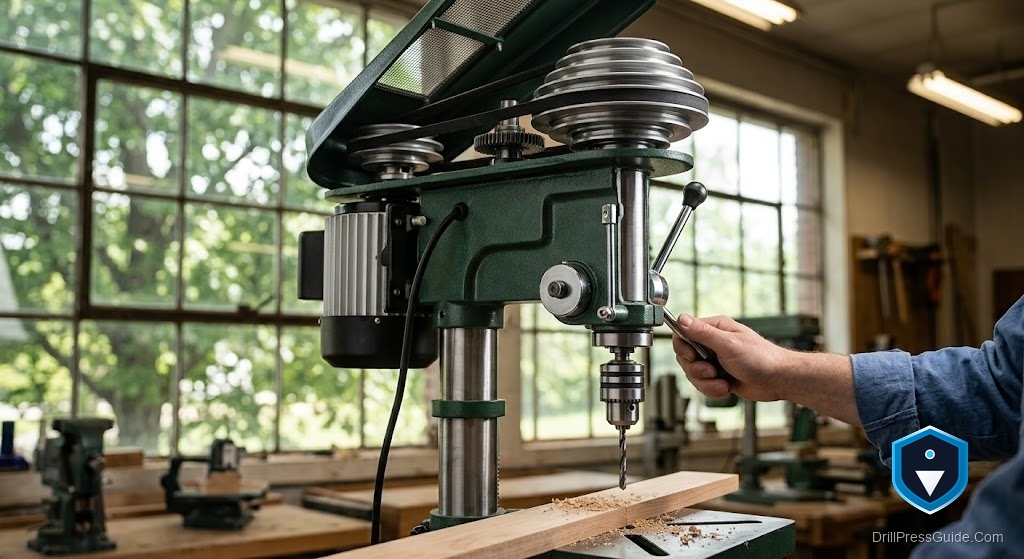
On these Shop Fox models the changeover is mechanical. You move a belt onto a third pulley that drives the oscillation, then fit a sanding drum. It works, but it is a hands-on swap, not a switch you flip.
The Shop Fox oscillating lineup at a glance
Three models cover the oscillating range. The numbers below come from the Shop Fox and Grizzly spec sheets and manuals.
| Spec | W1667 (benchtop) | W1668 (benchtop) | W1848 (floor) |
|---|---|---|---|
| Swing | 8-1/2 in | 13-1/4 in | 13-1/4 in |
| Motor | 1/2 HP | 3/4 HP | 3/4 HP |
| Speeds | 5 (620 to 3100 RPM) | 12 (250 to 3050 RPM) | 12 (250 to 3050 RPM) |
| Spindle travel | 1-5/8 in | 3-1/4 in | 3-1/8 in |
| Oscillating stroke | 1/2 in | 3/4 in | 3/4 in |
| Chuck capacity | to 1/2 in | to 5/8 in | to 5/8 in |
| Arbor | JT-33 | JT-33 | JT-33 |
| Table | 7 x 7 in | 12-3/8 in round | 12-3/8 in round |
| Overall height | 23 in | 38 in | 63 in |
Shop Fox W1668, the benchtop workhorse
This is the model most people mean when they say shop fox oscillating benchtop drill press. The 3/4 HP motor pulls 9 amps on 110V, the swing is 13-1/4 inches, and the 12 speed range runs from 250 to 3050 RPM, which covers large bits in wood down low and small bits in metal up high.
Verdict: this is the best all-around pick in the family. Owners report low runout out of the box, and the JT-33 arbor and 5/8 inch chuck handle real work. The double-nut depth stop is easy to set and holds.
Honest flaw: there is no work light, and there is no lever for speed changes. Every speed change means opening the cover and moving the belt across the pulleys by hand. Adding the third belt to reach sanding mode is one more step on top of that.
Who should skip this: if you already own a good spindle sander and only want to drill, a plain shop fox bench drill press without the oscillating hardware gives you the same drilling with less fuss.
You can see the current W1668 listing here: Check on Amazon
Shop Fox W1848, the floor version of the same idea
The shop fox 13in oscillating floor drill press w1848 uses the same head and the same 3/4 HP motor, but mounts it on a full floor column that stands about 63 inches tall. Speeds and the 3/4 inch sanding stroke match the W1668.
Verdict: pick this shop fox floor drill press if you drill tall or long stock and want to raise and lower a bigger table along the column. The extra column length is the whole reason to give up the floor space.
Honest flaw: it is heavy and takes real floor area, and owners note the onboard light is dim, so plan on adding task lighting. The changeover to sanding is still the same belt move as the benchtop.
Who should skip this: if your shop is tight and most of your parts fit on a bench, the W1668 does the same drilling and sanding without eating floor space.
The W1848 is carried by major retailers, including this live listing: https://www.lowes.com/pd/Shop-Fox-W-9-Amp-12-Speed-Floor-Drill-Press/5015570739
Shop Fox W1667, the compact one with a catch
The W1667 is the small-shop entry: 1/2 HP, an 8-1/2 inch swing, 5 speeds from 620 to 3100 RPM, and a 7 by 7 inch table. It weighs about 54 pounds, so it moves easily.
Verdict: fine for small boxes, model parts, and light detail sanding on tight curves with a 1/2 inch drum. It is honest about what it is.
Honest flaw: spindle travel is only 1-5/8 inches. That is the shortest quill stroke in the group by a wide margin, and it limits how deep you can drill or sand in a single pull. The 1/2 HP motor and small table also cap the size of work you can support.
Who should skip this: anyone who drills stock thicker than about an inch and a half, or who wants to sand tall edges. Step up to the W1668 instead.
You can view the W1667 on the manufacturer site: https://www.grizzly.com/products/shop-fox-8-1-2-benchtop-oscillating-drill-press/w1667
W1667 vs W1668 vs W1848, which head fits your work
Put the three side by side and the split is clear.
The W1667 and the W1668 are not small and large versions of one machine. They are different classes. The W1667 gives you 1-5/8 inches of travel and 1/2 HP. The W1668 nearly doubles the travel to 3-1/4 inches and adds a stronger 3/4 HP motor with 12 speeds instead of 5.
The W1668 and the W1848 are the true siblings. Same head, same motor, same 3/4 inch sanding stroke. The only real choice between them is bench versus floor. If your work height is low, the benchtop wins on space. If you drill tall pieces, the floor column wins on reach.
Where a Shop Fox oscillating press falls short
These are drill presses first and sanders second, and a few limits come with that.
The oscillating models top out at 3/4 HP, so they are light-metal and wood tools, not heavy metal machines. If you drill steel all day, look at a fixed press with more power.
Speed changes are belt moves on every model, and none of them ship with a bright work light. If you want a lever for speeds or a laser, a different press suits you better.
The oscillating feature also adds a belt and pulley you have to maintain. If you never plan to sand, that hardware is weight you are carrying for nothing.
Setup, speeds, and staying safe
Bolt the press down before you run it, especially the floor W1848, and always unplug it before you change speeds or belts. The W1668 manual is direct about closing the belt cover, since the motor will not start until the cover is shut.
Match speed to the job. Big drums and large bits want the low end of the range, and small bits in metal want the high end. OSHA’s woodworking drill press guidance and the CCOHS drill press page both stress locking the workpiece and clearing chips, which matters even more when you swap to a spinning sanding drum.
Sanding drums, sleeves, and table inserts are the shop fox drill press accessories you will replace most often, and parts diagrams for each model are published by Grizzly, so shop fox drill press parts stay easy to source.
If you want reach and angle instead of sanding, that is a different tool. A shop fox radial drill press like the W1670 slides and swivels its head, and a straight shop fox 17 drill press such as the W1680 trades the oscillating trick for a bigger pure drilling machine.
The verdict
The Shop Fox oscillating range earns its keep if you actually want the sanding motion. If you do not, you are paying in weight and setup steps for a feature that sits idle.
- Best overall: the W1668, for its 3/4 HP motor, 13-1/4 inch swing, and full 3/4 inch sanding stroke on a bench.
- Best for tall work: the W1848, the same head on a floor column, if you have the space.
- Only for small parts: the W1667, held back by 1-5/8 inches of travel.
- Skip the oscillating models if you already own a spindle sander or you want a work light and lever speed changes.
FAQ
What does the oscillating feature do on a Shop Fox drill press? In sanding mode the spindle spins and also strokes up and down. You fit a sanding drum in place of the chuck. That stroke spreads wear across the whole sleeve, so abrasives last longer and curved edges come out smoother.
Is the Shop Fox W1668 a good drill press on its own? Yes. Owners report low runout, and the 3/4 HP motor, 13-1/4 inch swing, and 12 speeds from 250 to 3050 RPM handle wood and light metal well. The main gripes are no work light and belt-only speed changes.
What is the difference between the W1668 and the W1848? They share the same head, 3/4 HP motor, and 3/4 inch sanding stroke. The W1668 is a benchtop unit about 38 inches tall. The W1848 is the floor version on a full column, roughly 63 inches tall, for taller work and a table that rides the column.
Why is the W1667 so much more limited? It is a smaller class. It uses a 1/2 HP motor, an 8-1/2 inch swing, and only 1-5/8 inches of spindle travel. That short travel caps hole depth and sanding height, so it suits small parts only.
Can these presses drill metal? They can drill light metal. The chuck takes bits to 5/8 inch on the larger models, and the low speeds suit steel. At 3/4 HP they are not built for heavy or constant metal work.
How do I change speeds? You unplug the machine, open the belt cover, and move the belt across the pulleys to the speed shown on the chart under the cover. There is no speed lever on these models.
Where do I get parts and sanding drums? Grizzly publishes parts lists and diagrams for each model, and sanding drums, sleeves, and table inserts are stocked as standard accessories. Match parts to your exact model number.
Do I need the floor model, or is the benchtop enough? If most of your work fits on a bench and your pieces are not tall, the W1668 is enough. Choose the W1848 only if you regularly drill long or tall stock that needs the floor column’s clearance.
References
- Shop Fox W1668 Oscillating Drill Press Owner’s Manual, Grizzly Industrial: https://cdn0.grizzly.com/manuals/w1668_m.pdf
- OSHA Woodworking eTool, Drill Press: https://www.osha.gov/etools/woodworking/production/machines-tools/drill-press
- CCOHS, Metalworking Machines, Drill Presses: https://www.ccohs.ca/oshanswers/safety_haz/metalworking/drillpresses.html