A Practical Guide to the Sears Drill Press Lineup

For most of the twentieth century, if an American home shop had a drill press, there was a good chance it came from Sears. Sold under the Craftsman name and carrying Sears model numbers, these machines were built in huge numbers across many sizes, and they turn up constantly on the used market today. “Sears drill press” is not one machine but a whole lineage, and understanding how it breaks down helps you buy a good one, identify what you have, and keep it running. Here is the practical guide.
What a Sears drill press is
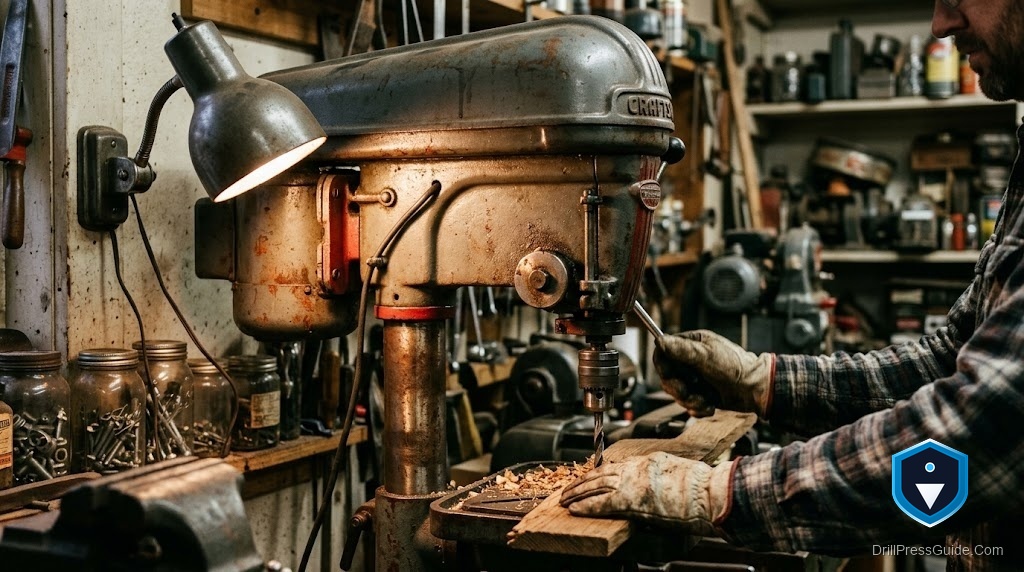
A Sears drill press is almost always a Craftsman-branded machine sold through Sears, built on the classic layout: an induction motor driving stepped pulleys for multiple spindle speeds, a quill carrying the spindle through its travel, a torsion return spring under a spring cap, a tilting table, a locking switch, and a keyed chuck. The defining trait is the model number, most often a 113-prefix (like 113.213850), which is the key to manuals and parts. That numbering, and the deep parts documentation behind it, is exactly why old Sears presses remain so serviceable.
The short answer to “is a Sears drill press worth it?” is this: yes, many vintage Sears presses are well built and, thanks to their documentation, easy to revive. Read the 113-prefix number, check the mechanicals, and match standard parts, and a used Sears press is often a better machine than a new bargain import.
How the lineup breaks down
Sears sold drill presses in a familiar range of formats:
- Benchtop (tabletop) presses. From the compact 8-inch (a common 3-speed starter) up through 9-inch and 10-inch machines. These bolt to a bench and suit small-to-medium work.
- Floor-standing (standing) presses. Taller machines on a cast base, commonly in the 15-inch class, for drilling long work upright with a generous adjustable table.
- Different speed counts and motors. Across both formats, speed counts (belt-set) and motor sizes (fractional-horsepower, like 1/3 or 1/2 HP) rise with the machine.
Whichever format, the mechanicals and the parts approach are the same, so the buying and maintenance logic carries across the whole lineup.
Buying and identifying a Sears press
Because so many are sold used, identification matters. Read the full 113-prefix model number off the ID label or cast plate; that unlocks the parts diagram and manual. Then check the mechanicals: spin the chuck for runout, feel the quill for slop, confirm the return spring retracts smoothly, and run the motor and switch. Vintage Sears castings are often heavier and better than modern entry-level machines, so a sound one is worth reviving. If the label is gone, match wear items by measurement and identify the model from the castings.
Keeping one running
The failure points are standard and documented: the V-belt, the chuck and chuck key, the torsion return spring and spring cap, ball bearings, the center pulley, the motor pulley and bracket, retaining rings, taper pins, the spindle assembly and spindle pulley, the head casting, the bed lock, and the locking switch. Pull the parts diagram for your model number from Sears PartsDirect and match parts to it. Common upgrades and accessories (a fresh belt, a good vise, a proper stand for benchtop models) make an old Sears press a genuinely useful shop tool again. A drop of the right maintenance keeps these machines accurate for decades.
The verdict
The Sears drill press lineup is a long, serviceable lineage of Craftsman-branded machines, from compact 8-inch benchtops to 15-inch floor presses, all keyed to a 113-prefix model number that unlocks manuals and parts. That documentation is the reason a used Sears press is so often worth buying and reviving: read the number, check runout, the quill, and the return spring, and match standard wear items. Whether you want a small bench machine or a floor press for long work, there is a Sears press to fit, and keeping it running is straightforward. Buy on condition and the model number, and an old Sears press earns its bench space.
Takeaways:
- “Sears drill press” almost always means a Craftsman machine keyed to a 113-prefix model number.
- The lineup spans benchtop 8, 9, and 10-inch presses and floor-standing presses in the 15-inch class.
- Speeds are belt-set and motors are fractional-horsepower, rising with the machine size.
- The 113-prefix number unlocks manuals and parts through Sears PartsDirect.
- Vintage Sears presses are often heavier and better built than new entry-level machines and are worth reviving.
Tooling and replacement parts
Keep a Sears press running with good tooling. Fit a quality keyed drill chuck with the matching arbor if the original wears, keep a fresh drill press V-belt on the shelf, and add a drill press quill return spring to revive a tired quill. A drill press vise makes work-holding safe, and a spare drill press chuck key saves a stalled job. Match parts to the 113-prefix model number before ordering.
FAQ
Are Sears drill presses the same as Craftsman? Yes, in almost all cases. Sears sold drill presses under the Craftsman name with Sears model numbers, most often a 113-prefix.
What sizes of Sears drill press are there? Benchtop presses from 8-inch through 10-inch, and floor-standing presses commonly in the 15-inch class, with various speed counts and motor sizes.
How do I find parts and a manual for a Sears drill press? Read the full 113-prefix model number off the plate and pull the matching parts diagram and manual from Sears PartsDirect.
Is a vintage Sears drill press worth buying? Often, yes. Many are heavier and better built than new entry-level machines, and the parts documentation makes them easy to revive. Check runout, the quill, and the return spring.
What if the model number label is missing? Match wear items (belt, chuck, spring) by measurement and identify the model from the castings by comparing to diagrams on Sears PartsDirect.
What are the common wear parts on a Sears drill press? The V-belt, chuck and chuck key, torsion return spring and cap, bearings, pulleys, spindle assembly, and the locking switch, all documented in the model’s parts diagram.
Should I buy a benchtop or floor Sears press? Choose benchtop for small-to-medium work and tight space; choose floor-standing for long work upright and a generous adjustable table.
References
- Sears PartsDirect, Craftsman drill press parts and manuals: https://www.searspartsdirect.com/
- Craftsman, support and manuals: https://www.craftsman.com/