
Which JET 17-Inch Drill Press Belongs in Your Shop?
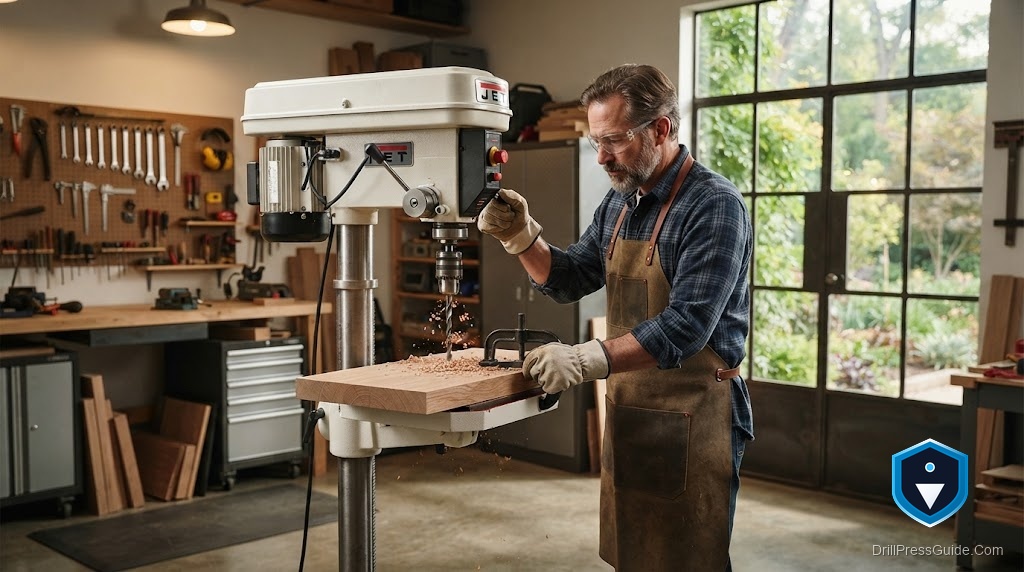
The JET 17-inch is the drill press a lot of serious woodworkers and metalworkers aim for once they outgrow a benchtop. It is a floor-class machine with the swing, the travel, and the build to handle real work, and it comes in more than one form. So the question is not just “should I buy a JET 17-inch?” but “which JET 17-inch belongs in your shop?” Here is the honest breakdown of the JDP-17 family and where each fits.
What the JET 17-inch is
The JET JDP-17 is a 17-inch floor drill press: the spindle centerline sits 8.5 inches from the column, so it reaches the center of a 17-inch-wide workpiece. It is built around a 16-speed drive, a heavy cast-iron table and base, a quill with generous travel, and JET’s usual attention to fit and finish. You mount it to the floor through base holes, follow the setup and assembly steps to square everything, and store the chuck key and wrench in their holders so they stay with the machine.
The short answer to “which JET 17-inch?” is this: the standard JDP-17 covers most serious shops, and the JDP-17DX adds convenience features (like a digital readout and work light on the deluxe variant). Choose the DX if those extras matter to you; choose the standard if you want the capability without the frills.
The variants, and how they differ
- JDP-17 (standard). The core machine: 16 belt-set speeds, the full 17-inch swing, and the heavy castings. A no-nonsense floor press for woodworking and light-to-medium metal.
- JDP-17DX (deluxe). The same platform with added convenience: typically a digital speed or depth readout and a work light. The extras help in day-to-day use but do not change the fundamental capacity.
Both share the 16-speed drive and the 17-inch swing, so this is a decision about convenience features, not raw capability. If a readout and light earn their place on your bench, the DX is worth it; if not, the standard JDP-17 does the same work.
Where the 17-inch fits against smaller and larger presses
Be honest about the size. A 17-inch floor press is a big step up from a 12-inch benchtop: more swing, more travel, more mass for steadier drilling, and a floor footprint you have to plan for. It suits a shop that drills wider panels, longer stock, and heavier metal, and it is a machine you set up once and keep. If your work is small and your space is tight, a benchtop is the smarter pick. If you routinely drill very large or very thick work, look at even bigger industrial floor machines. For most serious home and pro woodshops, the 17-inch is the right ceiling.
Setup and living with it
The JDP-17 rewards careful setup. Bolt the base down or shim it dead level, follow the assembly sequence so the head and table lock square, fit the chuck on a clean spindle taper, and square the table to the spindle. Pay attention to the electrical connections and grounding instructions, and avoid undersized extension cords on a motor this size. Set the locking handles and set screws properly so the table holds position, and keep the chuck key and wrench in their holders. Support the machine by its model number (JDP-17 or JDP-17DX) for parts and manuals.
The verdict
The JET 17-inch that belongs in your shop is the standard JDP-17 if you want serious floor-press capability without extras, and the JDP-17DX if a digital readout and work light earn their place. Both share the 16-speed drive and the 17-inch swing, so choose on convenience, not capacity. It is the right ceiling for most serious woodshops: a step up from a benchtop in swing, travel, and steadiness, and a machine you set up once. Level the base, square the table, mind the grounding, and support it by model number.
Takeaways:
- The JDP-17 is a 17-inch floor press (spindle 8.5 inches from the column) with a 16-speed drive and heavy castings.
- The standard JDP-17 covers most serious shops; the JDP-17DX adds convenience like a digital readout and work light.
- Both share the same swing and speed drive, so choose on features, not capacity.
- The 17-inch is a big step up from a benchtop in swing, travel, and steadiness, with a floor footprint to plan for.
- Level the base, square the table, follow the grounding instructions, and support it by model number.
Tooling and replacement parts
Set a JET 17-inch up right with good tooling. Fit a quality keyed drill chuck with the matching arbor if the original wears, add a heavy drill press machine vise for safe work-holding, and keep a fresh drill press V-belt on hand. A set of Forstner bits uses the swing, and a spare drill press chuck key saves a stalled job. Confirm the spindle taper before ordering an arbor.
FAQ
What is the difference between the JET JDP-17 and JDP-17DX? Both share the 17-inch swing and 16-speed drive. The DX (deluxe) adds convenience features such as a digital readout and a work light; the capacity is the same.
What does “17-inch” mean on the JET drill press? It is the swing: the spindle sits 8.5 inches from the column, so the machine reaches the center of a 17-inch-wide workpiece.
How many speeds does the JET 17-inch have? Sixteen, set by moving the belt across the pulley steps.
Is the JET 17-inch a benchtop or floor machine? It is a floor-standing machine. Plan for the footprint and bolt or level the base for stability.
Should I buy the JET 17-inch or a benchtop press? Choose the 17-inch for wider panels, longer stock, and heavier metal in a serious shop. A benchtop suits small work and tight space.
How do I find parts for a JDP-17? Support it by its model number (JDP-17 or JDP-17DX) through JET for the manual and parts diagram.
References
- JET Tools, drill presses: https://www.jettools.com/us/en/p/drill-presses/
- JET Tools, parts and service: https://www.jettools.com/us/en/customer-service/


