Shopping for a Ryobi 10-Inch Drill Press? Start With Size, Speed, and Support
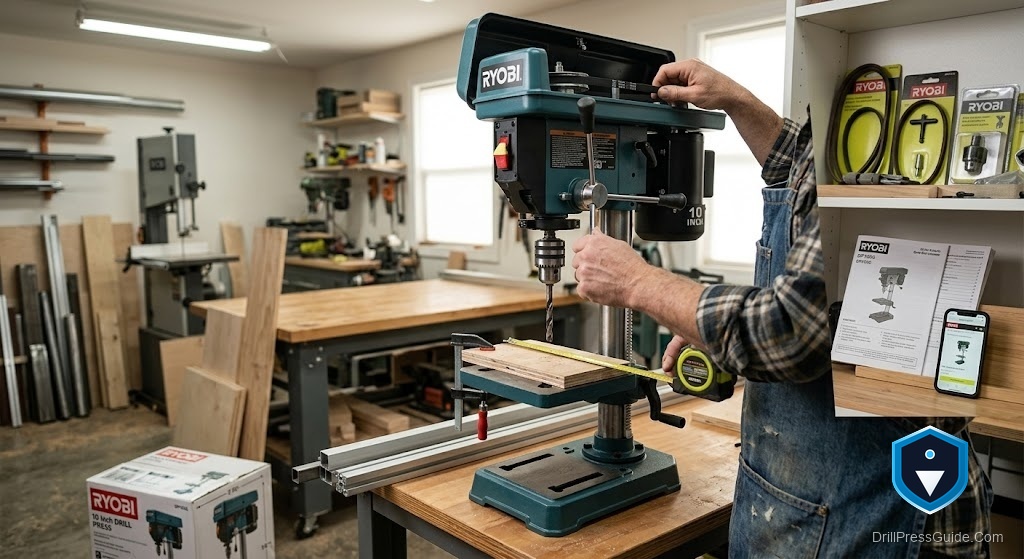
Ryobi is the brand a lot of home shops reach for when they want capable tools without complexity, and the Ryobi 10-inch drill press fits that pattern exactly. It is a compact benchtop machine (models like the DP100 and DP101 turn up most often) aimed at the DIY user and weekend woodworker who needs straight, accurate holes without a big floor press. If you are shopping for one, whether new or the used examples that are common, the smart approach is to start with size, then speed, then support. Here is how.
What a Ryobi 10-inch drill press is
A Ryobi 10-inch drill press is a benchtop machine built on the standard layout: a motor driving a stepped-pulley belt for several speeds, a spindle with a keyed chuck, a quill with a return spring and travel for drilling, a depth stop, and a small cast table that tilts for angled work. “10-inch” is the swing, meaning the spindle reaches the center of a 10-inch-wide workpiece, so the machine handles workpieces up to 10 inches across. The DP100 and DP101 are the model numbers most people mean. It is deliberately simple and compact, sized for a home bench rather than a production shop.
Start with size
Size is where shopping begins:
- Swing. Ten inches of swing centers the spindle on a 10-inch-wide workpiece, comfortable for most home-shop parts but not wide panels.
- Spindle travel. The stroke sets how deep you drill in one pass; a 10-inch benchtop press has a modest travel matched to light work.
- Footprint. It sits on a bench and is easy to place and store, which is much of its appeal for a small shop.
If your work is home-shop scale, the 10-inch size is a sweet spot. If you need wide stock or deep drilling, a larger benchtop or floor press is the better call.
Then speed and support
After size, weigh speed and what backs the machine:
- Speed range. The belt gives several speeds; slower for larger bits and metal, faster for small bits in wood. Check the range covers your materials.
- Model number. Note whether it is a DP100, DP101, or another Ryobi model, since that identifies the manual and parts.
- Manual and assembly. Keep the manual for assembly and belt routing; Ryobi presses go together simply, but the manual documents the speed chart and setup.
- Parts. The wear items (belt, chuck, key, return spring) are standard and easy to match by measurement. Note the model number for anything model-specific.
Where a Ryobi 10-inch fits
Let me be honest about the fit. A Ryobi 10-inch drill press is a solid choice for the DIY user and home woodworker who wants a compact, dependable bench press for everyday drilling: pilot holes, dowels, light metal, and drum sanding. It drills far straighter than a handheld drill and takes little bench space. What it is not is a machine for large bits, thick steel, wide stock, or production work, so match your expectations to light-duty home use. Within that lane, the Ryobi is exactly enough machine, which is why the DP100 and DP101 stay popular.
Tooling and replacement parts
Get the most from a Ryobi 10-inch with good tooling. Fit a quality keyed drill chuck with the matching arbor if the original wears, keep a fresh drill press V-belt on the shelf, and add a set of brad-point drill bits for clean holes in wood. A small drill press vise makes work-holding safe, and a spare drill press chuck key saves a stalled job. Confirm the taper by dropping the chuck before ordering an arbor.
The verdict
Shopping for a Ryobi 10-inch drill press comes down to matching a simple, compact bench machine to home-shop work, and the order is clear: start with size (10-inch swing, modest travel, small footprint), then speed (a belt-driven range for wood and light metal), then support (note the DP100, DP101, or other model number, keep the manual, and match standard wear parts). It drills far straighter than a handheld drill and handles everyday tasks dependably, but it is light-duty, so leave large bits, thick steel, and wide stock to a bigger press. Back it with a good chuck, belt, and bits, and a Ryobi 10-inch earns its place on a home bench.
Takeaways:
- The Ryobi 10-inch drill press is a compact benchtop machine (models like the DP100 and DP101) for DIY and home-shop use.
- Start with size: a 10-inch swing, modest spindle travel, and a small bench footprint.
- Then weigh speed (a belt-driven range for wood and light metal) and support (note the model number, keep the manual, match standard parts).
- It is light-duty: great for everyday drilling, not for large bits, thick steel, wide stock, or production work.
FAQ
What is the swing of a Ryobi 10-inch drill press? Ten inches, meaning the spindle reaches the center of a 10-inch-wide workpiece. It handles workpieces up to 10 inches across.
What Ryobi 10-inch drill press models are there? The DP100 and DP101 are the models most people mean. Note your exact model number for the manual and parts.
Is a Ryobi 10-inch drill press good? For DIY and home-shop use, yes. It is compact, dependable, and drills far straighter than a handheld drill for everyday tasks.
How do I assemble a Ryobi 10-inch drill press? Follow the manual for mounting the head and table on the column, fitting the chuck, and routing the belt. It goes together simply; the manual has the speed chart.
Where do I get Ryobi 10-inch drill press parts? The wear items (belt, chuck, key, return spring) are standard and easy to match by measurement. Note the DP100 or DP101 model number for anything model-specific.
Can a Ryobi 10-inch drill metal? Light metal at appropriate low speeds, yes. It is a light-duty bench machine, not built for thick steel or large holes.
What chuck does it use? A keyed chuck on a standard taper. Confirm the taper by removing the chuck before ordering a replacement arbor.
References
- Ryobi Tools, benchtop drill press product listings and specifications: https://www.ryobitools.com/
- Ryobi Tools, drill press manuals and support: https://www.ryobitools.com/support
- Fine Woodworking, benchtop drill press buying guidance: https://www.finewoodworking.com/