Which JET Smart Drill Press Belongs in Your Shop?
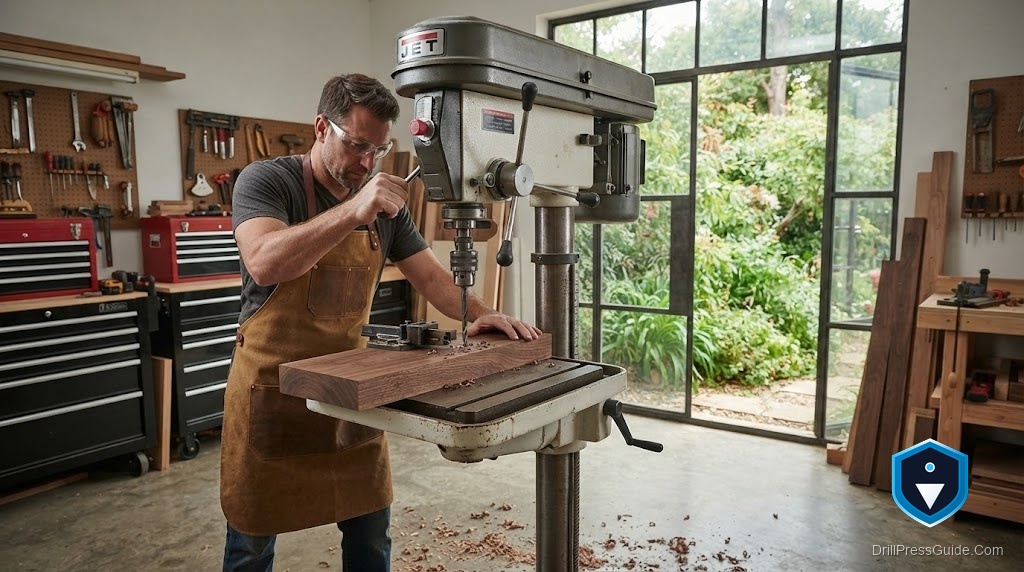
JET has a reputation among serious woodworkers and metalworkers for machines that feel a cut above the home-center crowd, and its larger drill presses carry that reputation. When people search for a “JET smart drill press,” they are usually circling JET’s higher-capability presses, the 17-inch class and the well-equipped multi-speed machines that anchor a real shop. The range spans benchtop, floor, and radial designs, so the useful question is not “is JET good” (it is) but which JET belongs in your shop. Here is how to decide.
What a JET drill press is
A JET drill press is a stationary machine built on the standard layout, a spindle in a quill that travels down through a stroke, a column, a work table, and a motor, but built to JET’s heavier standard with solid castings and thoughtful features. The larger machines, like the JDP-17 class, use a multi-speed drive (16 speeds is common) for a wide RPM range, generous swing, and features such as chuck-key and wrench storage, clear grounding and electrical setup, and a table that raises, tilts, and repositions on locking handles. JET documents setup and assembly carefully, from base mounting holes to spindle alignment. These are machines meant to be a shop’s main press for years.
How the range breaks down
JET’s presses sort by capacity and design:
- Benchtop machines. Compact JET presses for smaller shops that still want JET build quality, including well-equipped 12-inch-class benchtop models.
- The 17-inch floor class (JDP-17). The heart of the “smart” search: a 17-inch-swing floor press with a 16-speed drive, generous travel, and the features and rigidity a serious shop wants. This is the one most people mean.
- 3/4 HP and larger floor presses. Machines with more motor and capacity for heavier and continuous work.
- Radial drill presses. JET’s radial design lets the head move out and pivot over the work, reaching drilling positions a fixed column cannot.
The practical takeaway: a benchtop JET for a smaller shop, the JDP-17 class for a serious main press, a larger floor machine for heavier work, and a radial when reach and positioning matter most.
Which one belongs in your shop
Let me be direct. Choose the machine to your work and space:
- Tight space, lighter work. A JET benchtop press gives the build quality without the floor footprint.
- A serious main press. The JDP-17 class is the sweet spot: 17-inch swing, 16 speeds, and the rigidity to be the press you keep for a decade.
- Heavy or continuous drilling. Step up to a larger floor machine with more motor and capacity.
- Awkward reach or large panels. A radial press moves the head to the work, which a fixed column cannot.
Match swing, speed range, spindle travel, motor rating, and design to what you actually drill, and let the JDP-17 be the default for most serious shops.
Setup and support
JET machines reward careful setup. Follow the manual for base mounting, table and column assembly, spindle and chuck fitting, and especially the electrical connections and grounding instructions, and avoid undersized extension cords. Store the chuck key and wrenches in their holders so they are never lost. For service, JET supports its line with parts and manuals by model number, and the wear items (belt, chuck, key, return spring) are standard.
Tooling and accessories
Set a JET press up right with good tooling. Fit a quality keyed drill chuck with the matching MT arbor if the original wears, add a solid drill press machine vise for safe work-holding, and keep a fresh drill press V-belt on hand. A set of Forstner bits uses the generous swing, and a spare drill press chuck key saves a stalled job. Confirm the taper before ordering an arbor.
The verdict
The JET drill press that belongs in your shop depends on your work: a benchtop JET for tight space and lighter tasks, the JDP-17 class (17-inch swing, 16 speeds) as the serious main press most shops should default to, a larger floor machine for heavy or continuous drilling, and a radial press when reach and positioning matter. Match swing, speed range, spindle travel, motor, and design to what you drill, follow JET’s setup and grounding instructions carefully, and store the chuck key and wrenches so they stay with the machine. Back it with a good chuck, vise, and belt, and a JET press earns its place as a shop’s main tool for years.
Takeaways:
- JET drill presses span benchtop, floor (including the 17-inch JDP-17 class), larger floor, and radial designs.
- The JDP-17 class (17-inch swing, 16 speeds) is the sweet spot most people mean by a “smart” JET and the default serious main press.
- Match swing, speed range, spindle travel, motor, and design to your work and space.
- Follow JET’s setup and grounding instructions, store the chuck key and wrenches, and support the machine by model number.
FAQ
What is the JET JDP-17 drill press? A 17-inch-swing floor drill press with a 16-speed drive, generous travel, and JET’s build quality and features, the machine most people mean by a “smart” JET and a strong choice as a shop’s main press.
Which JET drill press should I buy? A benchtop JET for tight space and lighter work, the JDP-17 class as a serious main press, a larger floor machine for heavy work, or a radial press when reach matters. Match to your work and space.
How many speeds does the JDP-17 have? Sixteen, through a multi-speed drive, giving a wide RPM range to match wood and metal.
Does JET make a radial drill press? Yes. A JET radial press lets the head move out and pivot over the work, reaching positions a fixed-column press cannot.
How do I set up a JET drill press safely? Follow the manual for base mounting, table and column assembly, and spindle fitting, and pay close attention to the electrical connections and grounding instructions. Avoid undersized extension cords.
Where do I get JET drill press parts? Through JET’s parts and manual service by model number. The wear items (belt, chuck, key, return spring) are standard and easy to match.
What chuck and taper does a JET press use? A keyed chuck on a Morse taper (often MT2 or larger depending on the machine). Confirm the taper by removing the chuck before ordering an arbor.
References
- JET Tools, drill press product line and JDP-17 specifications: https://www.jettools.com/us/en/c/drill-presses/
- JET Tools, drill press manuals, parts, and support: https://www.jettools.com/us/en/support/
- JET Tools, radial drill press documentation: https://www.jettools.com/us/en/c/drill-presses/