
Choosing and Using a Clarke Metalworker Drill Press
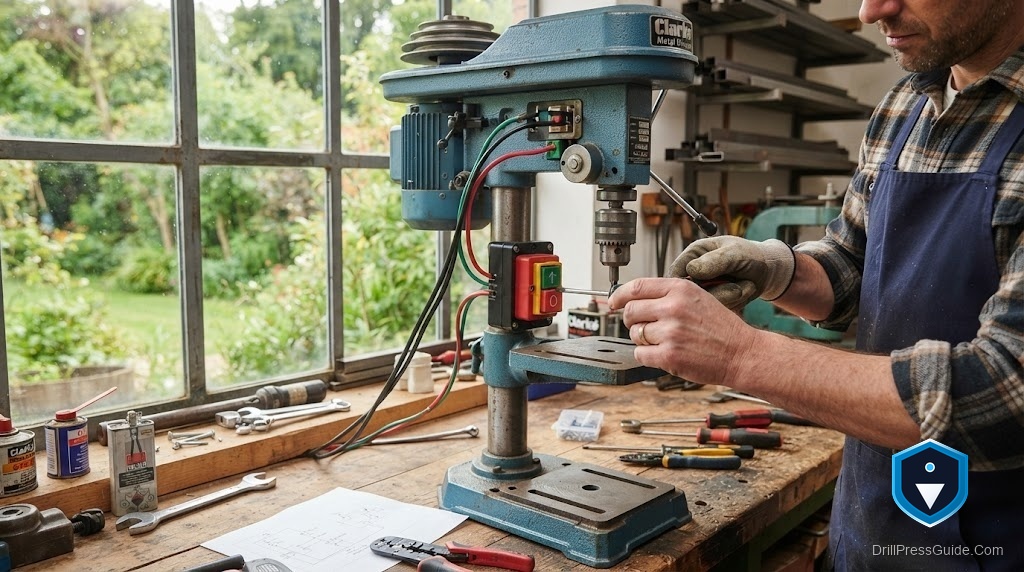
If you have shopped for a drill press in a hobby or home workshop and seen the Clarke Metalworker name, you have met one of the most familiar value brands in that world. Clarke Metalworker is a workshop tool range sold widely to home and hobby users, and its drill presses turn up both new and, very commonly, on the used market. That makes the Clarke a sensible machine for the right buyer, provided you approach it for what it is: a value-priced workshop press to judge on condition and fit, not an industrial machine to buy on reputation. Understanding what a Clarke Metalworker drill press is and how to choose and use one is the key to a smart buy. This guide walks through it.
A Clarke Metalworker drill press is a benchtop or floor drilling machine from the Clarke Metalworker workshop tool range, aimed at home, hobby, and light workshop use. Like any drill press, it is a motor driving a spindle through a belt and pulleys, with a quill feeding the chuck and bit into work on a table. Because it is a value workshop machine rather than a heavy industrial one, treat it as a light-to-medium-duty press for wood and mild steel, and judge a given example on its condition and its fit to your work rather than on the badge.
Evaluate the specific machine
Whether new or used, a value machine is judged by its bones, so run the fundamental checks. Spin the spindle and check for runout and rough bearings, since a wobbly spindle drills poor holes regardless of brand. Feed the quill and feel for smooth travel and a working return. Inspect the chuck for wear and true running. Look over the table and column for damage and rust and confirm the table adjusts and locks solidly. And confirm the motor runs smoothly and the speed range suits your work. A sound Clarke is a perfectly serviceable light-to-medium-duty machine; a worn used one is worth only what its condition justifies.
Set expectations to its class. A Clarke Metalworker press suits home and light workshop work, small to medium holes in wood and mild steel, not heavy production. Judge it against that, and it can do good work.
The parts question
Because many Clarke presses are bought used and the range has changed over the years, think about parts. Most drill press wear items are standard and fit by measurement regardless of brand: a drive belt matched by profile and length, a chuck matched by arbor taper, bearings by their stamped numbers, and a quill return spring by its housing size. Model-specific parts, particular pulleys, tables, or handles, are the harder ones, so on a used machine confirm those are present and sound. If the chuck is worn and the arbor is a standard JT33, a common JT33 keyed chuck restores true holes once the old one is driven off, and a tired quill spring takes a generic return spring assembly matched to its housing.
Setting it up for good work
A value machine set up well drills far better than its cost suggests. Square the table to the spindle, and level and secure the machine. Clamp metal work in a cast-iron drill press vise bolted to the table rather than holding it by hand, for both safety and hole quality. Run the correct speed for the bit and material by setting the belt on the right pulley steps, use sharp bits and cutting fluid on metal, and set the depth stop for repeatable holes. These fundamentals matter far more to your results than the brand.
When to buy and when to pass
Buy a Clarke Metalworker press, new or used, when it is sound and its light-to-medium-duty capacity matches your work, since it offers real value for home and hobby drilling. Pass on a used one with a bent spindle, damaged castings, missing model-specific parts, or a dead motor with no easy replacement, since it is a value machine to begin with and not worth a costly rescue. In that case a current value benchtop press, bought new with available parts and support, covers the same ground. Match the machine to your work and its condition, and the Clarke earns its place.
Conclusion
A Clarke Metalworker drill press is a familiar value workshop machine for home, hobby, and light use, best approached for what it is: judged on condition and fit rather than reputation. Check the spindle, quill, chuck, table, and motor, treat it as a light-to-medium-duty press for wood and mild steel, and confirm the model-specific parts are sound since standard wear items fit by measurement. Set a good one up with a square table, a solid vise, correct speeds, and sharp bits, and it does honest work well above its cost. Buy a sound one that matches your work, pass on one with major faults, and the Clarke Metalworker is a sensible choice for the right shop.
Three takeaways: a Clarke Metalworker drill press is a value workshop machine judged on condition and fit, not reputation; treat it as light-to-medium duty for wood and mild steel, with standard wear parts that fit by measurement but scarcer model-specific parts; and set a sound one up properly, passing on a used machine with major faults.
Frequently Asked Questions
What is a Clarke Metalworker drill press? A benchtop or floor drilling machine from the Clarke Metalworker workshop tool range, aimed at home, hobby, and light workshop use. It is a value-priced press best treated as light-to-medium duty for wood and mild steel.
Is a Clarke Metalworker drill press any good? For home and light workshop work, a sound one is a perfectly serviceable machine that offers real value. Judge the specific example on its condition, spindle, quill, chuck, table, and motor, rather than on the brand.
What should I check on a used Clarke press? Spindle runout and bearing smoothness, quill travel and return, chuck wear, table and column condition, and that the motor runs and the speed range suits your work. Condition, not the badge, decides a used machine’s value.
Can I get parts for a Clarke Metalworker drill press? Standard wear items (belt, chuck, bearings, return spring) fit by measurement regardless of brand. Model-specific parts (particular pulleys, tables, handles) are harder to find, so on a used machine confirm those are present and sound.
What work is a Clarke Metalworker press suited to? Home and light workshop work, small to medium holes in wood and mild steel, not heavy production. Set your expectations to that class, and set up well it does good, accurate work.
When should I pass on a Clarke drill press? When a used one has a bent spindle, damaged castings, missing model-specific parts, or a dead motor with no easy replacement, since it is a value machine not worth a costly rescue. A current value press then covers the same ground.
References
- VintageMachinery.org, machine tool references and literature. http://vintagemachinery.org
- Jacobs Chuck Manufacturing, Mounting and Removing Chucks. http://www.jacobschuck.com/uploads/ueditor/file/20200604/1591240204146153.pdf


