
Drill Press Part Identification: Naming What You Are Looking At
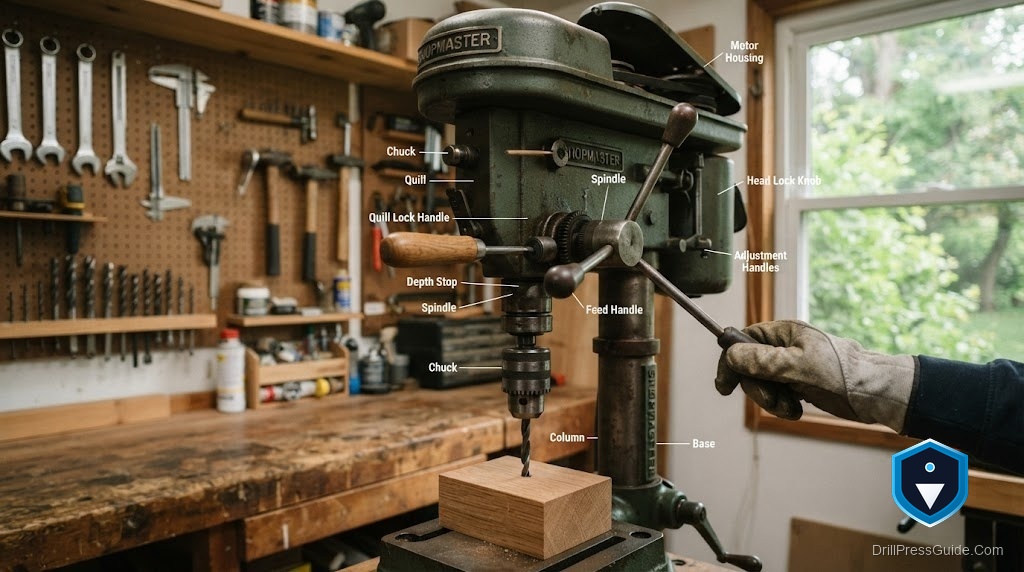
Standing in front of an unfamiliar drill press, or holding a mystery part that fell out during a teardown, you hit the same wall everyone hits: you cannot fix, order, or ask about a part you cannot name. Drill press part identification is the skill that gets you past that wall, matching the piece in front of you to its correct name and function so you can find a diagram, order a replacement, or describe the problem to someone who can help. It is not hard once you know the machine’s layout and the clues each part gives up. This guide teaches the identification, from the whole machine down to the mystery part in your hand.
Drill press part identification means recognizing each component of the machine, knowing its name, its job, and how to tell it from similar parts. The machine is a logical chain, motor to belt to spindle to chuck, on a frame of table and column, and once you understand that chain, most parts identify themselves by where they sit and what they connect to. The trickier cases, a loose part or a worn-off marking, are solved by measuring and matching against a diagram.
Identify by location in the chain
The fastest way to name a part is by where it lives, since each has a place in the machine’s flow of power and motion. At the top is the motor, the electric unit that provides power. From it, the drive belt, a V-belt, runs over the pulleys, the stepped cones that set speed. Power reaches the spindle, the rotating shaft, which rides inside the quill, the sliding sleeve that feeds the spindle down when you pull the feed lever, and is returned by the quill return spring in its housing. At the spindle’s bottom is the chuck, gripping the bit, tightened by the chuck key. Supporting it all are the table, the work surface that raises and tilts, the column, the vertical tube, and the base. Name a part by finding its spot in that sequence, and most identify themselves.
Identify a loose part by its features
When a part has fallen out and you cannot see where it belongs, read its features. A coiled flat spring is the quill return spring. A stepped cone with a bore is a pulley, identified by its bore and step count. A tapered shaft with a chuck mount is an arbor, identified by its taper. A threaded rod with nuts near the quill is part of the depth stop. A ring-geared clamping device is the chuck. Each part’s shape and fittings tell you what it is, and matching those features to an exploded parts diagram confirms it and gives the part number.
Use the machine’s markings and a diagram
For certain identification, especially on an unfamiliar or vintage machine, use the model information and a diagram. Find the model number, and on many machines the serial number, from the nameplate or casting, since the model determines which parts and diagram apply. On a vintage Craftsman the prefix tells the maker (103 for King Seeley, 113 for Emerson); on a Delta, pair the model with the serial number. Then match the part to the exploded diagram for that model, from a parts retailer, the manual, or the vintage machinery archives, which names every part and confirms your identification.
Turn identification into a fix
Identification pays off when it lets you order the right part. Once you have named a part, sort it into standard or model-specific. Standard parts fit by measurement across machines: a belt by profile and length, a bearing by its stamped number, a chuck by its arbor taper (commonly JT33, where a JT33 keyed chuck fits any JT33 arbor), and a quill return spring assembly by its housing size. Model-specific parts, pulleys, tables, handles, are ordered by the part number from the diagram. Naming the part is the step that unlocks all of this.
Conclusion
Drill press part identification is the skill of naming what you are looking at, and it comes down to three moves: locate a part in the machine’s chain from motor to chuck, read a loose part’s features to recognize it, and confirm it against the model’s exploded diagram. Once a part is named, you can sort it into standard (ordered by measurement) or model-specific (ordered by number) and get the right replacement. Learn the machine’s layout, read the clues each part gives, and match to a diagram, and no drill press part stays a mystery for long.
Three takeaways: name most parts by their location in the motor-to-chuck chain, identify a loose part by its shape and fittings, and confirm against the model’s exploded diagram, then order standard parts by measurement and model-specific parts by number.
Frequently Asked Questions
How do I identify drill press parts? Locate each part in the machine’s chain from motor to belt to pulleys to spindle, quill, and chuck, on the table and column. Most parts identify themselves by where they sit and what they connect to.
How do I identify a loose part that fell out? Read its features: a coiled flat spring is the return spring, a stepped cone with a bore is a pulley, a tapered shaft with a chuck mount is an arbor. Match those features to an exploded diagram to confirm and get the part number.
Why do I need my model and serial number? Because the model determines which parts and which exploded diagram apply, and running changes mean the same model used different parts over time. Matching the model and serial ensures correct identification.
Where can I find a diagram to identify parts? From a parts retailer searchable by model number, the original manual, or the vintage machinery archives for older machines. The exploded diagram names every part and confirms your identification.
Once I identify a part, how do I order it? Sort it into standard or model-specific. Standard parts (belt, bearing, chuck, spring) fit by measurement across machines. Model-specific parts (pulleys, tables, handles) are ordered by the part number from the diagram.
How do I tell a chuck arbor’s taper? By measuring and matching it, commonly JT33 on mid-size machines, sometimes JT2, JT6, or a Morse taper. The taper, not the brand, determines which chuck fits, so confirming it is key before ordering a chuck.
References
- Sears PartsDirect, drill press parts and exploded diagrams. https://www.searspartsdirect.com
- VintageMachinery.org, manufacturer index and publication archive. http://vintagemachinery.org


