Choosing and Using a 1 HP Drill Press
Horsepower is the spec buyers argue about most when choosing a drill press, and 1 HP is the number that marks the line between a light-duty machine and a serious one. But choosing a 1 HP press well means understanding how it compares to the smaller classes below it, and using one well means knowing what that power is actually for. This guide covers both: how to choose a 1 HP drill press against the alternatives, and how to use one so the power translates into clean, accurate holes. Here is what you need to know.
Where 1 HP sits among the power classes
Drill press motors run in a ladder of ratings, and knowing the rungs helps you choose:
- 1/4 and 1/3 HP. Small benchtop presses for light drilling in wood and thin material. Fine for pilot holes and small work, quickly overwhelmed by large bits.
- 1/2 HP. The mid class, suiting 12- and 15-inch machines for most woodworking and light metal.
- 3/4 HP. A step up, driving larger bits and light steel with more confidence.
- 1 HP. The serious threshold, driving large-diameter bits and light steel while holding speed under load, found on capable 15- and 17-inch machines.
Seen this way, 1 HP is the choice when you regularly use large bits, drill light metal, or run long sessions, and you want a machine that will not bog down. If your work is small and occasional, a 1/2 HP press may be all you need; if you routinely hog large holes in thick steel, you will look beyond 1 HP.
How to choose a 1 HP press
Horsepower is one spec among several. When comparing 1 HP machines, also weigh:
- Motor type and amperage. A continuous-duty induction motor with a believable amp draw beats an inflated peak rating. Read the plate.
- Swing and travel. Match the swing to your widest work and favor more spindle travel for deeper holes.
- Speed range. A wide range with low speeds lets the 1 HP torque work on large bits and metal.
- Rigidity. A heavy head and column and a tight quill turn power into straight holes.
- Bench or floor. A 1 HP rating usually comes on floor-class machines; confirm the footprint fits your shop.
Using a 1 HP press well
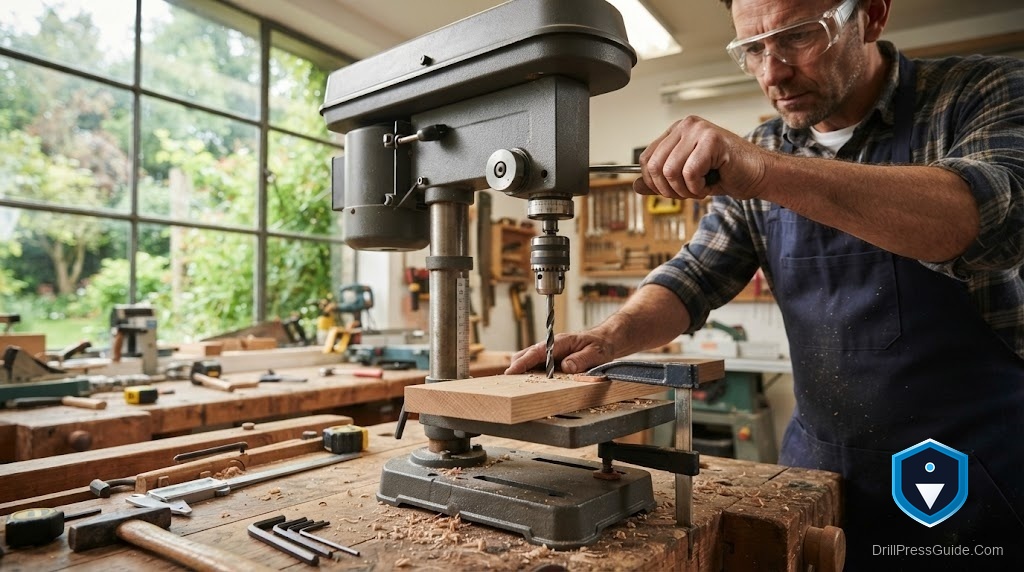
Power helps only when you use it correctly. Set low speeds for large bits and metal, since that is where the 1 HP torque matters, and higher speeds for small bits in wood. Feed steadily and let the machine cut rather than forcing it, because real power rewards a controlled feed with a cleaner hole. Always secure the workpiece in a vise or with clamps, since a 1 HP motor has the torque to grab and spin loose work. Keep the belt fresh and tensioned so power transfers without slipping, and use a quality low-runout chuck so the power goes into an accurate hole.
Tooling and replacement parts
Match a 1 HP press with tooling that uses its power. Fit a quality keyed drill chuck with the matching arbor, use a set of Forstner bits in wood and metal twist drill bits in steel, and add a heavy drill press machine vise to hold work safely. Keep a fresh drill press V-belt on hand. Confirm the taper before ordering an arbor.
The verdict
Choosing a 1 HP drill press makes sense when your work has outgrown the smaller 1/4, 1/3, and 1/2 HP classes: when you regularly use large bits, drill light steel, or run long sessions and need a machine that holds speed under load. Compare 1 HP machines on motor type and amperage, swing and travel, speed range, rigidity, and footprint, not horsepower alone. Then use the power well: low speeds for big bits and metal, a steady feed, secured work, a fresh belt, and a quality chuck. Get both the choice and the technique right, and a 1 HP press delivers clean, accurate, confident drilling. Only heavy steel work calls for stepping beyond it.
Takeaways:
- 1 HP is the serious threshold above the 1/4, 1/3, and 1/2 HP classes, for large bits, light steel, and long sessions.
- Choose a 1 HP press on motor type and amperage, swing and travel, speed range, rigidity, and footprint, not horsepower alone.
- Use low speeds for large bits and metal, a steady feed, and secured work to turn power into clean holes.
- Keep a fresh belt and a quality low-runout chuck so the power reaches the hole.
FAQ
Is a 1 HP drill press worth it over a 1/2 HP? If you regularly use large bits, drill light steel, or run long sessions, yes. For small, occasional work, a 1/2 HP press may be enough.
How does 1 HP compare to 1/3 or 1/4 HP? The smaller ratings suit light benchtop drilling and are overwhelmed by large bits. 1 HP drives large bits and light steel while holding speed under load.
What should I check besides horsepower? Motor type and amperage, swing and spindle travel, speed range, rigidity, and whether the footprint (usually floor-class) fits your shop.
How do I set the speed on a 1 HP press? Low speeds for large bits and metal, where the torque matters most, and higher speeds for small bits in wood. Match speed to material and bit size.
Do I need to clamp the workpiece? Yes. A 1 HP motor can grab and spin unsecured work. Always use a vise or clamps for safety.
Why is my 1 HP press not cutting well? Often a slipping or worn belt, a poor-quality chuck with high runout, or the wrong speed. Check the belt tension, the chuck, and the speed setting.
What chuck and taper does a 1 HP press use? Commonly a keyed chuck on an MT2 taper on this class. Confirm the taper by removing the chuck before ordering an arbor.
References
- Fine Woodworking, drill press power classes and buying guidance: https://www.finewoodworking.com/
- JET Tools, drill press specifications across power ratings: https://www.jettools.com/us/en/p/drill-presses
- Delta Machinery, drill press motor and specification references: https://www.deltamachinery.com/products/