The Gear Head Drill Press: Power, Precision, and When You Need One
Most drill presses change speed the same way: you shut the machine off, open a cover, and move a rubber belt across a set of pulley steps. The gear head drill press does it differently, and that difference marks the line between a light shop machine and a serious industrial one. Instead of belts, a gear head drives the spindle through a gearbox, the way a metal lathe or a milling machine does, and that single change brings more power, more durability, and a different way of working. Understanding what a gear head drill press is, what it offers, and whether you actually need one is the key to a smart decision. This guide covers it.
A gear head drill press is a machine in which the motor drives the spindle through a gearbox, a set of gears, rather than through a belt and pulleys, and you change speed by shifting gear levers to select different gear ratios instead of moving a belt. It is the heavy-duty arrangement found on industrial drill presses and mill-drills, built to transmit high power to large bits in hard material without the slipping a belt can suffer. The gearbox is the defining feature, and everything that makes a gear head machine distinct flows from it.
What the gearbox gives you
The advantages of gear drive are real and specific. It transmits more power without slipping, because gears cannot slip the way a belt can, so a gear head machine drives large bits through thick steel with authority a belt-driven press cannot match. It is durable and built for heavy, sustained use, since a steel gearbox handles high torque and long production runs better than a belt. And it makes speed changes quick and clean, a shift of a lever to select a gear rather than opening a cover and repositioning a belt, which is faster and keeps your hands clean. For heavy drilling in a professional shop, these are genuine, daily benefits.
The tradeoffs to weigh
A gear head machine is not simply better, it is different, and the tradeoffs matter. It is typically heavier, more complex, and a bigger investment than a comparable belt-driven press, because a gearbox is more machine than a pair of pulleys. It offers a set of fixed gear speeds rather than the belt machine’s easily tweaked positions, though for most work the available gears cover the range well. And the gearbox needs its lubrication maintained, oil kept clean and topped up, as an added upkeep item a belt drive does not have. None of these is a drawback in a shop that needs the power; they are simply the cost of the capability, and they weigh heavily against it in a shop that does not.
Do you actually need one?
The honest question for most buyers is whether the work justifies a gear head machine, and usually it comes down to power and duty. You need one if you regularly drill large holes in thick steel, run heavy production, or want the durability of gear drive for sustained professional use, since that is exactly what the gearbox is built for. You do not need one for general drilling in wood and mild steel, small to medium holes, or occasional home use, where a good belt-driven press does the same work at less cost, less weight, and less complexity. Matching the machine to the demand, rather than buying the heavier machine for its own sake, is what makes the decision a smart one.
Using and maintaining a gear head press
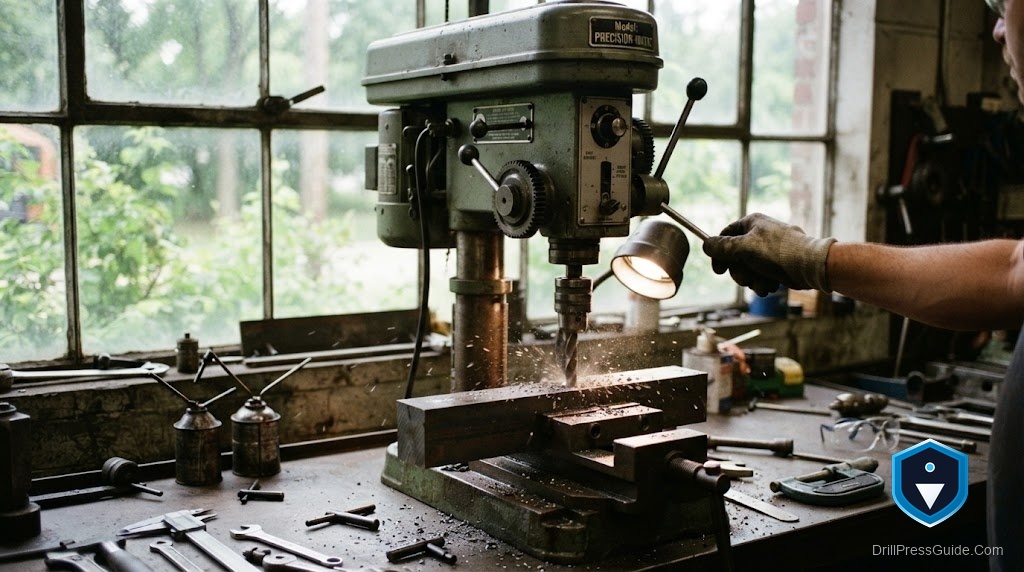
Whether the machine is gear head or belt driven, good drilling practice is the same, and it lets the gear head’s power do its job. Clamp the work in a heavy drill press vise bolted to the table, since a gear head machine drives big bits with serious torque that will spin an unclamped workpiece hard. Select the correct gear speed for the bit and material, running slow for large bits in steel, feed steadily, and use plenty of cutting fluid on metal. On the maintenance side, keep the gearbox oil clean and at the right level, change the speed only as the machine’s instructions direct (often with the spindle stopped), and keep bits sharp so the machine’s power goes into cutting cleanly.
Conclusion
The gear head drill press replaces belts and pulleys with a gearbox, and that gives it the power, durability, and quick lever speed changes that heavy industrial drilling demands, driving large bits through thick steel without slipping. It comes at the cost of more weight, more complexity, a bigger investment, fixed gear speeds, and gearbox maintenance, so it is the right machine for a shop that regularly drills large holes in hard material or runs heavy production, and more machine than a home or light shop needs. Match it to the work, clamp the workpiece, select the correct gear speed, and keep the gearbox oiled, and a gear head press delivers heavy-duty drilling that a belt machine cannot.
Three takeaways: a gear head drill press drives the spindle through a gearbox instead of belts, giving more power without slipping, durability, and quick lever speed changes; the tradeoffs are more weight, complexity, cost, fixed speeds, and gearbox maintenance; and it is worth it for heavy drilling in hard material, but overkill for general or home use.
Frequently Asked Questions
What is a gear head drill press? A drill press in which the motor drives the spindle through a gearbox rather than a belt and pulleys, with speed changed by shifting gear levers to select different ratios. It is the heavy-duty arrangement used on industrial presses and mill-drills.
What are the advantages of a gear head drill press? It transmits more power without the slipping a belt can suffer, so it drives large bits through thick steel with authority; it is durable for heavy, sustained use; and it changes speed quickly by shifting a lever rather than repositioning a belt.
What are the downsides of a gear head machine? It is typically heavier, more complex, and a bigger investment than a comparable belt-driven press, offers a set of fixed gear speeds rather than easily tweaked positions, and needs its gearbox lubrication maintained.
Do I need a gear head drill press? Only if you regularly drill large holes in thick steel, run heavy production, or want gear-drive durability for professional use. For general drilling in wood and mild steel or occasional home use, a good belt-driven press does the same work for less.
How is speed changed on a gear head drill press? By shifting gear levers to select different gear ratios, rather than opening a cover and moving a belt across pulleys. Follow the machine’s instructions, since many require the spindle to be stopped when changing gears.
How do I maintain a gear head drill press? Keep the gearbox oil clean and at the correct level, change gears only as the machine directs, clamp work in a solid vise against the high torque, run the correct gear speed for the bit and material, and keep bits sharp.
References
- VintageMachinery.org, machine tool references and literature. http://vintagemachinery.org
- Jacobs Chuck Manufacturing, Mounting and Removing Chucks. http://www.jacobschuck.com/uploads/ueditor/file/20200604/1591240204146153.pdf