
Choosing and Using a Drill Press Depth Stop
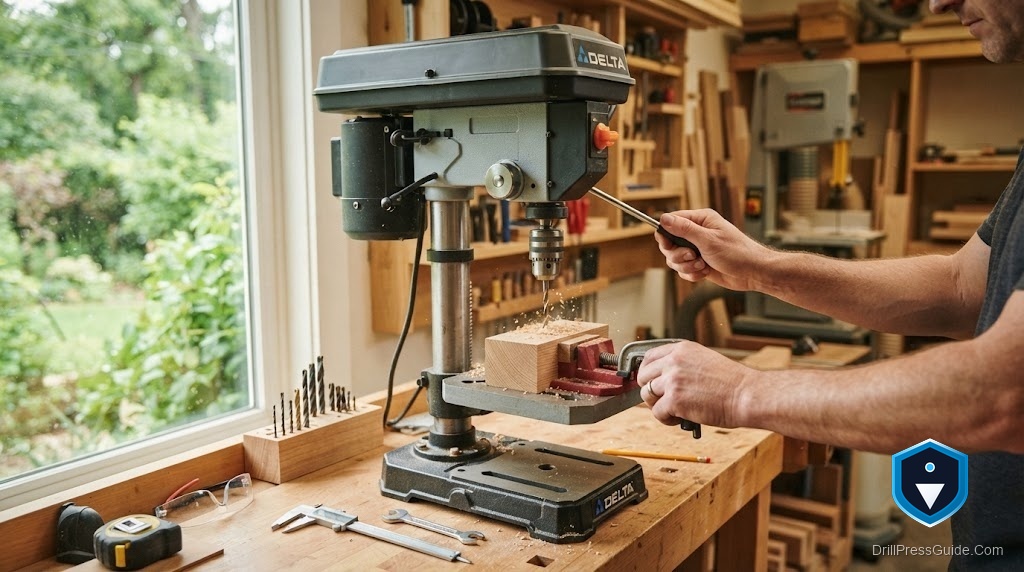
The first time you drill a row of holes that all need to stop at the same depth, and they do not, you understand why the depth stop matters. A blind hole too deep breaks through; one too shallow leaves the fastener proud; a dozen holes at a dozen depths look like exactly the amateur work they are. The depth stop is the small mechanism that fixes all of that, letting the drill press do what a hand drill never can: bore every hole to precisely the same depth, every time. Understanding the depth stop, how it works and how to set it, turns repeatable, professional holes into a routine part of the job. This guide covers it.
A drill press depth stop is a mechanism that limits how far the quill, and therefore the bit, can travel downward, so drilling stops at a preset depth. Most take the form of a threaded rod with adjustable nuts, or a calibrated collar or dial, on the quill feed mechanism. When the quill reaches the set point, the stop physically halts its travel, so you simply feed down until it stops and every hole comes out the same depth.
How the depth stop works
The principle is simple mechanical limiting. As you pull the feed lever, the quill descends and a moving part of the feed mechanism travels along the depth-stop rod or against the stop collar. Adjustable nuts or a locking collar set where that travel ends. Set the stop for a shallow depth and the quill halts early; set it deep and the quill travels farther. Because the stop is mechanical, it does not drift during a run, so once set, it enforces the same depth on hole after hole without any attention from you. Some machines add a calibrated scale so you can dial a depth by the numbers rather than by trial.
Choosing a machine by its depth stop
If you are shopping and depth work matters to you, judge the depth stop, since they vary in quality. Favor a positive, solid stop, a robust threaded rod with locking nuts or a stout collar, over a flimsy one that shifts under repeated hits. A calibrated scale is a convenience for dialing depths directly, though a good uncalibrated stop set by trial is perfectly accurate. Check that the stop is easy to adjust and locks securely, since a stop that loosens during a run defeats the purpose. On a machine with a poor depth stop, the mechanism is sometimes upgradable, but a solid factory stop is worth having from the start.
Setting the depth stop
Setting it accurately is a quick routine. For a through hole with a backer, set the stop so the bit fully clears the work into the backing. For a blind hole to a set depth, lower the bit until its tip just touches the work surface, then set the stop to allow exactly the depth you want, accounting for the drill point’s length if the depth is measured to the full diameter. Lock the stop and test on scrap first, since one test hole confirms the setting before you commit to the real work. Then drill the run, feeding down until the quill hits the stop each time.
Hold the work as you drill to depth, because consistent depth also depends on the work sitting consistently. A cast-iron drill press vise bolted to the table holds stock flat and secure so every piece meets the bit at the same height, which is what makes the depth stop’s setting hold true across a batch, and keeps hands clear of the bit.
Conclusion
The drill press depth stop is the small mechanism that delivers one of the machine’s biggest advantages over a hand drill: identical hole depth, every time. It works by mechanically limiting quill travel to a preset point, so once set it enforces the depth without drifting. Choose a machine with a positive, solid, securely locking stop, set it by touching off the surface and locking in the depth, test on scrap, and hold the work so every piece meets the bit at the same height. Do that and blind holes, counterbores, and stopped holes come out consistent and clean instead of guessed.
Three takeaways: the depth stop mechanically limits quill travel to a preset depth that does not drift, favor a positive solid stop when choosing a machine, and set it by touching off the surface, locking in the depth, and testing on scrap.
Frequently Asked Questions
What is a drill press depth stop? A mechanism, usually a threaded rod with nuts or a calibrated collar, that limits how far the quill and bit travel down, so drilling stops at a preset depth and every hole comes out the same.
How do I set a drill press depth stop? Lower the bit until its tip just touches the work surface, set the stop to allow the depth you want, lock it, and test on scrap. For through holes with a backer, set it so the bit fully clears into the backing.
Why do my holes come out at different depths? Either the depth stop is not set or is loosening during the run, or the work is not sitting at a consistent height. Set and lock a solid stop, and hold the work flat in a vise so every piece meets the bit the same way.
Does the depth stop drift during use? A good one does not. Because it limits quill travel mechanically, a positive stop with locking nuts or a secure collar holds its setting across a run. A flimsy stop that shifts under repeated hits should be checked periodically.
Do I need a calibrated depth scale? It is a convenience for dialing a depth by the numbers, but a good uncalibrated stop set by touching off and testing on scrap is just as accurate. The scale saves a step, not a requirement.
How do I account for the drill point when setting depth? Remember that a twist bit’s tip is pointed, so if you need a depth to the full diameter, allow for the point’s length. Testing on scrap and measuring confirms the setting before the real work.
References
- VintageMachinery.org, machine tool references and literature. http://vintagemachinery.org
- Sears PartsDirect, drill press parts and diagrams. https://www.searspartsdirect.com


