Understanding the Little Machine Shop Drill Press and the Mini Press World
Anyone who has gone looking for a small, precise drill press has run into Little Machine Shop, the go-to source for the mini and micro machine tools that fill apartment shops, model engineering benches, and jewelers’ corners. The drill presses in that world are a different animal from the big floor machines, built small on purpose, and understanding what they are, what they do well, and where their limits lie is the key to buying one that fits the work rather than one that disappoints. This guide covers the small-press world and how to choose within it.
Little Machine Shop is a retailer that specializes in benchtop and miniature machine tools and the parts and tooling for them, serving hobbyists, model makers, and small-scale precision work. A mini drill press in this category is a compact benchtop machine with modest capacity, chosen for small holes in small parts where a full-size press would be overkill and where bench space and precision at a tiny scale matter more than power. The appeal is doing fine, controlled work at a scale the big machines handle clumsily.
What the small press does well
The mini drill press earns its place through fit to a specific kind of work. It excels at small holes in small parts, model components, electronics enclosures, jewelry, light aluminum and plastic, where the work is delicate and the holes are tiny. Its compact size suits a crowded bench or a shop with no floor space, and its lighter weight makes it easy to move or store. At the higher end of the category, these machines offer fine spindle control and good runout for their size, which matters when you are drilling holes measured in fractions of a millimeter and cannot tolerate wander.
For a model engineer, a hobby machinist working in brass and aluminum, an electronics builder, or a jeweler, a quality mini press is exactly the right tool, and a big floor press would be harder to use, not easier.
Where the limits are
Honesty about the limits prevents disappointment. A mini drill press has modest chuck capacity and quill travel, so larger bits and deeper holes are beyond it. Its small motor lacks the power for heavy steel drilling, and forcing it bogs the motor and wanders the hole. Its light mass, an advantage for portability, means less rigidity than a heavy machine, so it is happier in soft materials and small diameters than in thick steel. And the smallest units can be tippy under load if not bolted down.
If your work runs to medium or large holes, thick steel, or anything demanding real power, the mini press is the wrong scale, and a benchtop or floor press is the right choice.
Choosing and equipping a mini press
Choose by scale and precision. Match the chuck capacity to your smallest and largest expected bits, favor a machine with good reported runout since accuracy at a small scale depends on it, and confirm the speed range reaches the high speeds small bits need to cut cleanly. Bolt the machine to the bench so it is stable under load.
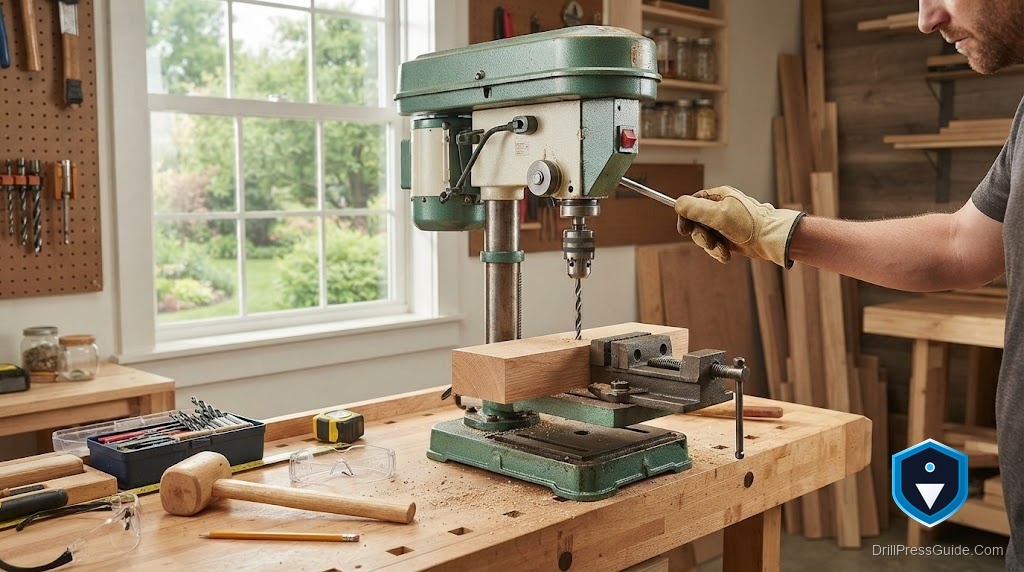
Equip it for its scale. Small work still must be held, and holding tiny parts by hand at a spinning bit is both dangerous and inaccurate, so a small light-duty drill press vise sized to the little table holds small parts securely without overwhelming the machine, which a heavy vise would. If the chuck that comes with the machine is coarse or runs out, and the spindle uses a JT-taper arbor, a quality JT33 keyed chuck can improve grip and concentricity once you confirm the taper matches; on many true micro machines the arbor is smaller, so check before buying. Use small, sharp bits and appropriate high speeds, and hold small parts in the vise rather than by hand.
Conclusion
The Little Machine Shop drill press and its mini-press peers occupy a real and useful niche: fine, controlled drilling of small holes in small parts, where compact size and precision at a tiny scale beat the power and mass of a big machine. Understand that the tradeoff is limited capacity, power, and rigidity, so match the machine to small-scale work and do not ask it to drill thick steel. Bolt it down, hold small parts in a properly sized vise, and use sharp small bits at the right speed, and a mini press does delicate work no floor machine can match.
Three takeaways: mini presses excel at small holes in small parts where precision and compact size matter, their limits are capacity, power, and rigidity, and small work still needs a properly sized vise and sharp small bits at high speed.
Frequently Asked Questions
What is a mini or micro drill press best for? Small holes in small parts, model components, electronics, jewelry, and light aluminum or plastic, where delicate, precise work at a tiny scale matters more than power. A big press handles such work clumsily.
What are the limits of a mini drill press? Modest chuck capacity and quill travel, a small motor without power for heavy steel, and light mass that reduces rigidity. Larger holes, deep holes, and thick steel are beyond it.
Why choose a mini press over a benchtop machine? When your work is genuinely small and precise and bench space is tight. A mini press gives fine control at a small scale and stores easily, where a heavier machine offers no advantage for tiny holes.
How do I hold small parts on a mini drill press? In a small vise sized to the little table, never by hand, since holding tiny parts at a spinning bit is dangerous and inaccurate. A light-duty vise holds them securely without overwhelming the machine.
Can I improve the chuck on a mini press? If the spindle uses a JT-taper arbor, a quality keyed chuck can improve grip and concentricity. Confirm the taper first, since many true micro machines use a smaller arbor than JT33.
Can a mini drill press drill steel? Only small holes in thin steel at appropriate speed. Its small motor and light mass are not suited to heavy steel drilling, which bogs the motor and wanders the hole.
References
- VintageMachinery.org, machine tool references and literature. http://vintagemachinery.org
- Jacobs Chuck Manufacturing, Mounting and Removing Chucks. http://www.jacobschuck.com/uploads/ueditor/file/20200604/1591240204146153.pdf